



Shoppers can now discover and compare products across search results, Google Shopping, AI answers, and conversational shopping experiences. For ecommerce brands, that makes it increasingly important to provide clear, structured product information that search engines and AI platforms can understand.
Product schema helps communicate details like price, availability, ratings, reviews, brand, and other product attributes in a machine-readable format. It can support richer search experiences while giving search and AI systems more context about the products you sell.
In this guide, we’ll cover how product schema works, why it matters for ecommerce SEO and AEO, and best practices for implementing it at scale.
Key Takeaways:
- Product schema helps search engines and AI platforms understand your products by providing structured details such as price, availability, ratings, reviews, and product attributes.
- Rich product information can improve search visibility and engagement by making eligible listings more informative with details like ratings, pricing, availability, and shipping information.
- Accurate implementation matters. Use the appropriate Product properties, keep structured data consistent with visible page content, and validate your markup regularly.
- Enterprise ecommerce sites need a scalable approach to generate, deploy, and test Product schema across thousands or millions of product pages.
Table of Contents:
What Is Product Schema and Why Is It Essential for Ecommerce Sites?
oduct schema is structured data that helps search engines understand specific details about a product, such as its name, price, availability, brand, ratings, reviews, and other attributes. By clearly defining this information, ecommerce sites can help their products qualify for richer search experiences while providing machines with reliable product data.
For AEO, that structured context can also make product information easier for AI systems to interpret when evaluating products and responding to shopping-related queries. For enterprise ecommerce sites managing large catalogs, consistent and accurate product schema is an important part of making product information understandable at scale.
You can see the full list of properties for the product schema on schema.org.
What Are the Key SEO and AEO Benefits of Using Product Schema?
Product schema boosts organic click-through rates by displaying visually prominent rich snippets like star ratings, prices, and shipping fees directly in search results. It also strengthens brand visibility across conversational AI search engines by providing verified, structured entity data.
There are many benefits of implementing product schema on your ecommerce site. Here are some of the most impactful advantages.
1. Standing Out in the SERPS
Product schema often displays price, availability, review ratings, and other product qualities in the form of a rich result or rich snippet in the SERPs.
As a result, this schema type can increase the pixel space of your SERP listing and potentially increase visibility in AI search. This enhances your content's visibility as shown here in this example from Google:
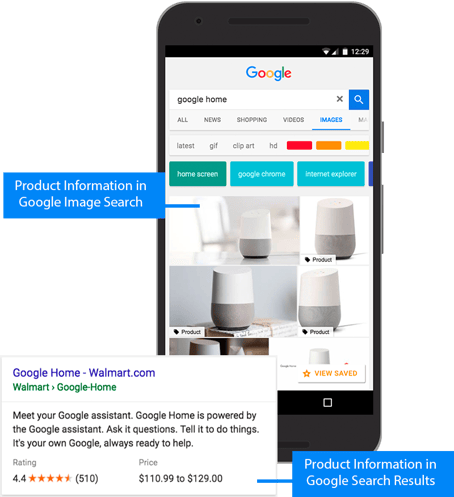
(A description, star rating, price range, and plenty more can appear alongside a product.)
These rich snippets draw attention and break through the noise of crowded SERPs.
Notice how some of the image results display a “Product” tag in the lower left-hand corner. This is another way that the product schema makes search results stand out to further drive engagement rates and conversions.
Recommended Reading: How to Optimize Your Google Shopping Product Feed
2. Increased Click-Through Rate
Product schema can make search listings more informative by helping eligible pages display details such as price, availability, ratings, and reviews directly in the search results. These details give shoppers useful information before they visit your site and can help your listing stand out among competing products.
For example, a strong star rating can provide the social proof a shopper needs to choose your result, helping increase organic click-through rate (CTR).
3. Alert Searchers to Price Drops
This schema type can also produce a Price Drop rich result which alerts searchers to a price change if you specify a price with the Offer property. Google analyzes the “historical average of your product’s pricing” to calculate the price drop.
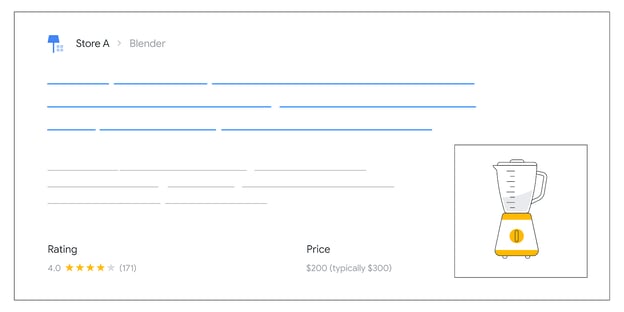 (Image Source: Google Search Central)
4. Shipping Information In the SERPS
Another benefit of the product schema is being able to provide shipping information directly on the SERPs.
With the addition of the OfferShippingDetails structured data, you can specify if a product has free shipping or if there is a fee. This can be a determining factor in who a customer decides to do business with.
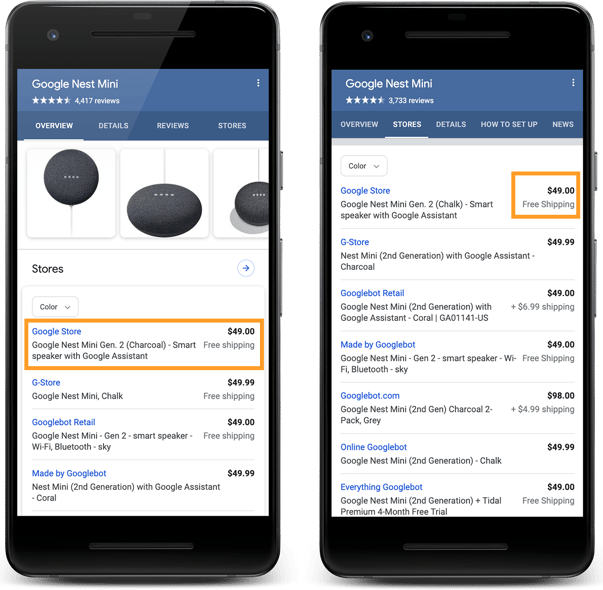
(Image Source: Google Search Central)
What Are the Required Properties and Best Practices for Product Schema Implementation?
At a minimum, Product structured data requires a name and at least one of the following properties to be eligible for product rich results: review, aggregateRating, or offers. Once you include one, the others are recommended when they’re relevant to the product.
Beyond the required properties, add as much accurate product information as possible to give search engines a more complete understanding of the page. Depending on the product, this can include details such as brand, description, image, color, size, SKU, GTIN, price, availability, ratings, and reviews.
Then, of course, there are best practices to follow when it comes to how to add schema markup to pages correctly.
Next, we’ll break down the required and recommended properties in more detail, along with the best practices to follow when implementing Product schema.

1. Review Property
If you choose to implement the review snippet to showcase reviews of your items, it has required properties of its own.
If you add the review schema, you must include the following required properties:
- author
- itemReviewed
- itemReviewed.name
- reviewRating
- reviewRating.ratingReview
Recommended Reading: What, How, and Why for Review Schema
2. AggregateRating Property
If you add the AggregateRating property (which shows the average rating from multiple reviews) to your Product schema, you’ll also need to include:
- itemReviewed
- itemReviewed.name
- ratingCount
- reviewCount
- ratingValue
Note: For reviews and ratings, you must host the reviews and/or ratings on your own site. Third-party reviews are not allowed.
3. Offers Property
In order to properly add an offer to your product, you must include only one required property: price.
There are, however, many recommended properties, including the isVariantOf property or the shippingDetails property which shows shipping costs and locations.
Let’s take a closer look at these properties.
isVariantOf Property
For products available in multiple variations, Google supports structured data that helps identify how those variants relate to one another. The isVariantOf property connects an individual product variant to its broader product group, while properties such as variesBy can describe the attributes that distinguish the variants, such as size, color, material, or pattern.
For ecommerce sites, this provides search engines with clearer information about your product catalog and helps distinguish closely related products without treating each variation as an entirely separate item.
Shipping Details Schema Markup
Shipping details can be used to highlight things such as:
- Free shipping
- Areas you do not ship to
- Customers’ shipping options
- Shipping cost by region
Below, we'll go over each of these options.
Free Shipping
To indicate that a product has free shipping, set the shippingRate to “0” for all regions where you ship that product.
If you have free shipping to the state of New York, for example, you would implement the following code from Google:
"shippingDetails": {
"@type": "OfferShippingDetails",
"shippingRate": {
"@type": "MonetaryAmount",
"value": "0",
"currency": "USD"
},
"shippingDestination": [{
"@type": "DefinedRegion",
"addressCountry": "US",
"addressRegion": ["NY"]
}]
}
Indicate Areas You Don't Ship To
The doesNotShip property specifies regions where shipping is unavailable. Google offers the example of shipping to the United States, but not to Alaska or Hawaii. In that case, the code used would look like this:
"shippingDetails": {
"@type": "OfferShippingDetails",
"doesNotShip": true,
"shippingDestination": {
"@type": "DefinedRegion",
"addressCountry": "US",
"addressRegion": ["AK", "HI"]
}
}
Shipping Options
Products often have multiple shipping options for users to choose (i.e. overnight, standard, etc.). These choices affect the overall cost to ship so you can specify the costs and options with multiple shippingDetails properties.
Recommended Reading: Technical SEO Best Practices: Schema
Each option should then contain unique combinations of the shippingRate and deliveryTime. Google displays the data based on the cheapest option to ship.
Shipping Cost by Region
Shipping costs often vary depending on the location of the recipient, and a simple tweak of the code can inform customers in a certain locale what shipping would cost them — down to the zip code level.
Google uses this example to highlight the specificity that the schema allows for. Here, the shipping rate is $3.49 for all customers who live in zip codes 98100-98199.
"shippingDetails": {
"@type": "OfferShippingDetails",
"shippingRate": {
"@type": "MonetaryAmount",
"value": "3.49",
"currency": "USD"
},
"shippingDestination": {
"@type": "DefinedRegion",
"addressCountry": "US",
"postalCodeRange": {
"postalCodeBegin": "98100",
"postalCodeEnd": "98199"
}
Why Should You Avoid Using Product Schema on Product Category Pages?
Another best practice is to avoid using Product schema on product category pages as it is specifically designed to describe a single, individual product or service.
A product category page is not about one product; instead, it's a listing page that showcases multiple products belonging to the same category.
Applying Product schema here would create a conflict and be misleading to search engines, as it would be trying to define a single product within a page that lists many. Instead, search engines expect ItemList Schema which tells search engines that the page contains a list of items that can be products or other entities.
Using Product schema on a category page will also create validation errors in schema testing tools, and could result in search engines not understanding your page correctly.
How to Create Product Schema
Product schema can be written in JSON-LD, RDFa, or Microdata.
The length of the code depends on how many of the properties you choose to include. Since schema live in bundled hierarchies of each other, the code can be very minimal, or it can be like unpacking a nesting doll.
Google uses an example that includes multiple properties: name, description, brand, and even the product’s SKU number.
<html>
<head>
<title>Executive Anvil</title>
<script type="application/ld+json">
{
"@context": "https://schema.org/",
"@type": "Product",
"name": "Executive Anvil",
"image": [
"https://example.com/photos/1x1/photo.jpg",
"https://example.com/photos/4x3/photo.jpg",
"https://example.com/photos/16x9/photo.jpg"
],
"description": "Sleeker than ACME's Classic Anvil, the Executive Anvil is perfect for the business traveler looking for something to drop from a height.",
"sku": "0446310786",
"mpn": "925872",
"brand": {
"@type": "Brand",
"name": "ACME"
},
"review": {
"@type": "Review",
"reviewRating": {
"@type": "Rating",
"ratingValue": "4",
"bestRating": "5"
},
"author": {
"@type": "Person",
"name": "Fred Benson"
}
},
"aggregateRating": {
"@type": "AggregateRating",
"ratingValue": "4.4",
"reviewCount": "89"
},
"offers": {
"@type": "Offer",
"url": "https://example.com/anvil",
"priceCurrency": "USD",
"price": "119.99",
"priceValidUntil": "2020-11-20",
"itemCondition": "https://schema.org/UsedCondition",
"availability": "https://schema.org/InStock"
}
}
</script>
</head>
<body>
</body>
</html>
The code is then added to the page’s HTML, which can usually be done on the page’s advanced settings if you use a content management system.
How Can Ecommerce Sites Generate, Deploy, and Test Product Schema at Scale?
Ecommerce sites can scale Product schema by using platforms like seoClarity to generate structured data, deploy it across relevant product pages, and continuously test and validate the markup. This is especially important for enterprise sites, where manually creating and maintaining schema across thousands or millions of products isn’t practical.
A scalable process should make it easy to create accurate markup, apply it consistently across product templates, and identify errors as product information changes. Below, we’ll walk through each step of the process.
#1. Building Structured Data
Create schema effortlessly with a point-and-click interface with Schema Builder, a free Chrome plug-in.
You simply click the property you want to add, and then find that applicable information on your product page. Take a look:
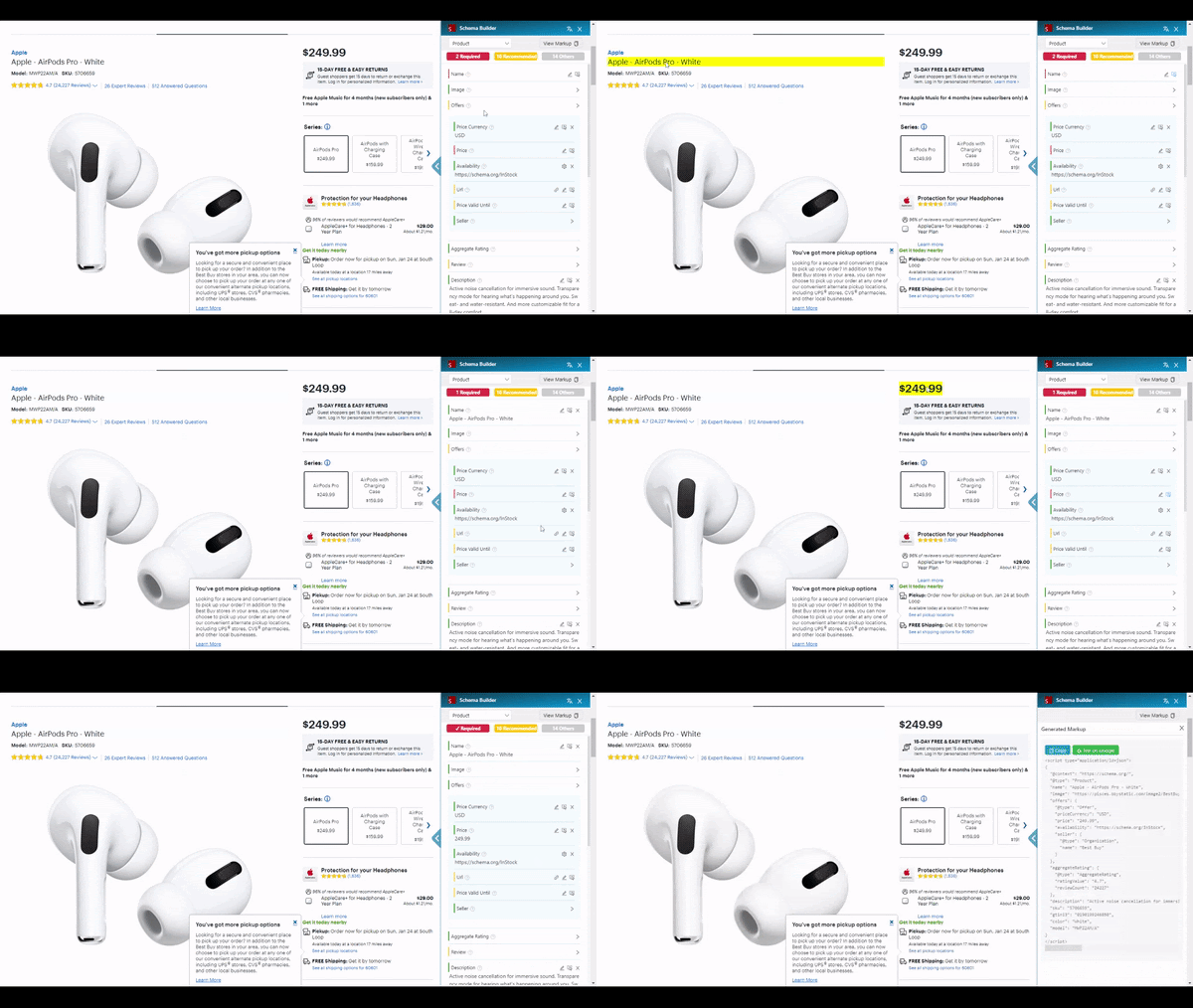
More on Schema Builder, here: Schema Markup Generator: Build Structured Data Without Developers.
#2. Deploying Structured Data Site-Wide
Most SEOs rely on the dev team to implement technical changes or updates, schema included. But depending on the dev team can sometimes lead to delays, as their priorities might differ or their workload could be high, affecting the timeline for SEO improvements.
Fortunately, you can implement structured data site-wide to any pages that match your specified variable all with a few clicks.
Schema Optimizer lets you implement schema once and see it go live on thousands of pages.
#3. Testing Structured Data
There can be a few common issues with schema, so you'll want to run it through Google’s Rich Results Test to confirm its eligibility for a rich snippet on the SERP.
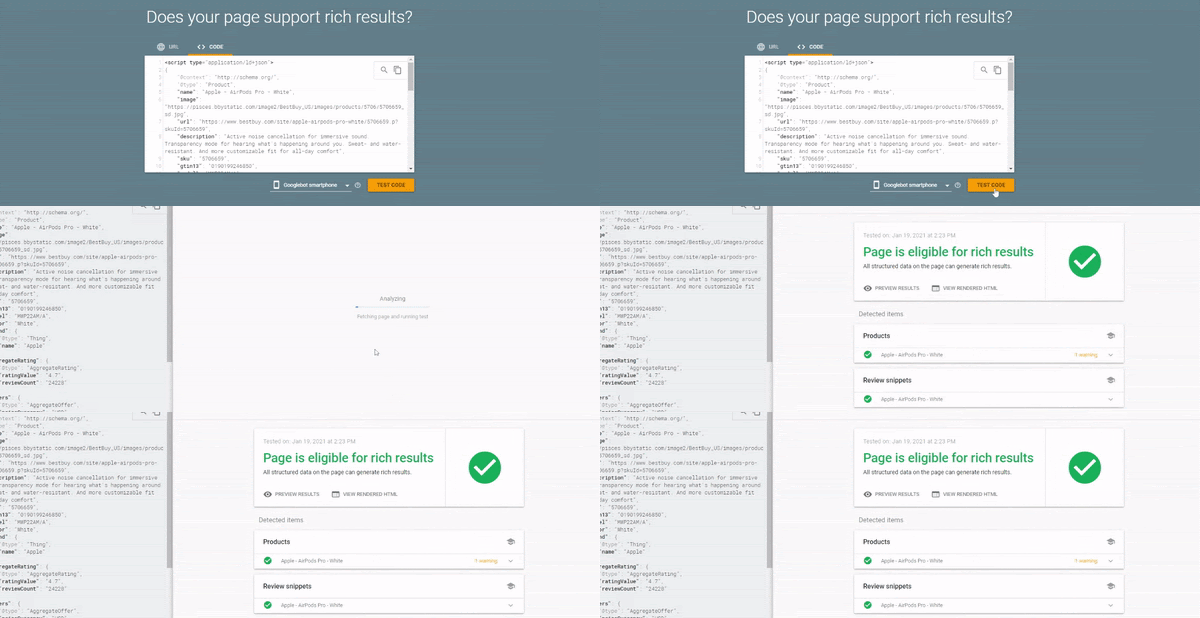
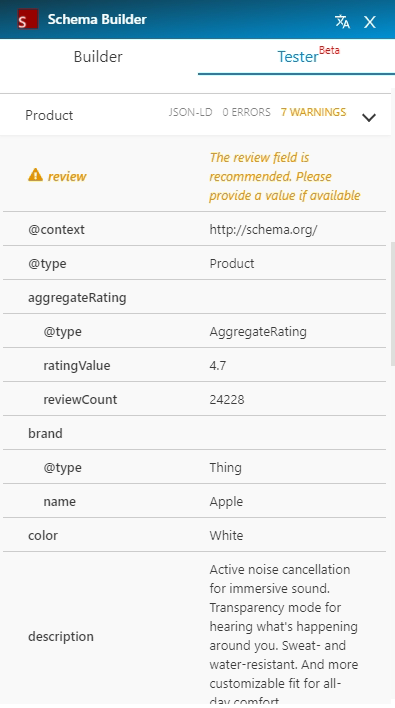
To keep all of your schema operations under one roof, you can use Schema Tester, also a part of the free Chrome plug-in. If you're looking to test and validate at scale, you'll want to leverage an entprise platform like seoClarity so you can run a schema audit.
Conclusion
There may be a few considerations to keep in mind if you implement the product schema, but the benefits far outweigh the time required to create and deploy it — especially when you utilize Schema Builder and Schema Optimizer to cut out the manual labor and focus on the wins.
Looking for other schema or how it impacts other industries? Check out these resources:

.png)


Comments
Currently, there are no comments. Be the first to post one!