



Still wondering if that author byline actually moves the needle in terms of SERP visibility?
In a world now flooded with AI-generated content, the question of who is behind the curtain is more critical than ever.
Today, establishing human authority in a digital landscape that is increasingly skeptical has become a widespread challenge.
This post will cut through the noise to show you why authorship is no longer a search gimmick, but a pillar of trust that influences how both users and AI systems interpret your brand’s credibility.
Key Takeaways:
- Authorship isn’t a direct ranking factor, but it strongly influences trust, quality signals, and interpretation.
- Consistent author entities help search systems connect content, expertise, and credibility across the web.
- Clear bylines and author pages improve user confidence and support AI-driven content evaluation.
Table of Contents:
What Is SEO Authorship?
In SEO, authorship refers to the idea that Google has some interest in who created a piece of content, perhaps as a means of establishing credibility and trustworthiness of the SEO content.
But does authorship actually matter for SEO today?
Fact Check: Is Authorship a Direct Ranking Factor?
The short answer is no. Google has consistently maintained that author identity is not a direct ranking signal.
From Gary Illyes’ comments at SMX 2016 and Pubcon 2023 to Danny Sullivan’s 2024 clarifications (see Tweet below), the message is clear: a byline—even from a world-renowned expert—won't automatically boost your rank. Instead, Google focuses on identifying authors as entities to strengthen its Knowledge Graph.
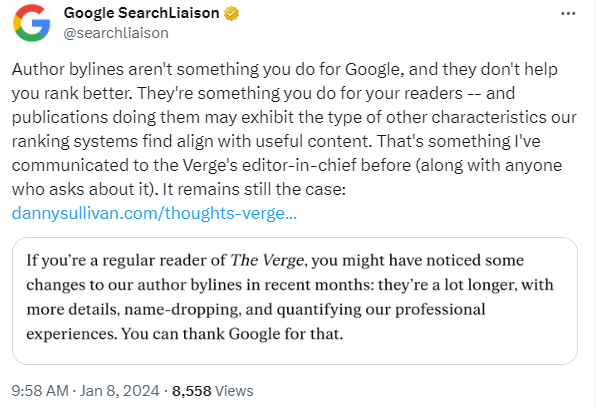
However, the "Authorship Paradox" remains. While not a direct signal, authorship is a critical component of how Google evaluates quality. If identity doesn’t move the needle, why do the Search Quality Rater Guidelines emphasize "qualified authors" for high-quality content?
The distinction lies in Experience and Trust. Google’s systems are trained to reward content that demonstrates real-world expertise (E-E-A-T). Even without specific markup, Google can often recognize an author and associate their expertise across the web if they consistently reference a central author page.
The takeaway? Don't add bylines to "game" the algorithm. Add them to provide the transparency and authority that both users and AI-driven search systems require to trust your brand.
Why Is Authorship Important for SEO?
Ask yourself: In an era where AI can generate thousands of words in seconds, how do you prove there is a pulse (and a brain) behind your content?
One way is by attributing your digital assets to verified, real-world experts.
But the value of authorship is nothing new. For years, Google has shown a steady interest in associating content with known authors to better understand the source of information.
In addition, authorship indicates authority and trust that human users as well as traditional and AI search engines use to gauge the validity of a piece of content.
After all, a blog post about your company’s security protocols would be more trustworthy coming from the COO than from an anonymous source.
The Role of Authorship in E-E-A-T, YMYL and the Quality Guidelines
As previously mentioned, Google's Search Quality Rater's Guidelines give strong emphasis to E-E-A-T (Experience, Expertise, Authority, and Trustworthiness) as primary characteristics of quality content, especially for YMYL (Your Money/Your Life) content, topics that have to do with health, news, finances, or anything that impacts personal well-being.
Here is how Google defines each part of E-E-A-T:
- Experience: degree of experience on the topic demonstrated in the content.
- Expertise: expertise demonstrated in the content
- Authoritativeness: the authoritativeness of the content creator (i.e. the author) and the content itself
- Trustworthiness: the overall trust of the content creator, the content, and the website
Understanding how Google uses Search Quality Raters is key to understanding how authorship influences search quality, not rankings directly, but algorithmic goals.
Google contracts and trains independent agents from around the world to serve as human evaluators of the quality of search results.
These evaluators are given actual web pages that Google ranks for a query and asked to evaluate it based on Google’s Search Quality Raters Guidelines.
Recommended Reading: What is Google E-A-T and YMYL in SEO?
Google uses the ratings by Search Quality Raters to determine how well its algorithms rank the content that the Guidelines identify as “quality” and “useful.”
However, Google has been very clear that the individual standards in the Guidelines should not be considered ranking factors. Instead, taken together, they are the common characteristics of pages Google would want to rank higher because they tend to be more useful and trustworthy for searchers.
Google search engineers take the raters' evaluations and use them to tweak elements of the search algorithms that actually are factors with the goal of ranking higher.
So many things mentioned in the Guidelines, such as author bylines and bio pages, are not looked at by Google Search as ranking factors, but rather are to be seen as typical characteristics of the kinds of pages Google wants to rank high, especially for YMYL queries.
Recommended Reading: Tips For SEO Content Writing
The Impact of Authorship in AI Search
Author identity provides contextual signals that assist AI systems in evaluating whether information reflects real expertise, experience, and credibility.
When search engines are clearly able to identify a creator, they can better assess which sources are reliable enough to reference, summarize, or cite.
This isn't just theoretical; a 2026 study conducted by LinkedIn (as referenced in Search Engine Journal) confirms this shift. Their testing revealed that "named authors with visible credentials and clear publication dates appeared to perform better" in AI-driven discovery than anonymous or undated content [Source: Search Engine Journal].
Why Being a "Known Entity" Is Your Real SEO Goal
While Google does not use authors as a search ranking factors, known authors can and do still have a certain use in Google Search.
If Google can recognize an author as an "entity" it may use them in its Knowledge Graph to help organize search results. An entity is a person, place, thing or concept that Google can verify as existing and create vectors to all its associations across the web.
For example, "Empire State Building" and "New York City" are both known entities to Google, and Google's Knowledge Graph recognizes them as having a relationship.
Similarly, when Google recognizes a person as an author entity and can associate that entity with content they have created, they may display that content prominently when people search for that author.
For example, from time to time Google shows a knowledge panel result for me in the right sidebar of search results for my name:
Clicking on the icon at upper right or the "More about Mark Traphagen" button opens up a custom set of search results focused on just content I have produced across the web.
Even when that knowledge panel doesn't display, since Google recognized me as an author entity a search for my name shows that content prominently.
Why Should Enterprises Care About Authorship?
The most important takeaway for enterprise SEO is the more important the content, the more you should focus on it being trustworthy, which means involving real qualified experts in its creation.
Including authors in a byline and linking those bylines to dedicated author pages demonstrates that you care about providing your visitors with content they can trust.
So this is something you should do primarily for your users. Showing you care enough to create E-E-A-T content builds user trust around your brand.
But there is the peripheral search benefit of your content ranking when people search for one of your authors.
With the rapid adoption of generative AI and AI search experiences, we have experienced an explosion of content like we’ve never seen before. Therefore anything you can do to stand out from the crowd in your content is critical.
Measuring the Performance of Authors’ Content
If you want to segment your SEO performance by author to see how one writer’s content performs compared to another, you can add your content to page tags.
In the seoClarity platform, you can bundle pages into custom groups and analyze the organic performance of the content within those specific groupings.
This is a great way to drill into organic performance in a view that’s meaningful to you. This can be especially useful for publishers who create a lot of content with a number of contributors.
Finding an Author’s Work on Your Site, At Scale
If you need to locate all pages on your site that were authored by someone in particular, you can turn to your website crawler.
A powerful site crawler will let you crawl your site based on custom criteria.
You can set up your crawler to extract the author name from the XPath — many websites build author names into their templates for blog or article pages.
This allows you to quickly find the content where a particular author has the byline.
The History of Google Authorship
Google’s interest in identifying and evaluating content creators can be traced back to 2007, when it filed the Agent Rank patent, which described methods for associating content with individual authors.
The patent outlined a scheme for “digital signatures” connecting an author to a piece of content, and how that might be used as a ranking signal.
Here are key developments in Google’s brief public experiment with Google Authorship in search results:
- 2011: In early spring, Google confirms that it supports the rel=“author” markup and recommends tagging authors with it for content they created.
- 2011: It started with verifying and associating authorship using Google+. Later that year Google began experimenting with a SERP rich snippet, displaying an author’s profile photo and link to their online content along with results for pages they had authored.
- 2013: Authorship results begin to decline in search results.
- 2014: Google announces the end of their experiment with showing author rich snippets in a Search Engine Land article that I co-wrote with Eric Enge after I was informed directly by Google that this was happening.
- 2019: Google ends the public version of Google+, also ending its experiment with dependence on author and publisher structured data implementation to verify authorship.
- 2020: Google files the Author Vectors patent that describes methods for identifying authors through writing patterns and behavioral signals.
Together, these developments show a shift from explicit authorship markup toward algorithmic author identification based on entities, behavior, and writing patterns.
FAQs About Authorship and SEO/AEO
Still have questions regarding authorship and SEO or AEO? Here are the answers to the most common queries we hear from enterprise teams.
1. Can I use a "Brand Name" instead of an individual author?
Yes, but with a caveat. While you can attribute content to "The [Brand] Editorial Team," you lose the "Entity" benefit. Google’s Knowledge Graph thrives on connecting real people to specific topics. Whenever possible, use a high-profile subject matter expert from your team to act as the "face" of that content cluster.
2. What happens if an expert author leaves my company?
This is a common enterprise challenge. Avoid deleting their author page, as this can break the "Entity" associations Google has built. Instead, keep the page active but update it to reflect their legacy status, or "co-author" new updates with a current expert to transition the authority signals smoothly.
3. Can I assign an author byline to content generated entirely by AI?
You can, but you should be transparent about it. Google’s guidance is that using AI to create content isn't a violation of search policies as long as it's not used primarily to manipulate search rankings. However, from a trust perspective, assigning a "Person" byline to an AI-generated piece is risky.
The Actionable Approach: If AI wrote the draft, have a human expert review, fact-check, and "sign off" on the content. You can then list the human as the author or use a byline like "Expertly Reviewed by [Name]" or "AI-Assisted Content by [Name]." This preserves the E-E-A-T signal while remaining honest with your users.
4. Should I use "Guest Authors" to improve my SEO?
Only if they bring genuine expertise. In the past, guest posting was used as a link-building hack. Today, the value of a guest author lies in their established entity status. If a recognized expert in your field writes for you, their existing "vector" in the Knowledge Graph can help associate your domain with that specific topic.
5. Does social media activity impact an author's SEO value?
Indirectly, yes. While a tweet isn't a ranking factor, Google uses "repeated signals across the web" to identify entities. If an author is consistently cited, followed, and linked to on platforms like LinkedIn or X (Twitter), it becomes much easier for Google to verify them as a legitimate authority in their field.
6. How do I handle authors with the same name?
This is where Structured Data is non-negotiable. Using the sameAs property in your Schema markup allows you to link to the specific author’s LinkedIn profile or official website, helping Google distinguish "John Smith the SEO" from "John Smith the Cardiologist."
Conclusion
Authorship in SEO may have had a rocky past, but it isn’t completely obsolete.
Sure, the author name no longer appears on the SERPs, and Google+ is defunct, but adding an author to your blog content is still a way to enhance the user experience and build trust.
It’s a small step that can do a lot!
Editor's Note: This piece was originally published in April 2022 and has since been updated for accuracy.

2 Comments
Click here to read/write comments