



We have a huge problem with reporting on keyword rankings.
On one hand, SEOs have grown accustomed to monitoring their search engine rankings and using those metrics to determine success.
On the other hand, results pages have changed with AI Overviews and AI Mode occupying significant SERP real estate.
Reporting on just the rank position no longer reveals the full impact of SEO on the company's bottom line.
So, how do you create an SEO rankings report that accounts for these changes in search visibility? What do you include to make the ranking data valuable and actionable for the key stakeholders?
The answer to these questions starts with a look at why traditional rank tracking is broken.
Table of Contents:
- What Is an SEO Ranking Report?
- Challenges When Creating a Ranking Report
- How to Account for Changes in Search Visibility in a Ranking Report
- How to Overcome New Search Visibility Challenges
What Is an SEO Ranking Report?
An SEO Ranking Report details where your website's pages stand in search engine result pages (SERPs) for targeted keywords. It highlights the performance of your keywords, tracking improvements or declines over time, which is crucial for understanding the effectiveness of your SEO strategies.
These reports also play an important role in helping earn buy-in by showcasing the value of SEO to executives.
Beyond mere rankings, SEO ranking reports can also shed light on competitive positioning and unearth opportunities for optimization.
Essentially, an SEO Ranking Report acts as a compass, guiding SEO professionals in refining their strategies to enhance visibility, drive traffic, and ultimately, boost conversions.
Challenges When Creating a Ranking Report:
The Problem with Traditional Rank Tracking
Consider how you currently track your rankings. You set up a rank tracker to do one thing: assess where your domain is on the SERP for a given keyword.
And there are many types of rank tracking tools on the market.
Of course, an advanced rank checker delivers more insights than just the rank. It tells you what other search listing types it found on the page and additional information about those insights.
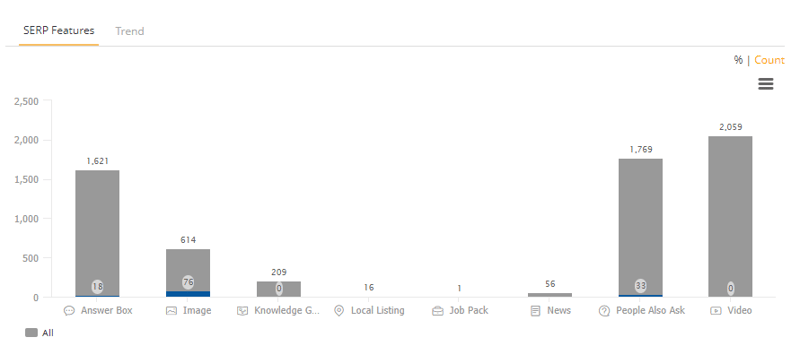 (SERP Features view in seoClarity.)
Assessing rank position today is becoming increasingly difficult, especially as AI search engines introduce new layers of content that exist outside the traditional organic ranking model.
For one, Google search results differ between users.
Google personalizes them based on location, device, search history, and whether AI Overviews or AI Mode are triggered for the query.
AI results consume significant SERP real estate and increase zero-click behavior. Here, user intent is satisfied directly on the results page.
This creates a major reporting blind spot: organic rankings may remain unchanged, yet actual visibility and opportunity decline. Traditional rank tracking fails to capture this nuance.
Then, there's the whole issue of mobile vs. desktop rankings.
SERP dynamics are different too. The search engine expands search results constantly, after all. Just look at the progression of the SERP for the query "hotels" over the years:
In short, with all the various SERP elements – video carousel, ads, featured snippets, and so on – rank position one doesn’t guarantee strong search visibility.
The Value of Rankings Has Changed
Since search rankings fluctuate between users, their device and locations, it's almost impossible to confirm with any certainty the one true keyword rank position of a page.
What's more, a page can rank for tens or hundreds of keywords of varying search volumes, many of which you hadn't even thought of when creating it.
In the past, we could associate ranking at the top of SERPs with an almost guaranteed increase in organic traffic.
Today, that no longer holds true. Even a top-five ranking doesn’t guarantee organic traffic.
Our Mobile and Desktop CTR Study found that AI Overviews now appear for roughly 20% of queries. It also shows that click-through rates for even the #1 organic rankings have declined significantly as AI responses increasingly satisfy intent before users engage with ranked listings.
Recommended Reading: Reporting SEO: How to Take SEO Reports to the Next Level
How Users Interact With SERP Results Has Changed
Users no longer just scan results and bounce between links or other SERP features. This is why search journeys are no longer linear.
As SERPs become increasingly shaped by AI Overviews, this behavior often plays out within AI-generated answers that serve as the primary interaction point.
In many cases, organic results are considered only after the AI layer has filtered options and clarified relevance.
This shift is reflected in user behavior data: nearly 60% of Google mobile searches now end without a click. Rather than opening multiple links, users increasingly ask follow-up questions directly within the AI interface.
Google’s AI Mode is designed to support this behavior, encouraging in-session exploration instead of bouncing between static result pages.
As a result, discovery and evaluation move upstream into the SERP, reducing the points where traditional rankings meaningfully influence user behavior.
Does It Make Sense to Track Keyword Rankings At All, Then?
Rankings no longer tell the full story about search visibility, yet they are still an important indicator of performance across both traditional and AI search experiences.
It's still important to track keyword rankings because:
- Rankings provide an overall analysis of your SEO efforts.
- Rankings indicate potential SEO issues. Sudden ranking fluctuations suggest algorithmic or other changes affecting your site's visibility.
- Rankings provide insights about potential issues with your site.
This importance also extends beyond traditional blue-link results and into AI-powered search experiences.
Our research indicates that rankings still matter for AI visibility. 94% of AI Overviews and 81% of AI Mode answers cite at least one URL from the top 20 organic results.
This reveals that, although they are not the only factor, strong rankings provide a meaningful advantage for inclusion.
How to Account for Changes in Search Visibility in a Ranking Report
We’ve already established a flaw with the traditional rank reporting. You know that rank position does not always correspond with your actual search visibility.
But, what can you do to report on it? Is there another approach to reveal the true value of your rankings beyond a generalized template?
As a matter of fact, there is another approach here.
Doing so, however, requires using a different way to evaluate the SERPs. Instead of relying on ranking position as the main metric, you must turn to measure the pixel height of every element on the SERP to evaluate how far down is your listing.
We call this Share of Visibility.
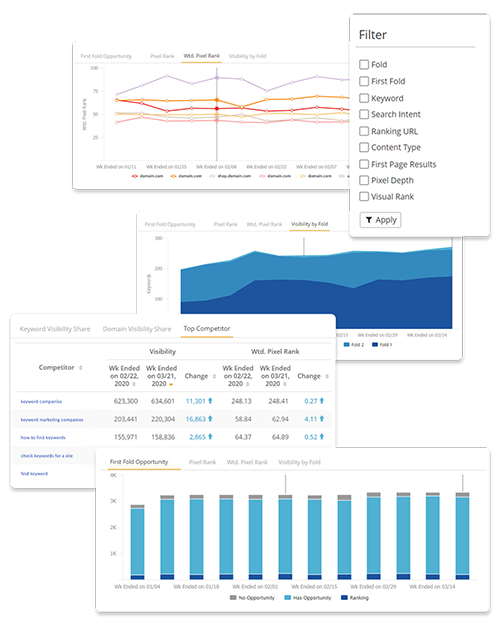
By approaching rankings this way, you establish whether your listing is visible when the page loads or if a user has to scroll to reach it. Plus, it tells you how many scrolls it takes.
This goes well beyond your traditional SEO ranking report or any other analytics tool. (Although, Google Analytics is an essential for any SEO!)
Analyzing the pixel height delivers another critical insight: it tells you how much real estate you have on the page for your keyword. Because, depending on the type of listing, your domain may appear as a small listing or a box-sized result.
Share of Visibility is here, far surpassing other rank reporting tools on the market.
See how SpareFoot leveraged Share of Visibility to increase organic CTR by 20.8%

How to Overcome New Search Visibility Challenges
Now that you know how to report on rankings despite search visibility changes, let's go over some methods on how to adapt your SEO and AEO strategy so that your performance shines.
I recommend the following three strategies.
1. Optimize for Search Visibility and Engagement, Not Just Ranking #1
Ranking #1 no longer guarantees traffic, but strong organic rankings are still an important signal for search visibility, including in AI experiences.
While AI answers and SERP features often capture initial attention, ranking well continues to improve the likelihood that your content is surfaced, referenced, or cited.
Our research confirms this relationship. AI Overviews cite pages ranking #1 43% of the time demonstrating that higher rankings significantly increase the chances of AI visibility, even if they don’t guarantee inclusion.
Rankings alone don’t tell the full story, but they remain a foundational signal that influences both traditional search performance and AI-generated visibility.
For branded and competitive queries, attention is shaped by structured data, reviews, pricing, and consistent entity signals across the ecosystem, not just where a page ranks.
You can use Content Fusion, an AI content optimization tool, to get an inside look at how the competitors structure their content.
Content Fusion analyzes the top-ranking sites’ metadata for your target keyword, and reveals patterns and key terms they use in their listing structure.
Similarly, check which of the most converting words your competitors use (and which ones they don’t) to spot opportunities to attract your audience’s attention.
For example, for the query “things to do in Chicago,” I use Content Fusion to see what meta-titles and descriptions the top-ranking websites have. Based on that, I can write metadata that stands out and includes the most critical on-page elements.
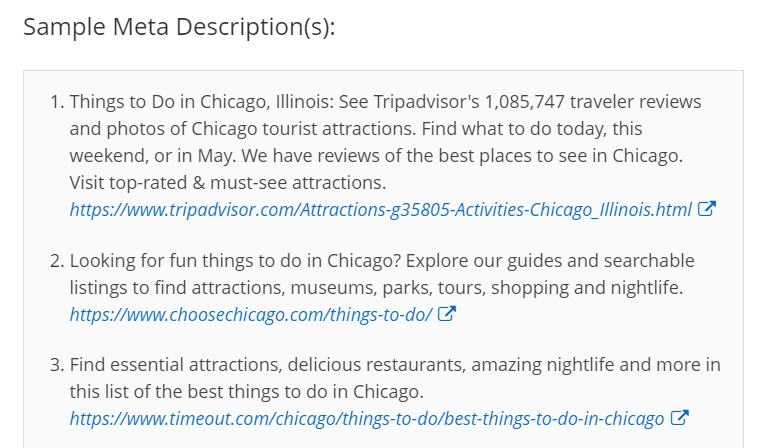
(Metadata report in Content Fusion.)
2. Compete for Other SERP features
Even strong rankings can be visually displaced by SERP features and AI-generated results, so visibility increasingly depends on where and how your content appears, not just where it ranks.
To get included in relevant SERP features, start by analyzing which queries trigger featured snippets, local packs, video carousel, AI Overviews, and others.
Once you identify where your site is being mentioned, optimize content to meet those formats directly. Clear answers, strong structure, and intent-aligned formatting increase the likelihood of being surfaced, whether as a traditional SERP feature or as a cited source in AI responses.
The same applies to rich media. If video or visual content is part of your strategy, optimizing it for search visibility helps maintain presence when classic organic listings are less prominent.
In modern SERPs, winning attention often means participating in multiple result types, not relying on a single ranking position.
One way to do this is through implementing schema markup. Incorporating the schema markup to your listings allows it to stand out among the crowd, plus it enhances search visibility.
While not every schema type drives rich results today, structured markup still helps traditional and AI search engines interpret content, which influences both SERP presentation and AI citation.
Visibility is driven less by a single enhancement and more by how clearly search engines understand and trust an entity.
3. Increase Topical Relevance to Expand Search and AI Visibility
Finally, update your content to ensure both traditional and AI search engines thoroughly understand what the page is about.
This improves search visibility and helps content surface across AI Overviews and conversational follow-ups.
Use Content Fusion to research additional topics to cover and strengthen your page’s authority. It evaluates the top-ranking content and delivers insights on:
- Topics and semantic phrases to add:
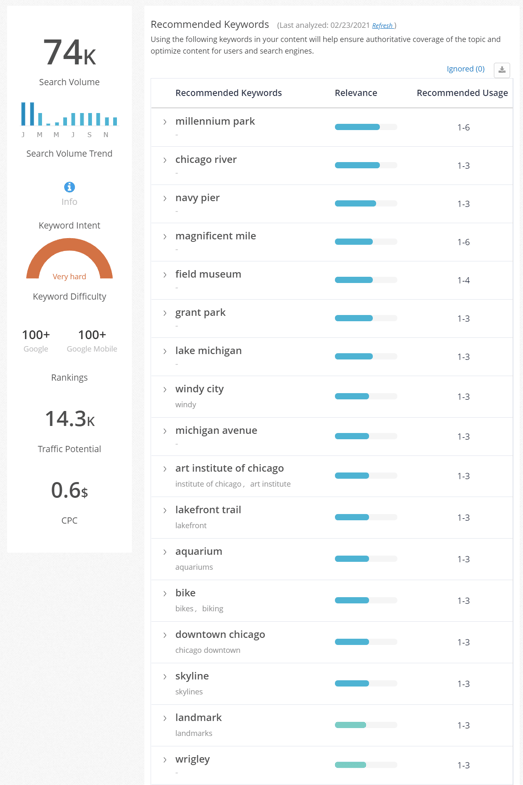
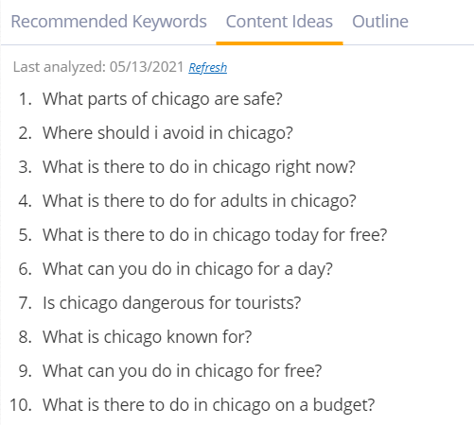
- Other queries users search for about your main topic:
- Outline structures of top-ranking content:

With even simple content tweaks, you’ll create a page that’s more relevant to what your audience is looking for, position it as a more authoritative resource, and increase the number of search phrases it will rank for.
Don't just take it from me — see 7 real-world examples of how Content Fusion increased search visibility.
Conclusion
Search results are no longer a simple list of blue links. AI-generated answers and SERP features now shape how users discover information, fundamentally changing what rankings represent.
Performance today depends on how prominently and consistently a brand appears across organic results, SERP features, and AI experiences.
To keep pace, SEO reporting must move beyond position tracking and account for real visibility. Measuring how content actually surfaces on the SERP provides a clearer, more accurate view of performance in an AI-influenced search landscape.
Schedule a demo with our team today.

Editor's Note: This post was originally published in January 2019 and has been updated to reflect the most up-to-date information in the SEO industry.


Comments
Currently, there are no comments. Be the first to post one!