



Chris Sachs's talk on the convergence of AEO and SEO was one of the most-discussed theatre presentations at this year's SMX Advanced. If you missed it, here's the full recording.
His central point reframes a problem a lot of teams are wrestling with right now: the drop in traditional clicks isn't a performance problem, it's a measurement problem. SEO and AI search aren't two separate strategies competing for budget, they're one converging discipline.
The idea that got the room talking? The real risk in AI search isn't being left out of an answer. It's being summarized inaccurately: your brand described on someone else's terms.
Book a time to talk through your brand accuracy with us.

Key Takeaways:
- SEO and AEO are converging into a single discipline, requiring brands to optimize both how they're discovered and how they're represented in AI-generated answers.
- AI search doesn't create authority—it synthesizes existing information, making comprehensive, accurate brand content more important than ever.
- Mentions and citations are useful indicators, but brand accuracy and business outcomes are the metrics that matter most as AI search continues to evolve.
- Closing content gaps helps you control your brand narrative, reducing the likelihood that AI will rely on outdated or inaccurate third-party sources to answer customer questions.
Why Should Businesses Treat SEO and AEO as One Strategy?
One of the biggest misconceptions about AI search is that it requires an entirely new strategy.
In reality, AI search builds on the same authority that SEO has always developed.
Large language models don't invent expertise, they retrieve information from authoritative sources, synthesize it, and present it as an answer. Your website, documentation, third-party reviews, Reddit discussions, forums, and publisher content all become part of that synthesis.
SEO helps establish your brand's authority and visibility. AEO influences how that authority is synthesized into AI-generated answers. Rather than competing disciplines, they're now two parts of the same search strategy. As AI-powered search continues to grow, organizations need a unified approach that ensures they're both discoverable and represented accurately.
Why Are Organic Clicks Declining Even When Search Visibility Is Growing?
Many organizations are reporting declining organic traffic while impressions continue to rise.
It's tempting to interpret that as evidence that SEO is becoming less effective. We see it differently.
The issue isn't performance, it's measurement.
Traditional metrics like clicks tell only part of the story in a world where users increasingly receive answers without visiting a website. Success now includes visibility inside AI experiences, influence over the answers users see, and whether those interactions drive meaningful business outcomes.
Instead of measuring SEO and AEO separately, we need to evaluate how search contributes to awareness, engagement, conversions, and revenue across every search surface.
Recommended Reading: The Search Pivot: Prove Value Beyond Traffic [Webinar]
Are AI Mentions and Citations the Right Metrics to Measure?
Mentions and citations are among the most discussed AI search metrics, but they don't tell the whole story.
They're useful diagnostic metrics because they indicate whether an AI model considers your brand authoritative enough to reference. But they aren't business metrics.
We've already seen citation behavior change as AI platforms evolve. Models have reduced the number of citations they display, then increased them again as their interfaces continue to change. That volatility is a reminder not to build your strategy around a metric that platforms can alter overnight.
Instead, focus on the outcomes that matter most: revenue, conversions, customer acquisition, and the accuracy of your brand's representation. Mentions and citations can help explain why performance changes, but they shouldn't define success.
Why Do AI Search Engines Get Brand Information Wrong?
One of the biggest misconceptions about AI search is that incorrect answers are simply hallucinations.
Our research tells a different story.
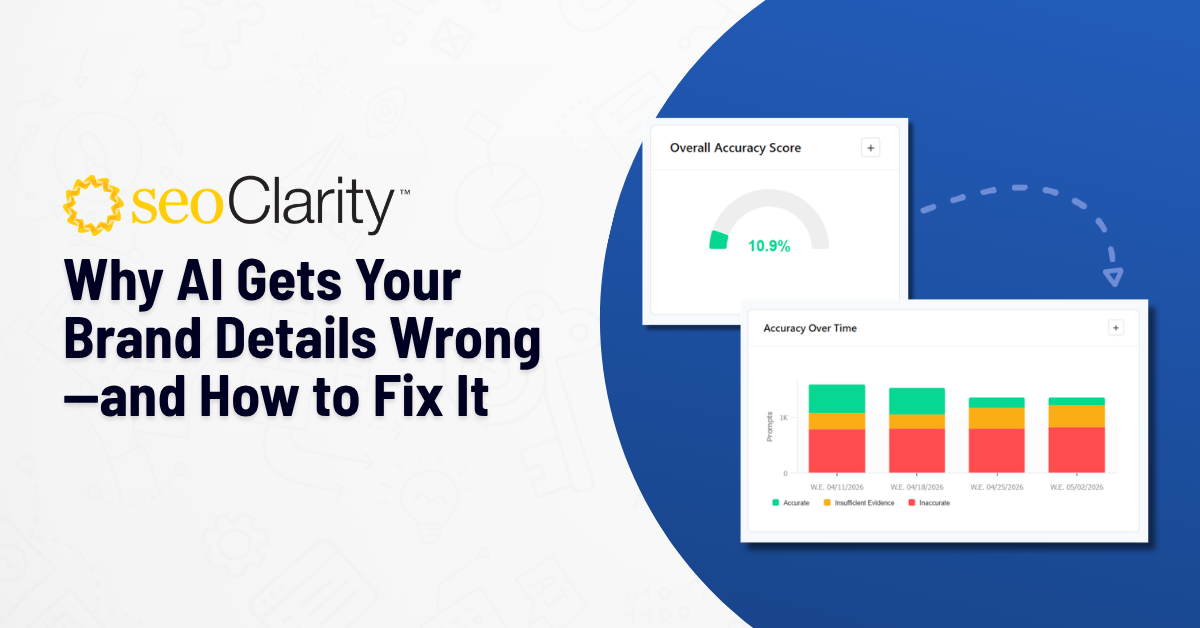
Across thousands of prompts analyzed over nine months in seoClarity's ArcAI database, approximately 40% of AI-generated answers contained some level of inaccuracy.
In many cases, AI isn't inventing information, it is filling gaps.
When your website doesn't fully answer a question, large language models look elsewhere. They pull information from Reddit discussions, review sites, forums, news articles, and other third-party sources to complete the response.
The result can be outdated pricing, incomplete product descriptions, inaccurate positioning, or messaging that doesn't reflect how you want your brand to be represented.
Recommended Reading: Why AI Gets Your Brand Details Wrong—and How to Fix It
How Do Content Gaps Cause AI to Misrepresent Your Brand?
Small gaps in your content can have a significant impact on how AI search engines describe your business.
For example, we found cases where AI surfaced outdated pricing from an old Reddit discussion instead of a brand's current pricing page.
In another example, a functional soda brand failed to appear for "gut health" searches because its website focused on the term "probiotics," while customers were searching using broader language.
We also saw apparel brands excluded from shopping recommendations because they described sizing by customer height rather than inseam length—the terminology shoppers actually used.
In each case, the brands had strong products and established authority.
The problem was that AI couldn't confidently connect their content to the way users were asking questions, so it relied on other sources to complete the answer.
How Can Brands Improve Accuracy Across AI Search?
As AI search continues to evolve, organizations need to monitor more than rankings.
They need to understand:
- Whether AI answers accurately describe their products and services.
- Which third-party sources are influencing those answers.
- Where content gaps cause AI to rely on external information instead of the brand's own content.
- Which prompts and customer questions matter most to their business.
The goal isn't simply to increase visibility.
It's to ensure your brand is represented accurately wherever AI search surfaces your content.
Rather than asking, "Did we get mentioned?" we should be asking, "Did AI tell our story correctly?"
That's becoming one of the most important measures of success in modern search.
What Does the Future of SEO and AEO Look Like?
AI search hasn't replaced SEO, it has expanded it.
Organizations that treat AEO as a separate discipline risk creating disconnected strategies, fragmented reporting, and content that isn't aligned across search experiences.
The brands that succeed will be those that build authority, close content gaps, monitor how AI represents them, and measure success based on business outcomes—not vanity metrics.
As search continues to evolve, the challenge isn't simply earning visibility. It's maintaining control over your brand narrative wherever customers search.

Comments
Currently, there are no comments. Be the first to post one!