



When AI gets your brand information wrong, the impact can be significant.
From influencing purchasing decisions and creating compliance concerns to increased support costs, inaccurate AI answers can undermine years of brand-building efforts.
And because users often trust the AI response they receive, they may never click through to your site to verify whether the information is correct.
The organizations that can influence how AI understands their brand will have a strong competitive advantage over those that leave it to piece together their story on its own.
In this blog, we’ll go through the top AI accuracy challenges brands face and walk you through how to solve them.
Key Takeaways:
- AI doesn't rely solely on your website. It synthesizes information from across the web, making consistency across all brand touchpoints critical.
- Many AI accuracy issues stem from missing, outdated, or conflicting information that forces AI systems to make assumptions about your brand.
- Improving AI accuracy requires a cross-functional effort across SEO, content, PR, and data teams to create and maintain a clear, authoritative source of truth.
- ArcAI Accuracy helps brands identify AI-generated misinformation, trace it back to its source, and take action before inaccuracies impact customer trust or business performance.
Table of Contents:
- Why Do AI Answers Provide Inaccurate Information About Your Brand?
- Why Brand Accuracy in AI Search Matters More Than Visibility
- What Are the Most Common AI Accuracy Challenges Brands Face?
- What Can My Company Do to Prevent Brand Misinformation in AI Search?
Why Do AI Answers Provide Inaccurate Information About Your Brand?
Unlike traditional search, where you primarily optimize your own website, AI search requires managing an entire information ecosystem.
This is because AI systems assemble information from a variety of sources, including websites, reviews, news coverage, industry reports, business directories, forums, social discussions, and structured knowledge databases. Your website may be an important source, but it is rarely the only source.
As a result, AI search engines are constantly evaluating multiple versions of the truth. In this example, we can see that several sites were referenced in the process of creating a single AI answer.
 If one source says your product costs $500, another says $600, and your website doesn't clearly state the current price, the AI must determine which information source is most reliable.
The result is that brands can lose control of their own narrative.
Why Brand Accuracy In AI Search Matters More Than Visibility
For years, SEO teams focused on rankings, impressions, and traffic. While those metrics remain important, AI-powered results introduce a new consideration: representation quality.
A brand may appear in AI-generated answers frequently but still be described incorrectly. In that scenario, visibility isn't creating value. In fact, it may actually be creating confusion that ultimately drives customers away.
In fact, it imppacts every stage of the marketing funnel:
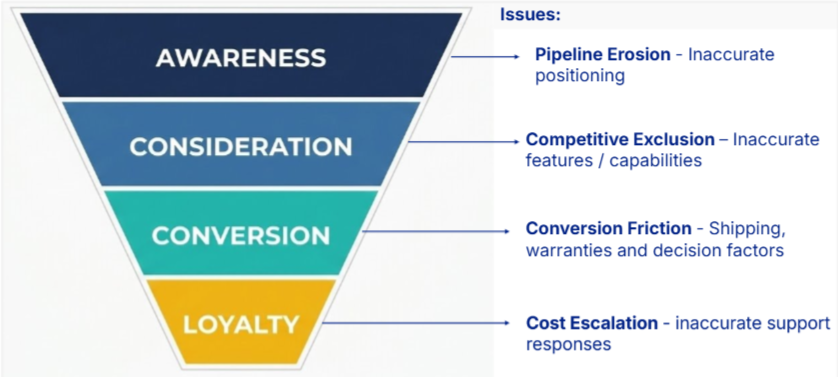
As such, the goal shouldn’t just be to appear in AI responses. It should be to ensure those responses accurately reflect your products, expertise, positioning, and brand identity.
What Are the Most Common AI Accuracy Challenges Brand’s Face?
Most AI inaccuracies can be traced back to four underlying problems.
- Missing Information: The AI is guessing because your website doesn't provide enough clear details.
- Wrong Tone: The AI doesn't understand your brand’s "vibe" (e.g., it sounds cheap when you are a luxury brand).
- Incorrect Data: The AI is making up fake prices, dates, or technical specifications.
- Conflicting Sources: Other websites or forums are spreading outdated or wrong info that the AI is repeating.
Below, we will walk through how to overcome these common challenges to ensure your brand is accurately represented in AI answers.
Problem 1. Missing Information Forces AI to Fill in the Blanks
AI systems are designed to provide complete answers. When important information is missing, they often compensate by pulling context from other sources or making educated guesses.
This commonly happens when product pages are thin, service descriptions lack detail, FAQs don't address common questions, or important business information is scattered across multiple locations.
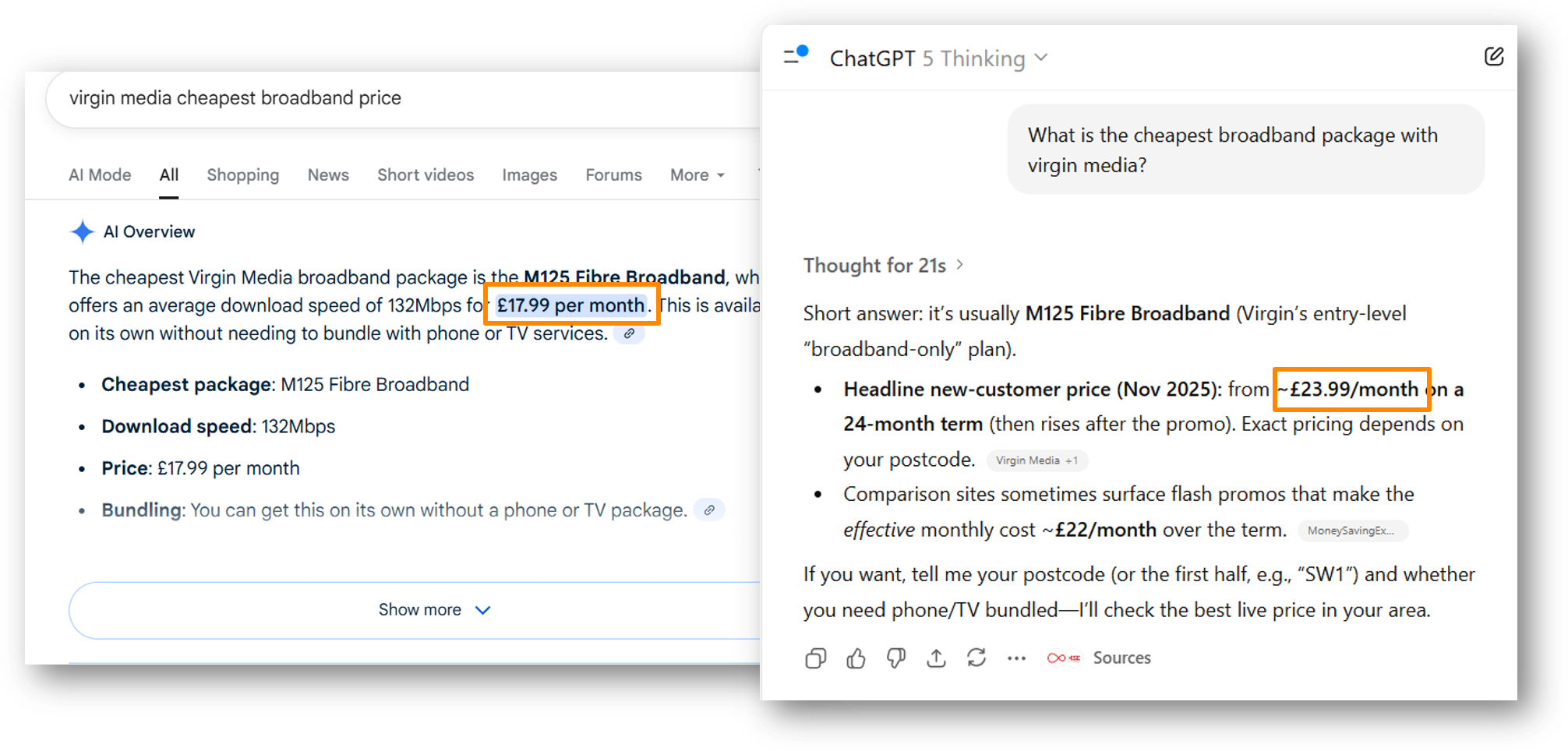
In the example below, the AI Overview and the ChatGPT response are showing conflicting information regarding the price of a phone plan. This suggests that the information on this plan is not clearly defined on the company’s site.
How to solve this problem:
The solution is straightforward: reduce ambiguity.
Brands should publish comprehensive, factual content that clearly answers the questions customers are most likely to ask. Detailed product information, service descriptions, documentation, comparison pages, and FAQs all help establish your website as the authoritative source.
The less AI has to infer, the more accurate its responses tend to be.
To easily identify these blind spots for ecommerce/retail, ArcAI Shopping provides a visual and logical audit of how AI responses recommend your products. By showing you your "Share of Model," you can see exactly where your product data is failing and take action.
Problem 2. AI Understands What You Do—but Not Who You Are
A surprising number of AI brand errors aren't factual. They're positioning problems.
An LLM may correctly identify your company as a software provider while failing to recognize that you're targeting enterprise buyers rather than SMBs. A luxury brand may be described as affordable. A premium service provider may be portrayed as a low-cost option.
In this example, Balsam Hill may not appreciate the positioning that they provide less “value” than their competitor.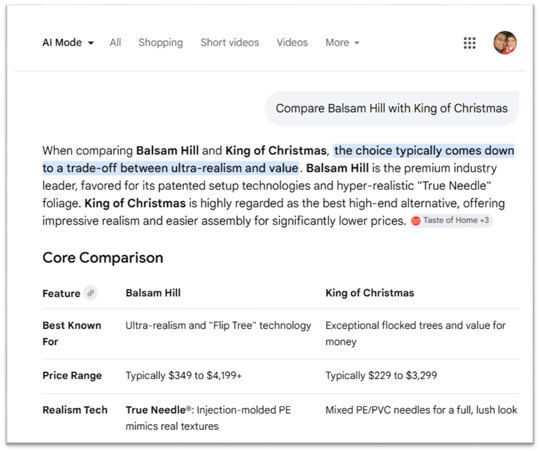 These issues occur when positioning signals are weak or inconsistent across the web.
How to solve this problem:
Enterprise teams should review how their brand is described across websites, press releases, product pages, analyst reports, and third-party mentions. Consistent language around audience, market position, expertise, and differentiators helps reinforce the narrative you want AI systems to understand.
To streamline this process, ArcAI Sentiment Analysis provides visibility into how your brand is being discussed and interpreted across AI platforms.
It helps you track brand perception across AI engines over time, pinpoint the sources driving AI-generated responses, and identify opportunities to improve both your on-site content and off-site authority signals.
Problem 3. AI Struggles With Facts That Aren't Clearly Structured
Even when accurate information exists, AI systems don't always interpret it correctly.
Pricing, product specifications, dates, service offerings, and company information are often buried within page copy, PDFs, or poorly structured content. This increases the likelihood that AI either misses the information or introduces inaccuracies.
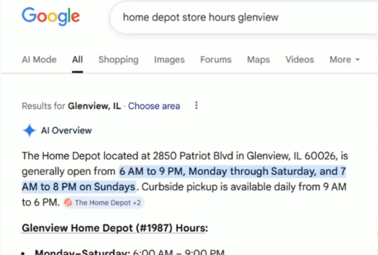
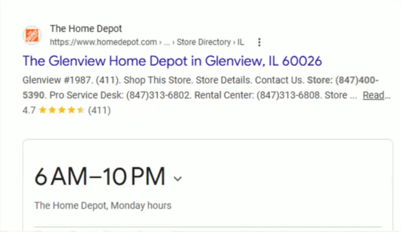
For example, this Home Depot location had its store hours listed as 6 am-10 pm on their site, but the AI Overview stated that they close at 9 pm.
How to solve this problem:
Structured data helps solve this issue.
Schema markup provides machine-readable context that makes it easier for search engines and LLMs to understand which facts are authoritative. For example, product schema and organization schema are great for reducing uncertainty and improving consistency.
Think of structured data as a way of explicitly telling machines which information represents the official version of the truth.
Problem 4. The Rest of the Internet May Be Telling a Different Story
Perhaps the most difficult challenge is conflicting information.
Many AI inaccuracies don't originate from your website at all. They come from outdated directories, old partner pages, review sites, forums, legacy press releases, and third-party content that continues circulating across the web.
For example, the source of this AI answer was not the company’s site, but rather a Forbes article from 2024 in which their product was described as “overwhelming.”
 In some cases, competitors may even intentionally publish misleading, incomplete, or biased information to influence how AI systems understand and describe your brand.
When AI encounters multiple versions of the same information, it must decide which source to trust. This means improving AI accuracy often requires looking beyond your owned properties.
How to solve this problem:
Enterprise organizations should regularly audit third-party mentions, update outdated listings, correct inaccurate references, and monitor the broader information ecosystem surrounding their brand.
The cleaner and more consistent your digital footprint becomes, the easier it is for AI systems to identify authoritative information.
What Can My Company Do to Prevent Brand Misinformation in AI Search?
Many organizations initially approach AI accuracy as a PR issue. In reality, it's closer to an information governance challenge.
SEO teams can improve discoverability. Content teams can create authoritative resources. PR teams can influence external narratives. Data teams can implement structured markup and maintain consistency.
But lasting accuracy improvements happen when these groups work together to ensure the same information appears consistently across every source that AI may reference.
Of course, maintaining that level of consistency becomes increasingly difficult as your brand is mentioned across websites, directories, news articles, forums, review platforms, and AI engines. That's why ongoing monitoring is critical. You can't fix misinformation if you don't know it exists.
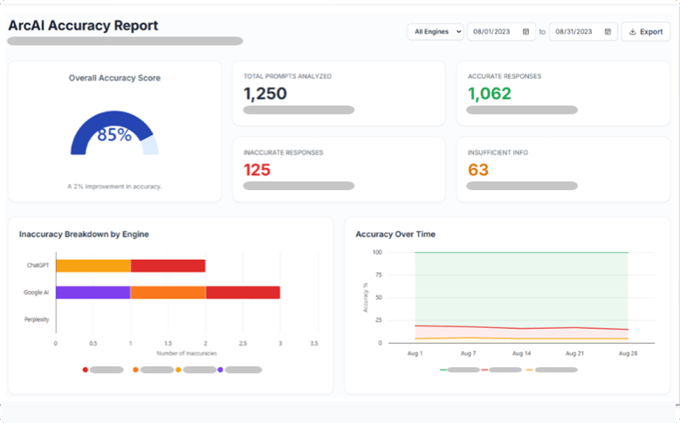
ArcAI Accuracy helps enterprise teams proactively monitor how their brand is represented across AI search platforms. By comparing AI-generated answers against a centralized source of brand truth, it can identify inaccuracies, uncover the sources contributing to those errors, and provide actionable recommendations to help teams correct misinformation before it impacts customer trust.
Final Thoughts
As AI search becomes a primary discovery channel, enterprise brands need to expand their definition of optimization.
The challenge is no longer just helping users find your content. It's helping AI systems understand your brand accurately enough to represent it correctly.
That means filling information gaps, strengthening positioning signals, structuring critical data, and managing the broader web ecosystem that shapes AI-generated answers.
In the era of AI search, mentions get you seen. Accuracy earns trust.



Comments
Currently, there are no comments. Be the first to post one!