



How brands are discovered has changed.
It used to be so “easy.”
Discover the keywords for your brand, optimize content for those terms, rank well for related searches and watch the traffic roll in.
The advent of AI search changed all that.
Ranking is gone. There is only visibility. What matters now is if your brand is mentioned or cited by AI search engines when people search for things related to you.
Knowing which of the millions of prompts reflect real influence in your niche, and which don’t, is what separates insight from noise in AEO prompt research.
Prefer Video? Watch our on-demand webinar instead:
Key Takeaways:
- Focus on the prompts that matter. You don’t need to track every possible variation.
- Build focused prompts around entity + aspect + intent. Keep each prompt to one variable whenever possible.
- Balance brand and non-brand prompts. Track mentions and citations based on the outcome you expect.
- Use ArcAI Prompt Research to do the heavy lifting. Find relevant prompts faster and build a more comprehensive, actionable prompt set.
Table of Contents:
- Why Tracking Prompts in AI Search is Important
-
The Challenge of Choosing Which Prompts to Track in AI Search
-
When Choosing Which Prompts to Track, Start With What You Want to Measure
- How to Build a Balanced Prompt Set
-
What to Avoid When Choosing Which Prompts to Track in AI Search
Why Tracking Prompts in AI Search is Important
For enterprise teams, tracking AI search prompts provides critical visibility into how and where your brand surfaces in AI-generated answers. Whether it’s being retrieved, cited, paraphrased, or omitted entirely.
Modern AI search experiences rely on retrieval-augmented generation (RAG), a process in which large language models pull relevant passages from external sources to ground their responses. They then synthesize this information into a conversational answer rather than simply returning a list of links to satisfy a query.
Without prompt-level insight, you’re blind to how AI systems interpret your content and influence discovery, trust, and downstream decisions.
The Challenge of Choosing Which Prompts to Track in AI Search
AI search makes visibility harder to measure than traditional search because prompts are fluid, contextual, and rarely repeated the same way twice
Here are some of the top challenges in tracking prompts in AI search:
- Too many variations: The same question is asked in many different ways.
- Longer questions: Prompts are more detailed and task-focused.
- Changing context: Wording shifts by location or conversation history.
- Hidden sub-questions: AI breaks one prompt into several smaller questions.
- Partial answers: Content may help answer only part of a prompt.
- Unclear signals: Tracking full prompts can hide what actually drives visibility.
All of these factors create a problem for tracking AI search performance. How can we ever hope to track such diverse, long-tail queries? The answer lies in taking a more topical approach.
The Biggest Mistake People Make When Tracking AI Prompts
Because we know users enter longer, more complex queries in AI engines, it’s tempting to track thousands of hyper-specific, long-tail prompts, but this creates noisy, unscalable data and false signals, and makes it impossible to isolate what should be optimized.
To build a successful AEO strategy, you must resolve the tension between long-tail conversational complexity and structured tracking.
Why Tracking Complex AI Search Prompts Fails
The temptation to track hyper-detailed prompts is understandable, but practically counterproductive. When you attempt to track long-tail, multi-variable queries, you run into three structural roadblocks:
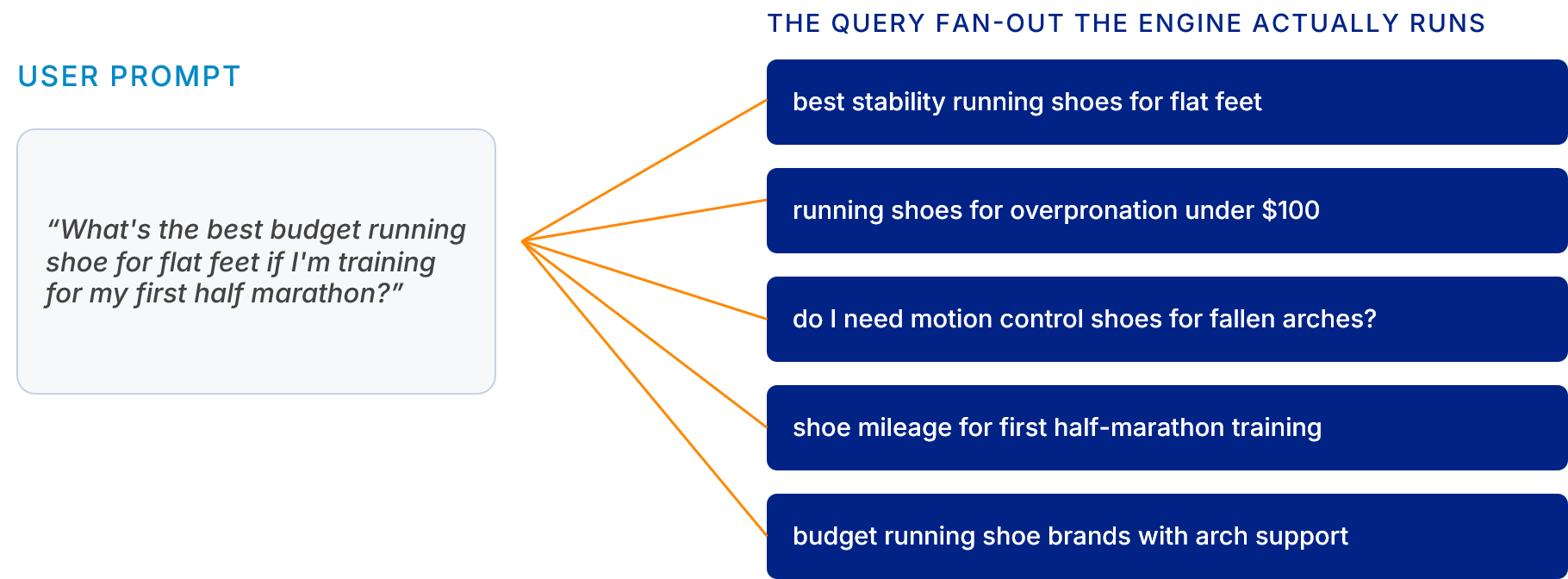
1. AI Query-Fan Out: AI search engines do not retrieve information based on the raw, prompts users enter. They rewrite and break a complex prompt into multiple simpler sub-queries. Your content is meeting the AI engine at that sub-query level, not at the level of the more complex original user query.
Here’s a visual example:
2. Variables Obscure Action: Long, complex prompts introduce too much noise. You cannot isolate variables or establish a reliable baseline to measure whether your content optimizations are actually working.
3. Inability to Scale: Attempting to track and manage thousands of highly nuanced, long-tail variations is costly and operationally impossible.
When Choosing Which Prompts to Track, Start With What You Want to Measure
Before building prompts, define what you actually want to learn from AI tracking.
It’s easy to start by creating a long list of prompts that seem relevant. But if a prompt doesn’t connect to your brand, content, products, services, or business goals, measuring it won’t give you much actionable information.
Instead, start with the questions you want your AI visibility data to answer. For example:
- How do AI platforms describe your brand? Track whether they reflect the qualities and differentiators you want associated with your brand. If your positioning has evolved but AI responses still reflect an outdated perception, that can reveal where your newer messaging isn't coming through clearly.
- How much does your content influence AI answers? For informational topics where you publish guides, how-tos, research, or other resources, track citations to understand when your content is being used as a source.
- How often is your brand recommended? For products or services you offer, track whether your brand appears when users ask for recommendations.
- How does your visibility compare with competitors? Look at which brands appear alongside (or instead of) yours for the same topics and prompts.
Defining these goals first helps determine which prompts are worth tracking. From there, you can build focused prompts around the specific entities, aspects, and intents that matter to your business.
How to Structure Prompts for AI Tracking
When constructing prompts to track, we suggest following this simple format that has proven to work the best for our clients: Entity + Aspect + Intent

1. Start With One Entity
The entity is the main thing you want to measure. It might be a product, service, category, brand, or other topic relevant to your business.
From your SEO keyword research, take your most valuable head terms as indicators of the topics you should cover.
For example, imagine an online consumer electronics retailer that sells smartphones. In this case, "smartphones" could be the entity.
2. Add One Aspect
Next, choose a single aspect of that entity: something people commonly want to know, compare, or evaluate.
For smartphones, aspects might include:
- High-megapixel cameras
- 1 TB of storage
- Folding screens
- Battery life
The key is to use one aspect per prompt.
Rather than tracking "smartphones with high-megapixel cameras and 1 TB of storage," create separate prompts for camera quality and storage. Isolating each aspect makes the resulting data much easier to interpret.
3. Add Enough Context to Signal Intent
Finally, add wording that establishes what the user is trying to accomplish.
For example, a transactional prompt might be: "Where can I buy a smartphone with a high-megapixel camera?"
Here, you might measure whether your brand or store is recommended or mentioned in the AI response.
An informational version could be: "How do I choose the best smartphone with a high-megapixel camera?"
For this prompt, you might instead measure whether your buying guide, product content, or other informational resources are cited or used as sources. The entity and aspect remain the same, but changing the intent allows you to measure a different part of your AI visibility.
Why Focused Prompts Are Best for AI Tracking
Focused prompts target one specific aspect of an entity with enough context to make the intent clear. Instead of trying to measure several ideas at once, each prompt isolates a single variable.
This makes AI visibility tracking more useful because focused prompts:
- Measure one variable at a time, making it easier to identify what you need to optimize.
- Connect intent to the right outcome, such as measuring brand mentions for recommendation-focused prompts or citations for informational prompts.
- Better reflect how AI systems find information, aligning with the focused sub-queries AI engines may use to build an answer.
Keeping each prompt focused on one entity, one aspect, and one intent also makes the results more actionable. If your brand isn't appearing for a prompt about where to buy smartphones with high-megapixel cameras, for example, you have a specific issue to investigate.
You can look at whether that attribute is clearly communicated on your product and category pages, whether your brand is associated with it elsewhere on the web, and whether relevant third-party sources mention your offerings.
But if one prompt combines camera quality, storage, battery life, and other attributes, it's much harder to determine why your brand did or didn't appear. The simpler the prompt, the clearer the signal, and the easier it is to know what to optimize.
What to Consider When Choosing Which AI Prompts To Track
Keep these three things in mind when choosing prompts to track success in AI search:
- For LLMs, the specific order of the query does not matter. "Best marathon running shoes by Nike" and "Top Nike running shoes for marathon runners" have nearly identical results. This is fundamentally how the transformer technology underlying all LLMs today works.
- We know where the demand already is. 10-15% of all searches happen on AI search. This means if “running shoes" is searched 100k times on Google it is searched 10k - 15k times on AI search engines. Start with the biggest terms from your SEO keyword research.
- Next, develop 3 to 5 simple questions to sample different search intents of those terms. For example:
- "Where can I buy the best running shoes?” - transactional intent, target: brand mentions
- "What are the best running shoes?” - informational intent, target: brand mentions
- "How do I choose the right running shoes?” - informational intent, target: citations
This follows the scientific methodology of sampling. Given how transformer technology works, if you are mentioned/cited for "best running shoes," the data shows you are highly likely to also be mentioned/cited for many hundreds of variations of that same intent.
How to Build a Balanced Prompt Set
Once you’ve defined your goals and built focused prompts around them, zoom out and look at your prompt set as a whole. A well-rounded set should capture different ways your brand can appear in AI search.
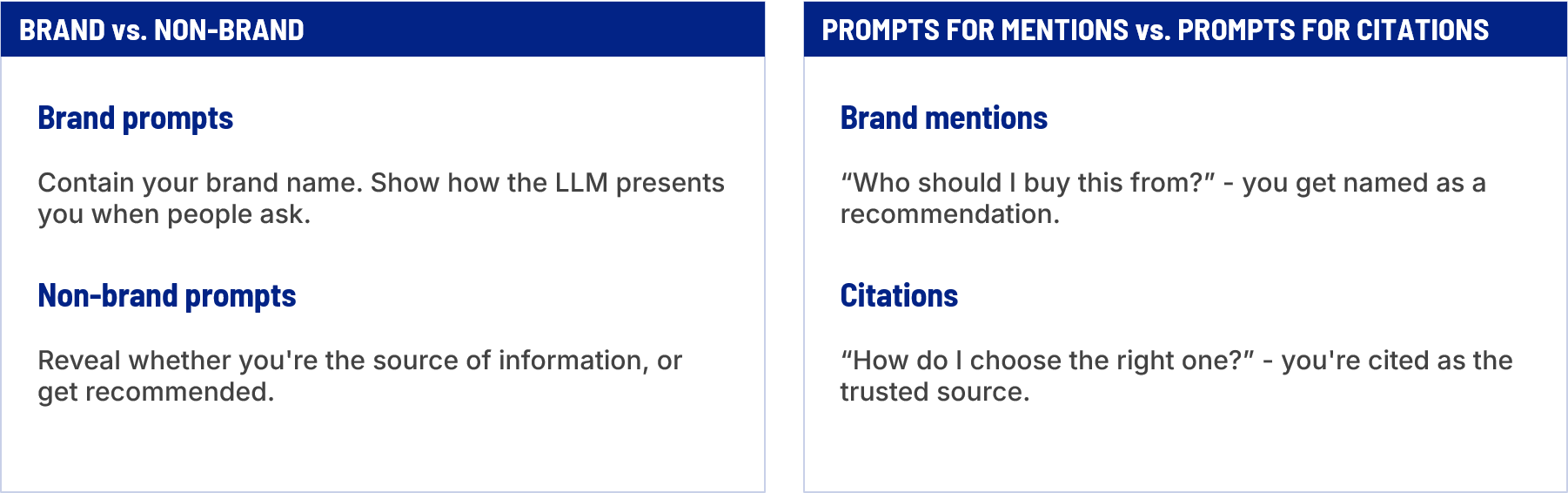
There are two dimensions to consider: brand vs. non-brand prompts and mentions vs. citations.
Balance Brand and Non-Brand Prompts
Brand prompts explicitly include your brand name. For example: Does Acme have running shoes for marathon training?
These prompts help you understand what AI platforms know and communicate about your brand.
Non-brand prompts don't mention your brand. Instead, they help you understand whether your brand surfaces naturally when someone asks about a relevant product, service, or topic. For example: Who has the best running shoes for marathons? Or: How do I choose running shoes for a marathon?
Tracking both gives you a broader view of your visibility: not only how AI responds when someone asks about your brand directly, but whether your brand appears when it isn't named in the prompt.
Track Prompts Based on Their Expected Outcome
You should also consider whether each prompt is primarily intended to generate a mention or citation.
Recommendation-focused prompts, such as "Who has the best running shoes for marathons?", are more likely to result in brand mentions. Here, the primary question is whether your brand gets recommended.
Informational prompts, such as "How do I choose running shoes for a marathon?", are more likely to surface citations. These help you understand whether AI platforms view your content as a useful source for answering the question.
A prompt can generate both a mention and a citation, but most prompts naturally lean toward one outcome.
Audit Your Prompt Mix Regularly
As your prompt set grows, periodically review it for balance. You should have prompts that help you understand how AI platforms talk about your brand, whether you surface for relevant non-brand queries, how often you're recommended, and whether your content influences AI-generated answers.
Together, these signals provide a more complete (and actionable) picture of your visibility in AI search.
What to Avoid When Choosing Which Prompts to Track in AI Search
Choosing the wrong prompts can make AI search visibility harder to interpret instead of clearer.
Because AI prompts behave differently than traditional keywords, small missteps can distort results.
The following are common mistakes teams make when deciding what to track:
- Tracking overly complex one-off prompts that don’t represent broader coverage
- Ignoring intent diversity (only tracking “best X” queries)
- Choosing questions that don’t map to business value
- Tracking too many questions and drowning in noise
- Failing to keep prompts consistent (changing wording constantly)
Taken together, these mistakes make AI search visibility appear volatile and unclear, when in reality the issue is what’s being measured—not how your content is performing.
How to Use ArcAI Prompt Research to Build Your Prompt Set Faster
Building a comprehensive prompt set manually can take time. Even when you understand what makes a good prompt, there’s still the challenge of deciding which topics and questions are worth tracking.
This is where ArcAI Prompt Research can help. Instead of starting from a blank page, it identifies relevant topics and prompts based on your domain, your content, and the audiences you want to reach.
Depending on your needs, you can use it to:
- Generate a starting set of prompts based on your domain and the topics you cover.
- Research prompts for a specific URL, such as a high-priority product, category, or landing page.
- Build more targeted prompt sets around factors such as brand vs. non-brand queries, personas, topics, and stages of the buyer journey.
1. Start With the Topics That Matter
Before identifying individual prompts, it helps to understand the broader topics your prompt set should cover.
Your knowledge of your customers and market is an important starting point, but brainstorming alone can leave gaps. Prompt Research surfaces additional relevant topics and provides estimated search volume to help you prioritize them.
Volume shouldn't be the only deciding factor, though. A lower-volume topic may represent a smaller but highly valuable audience or an important niche for your business.
2. Ground Your Tracking in Real User Questions
Another important consideration is where your prompts come from.
Rather than generating synthetic questions based solely on what an AI model thinks people might ask, ArcAI Prompt Research draws from a dataset of actual user questions. This helps ground your prompt tracking in the ways people are already asking about topics related to your business.
3. Segment Prompts for More Useful Analysis
Finding the prompts is only part of the process. You also need to be able to analyze performance in meaningful ways.
ArcAI automatically tags prompts across dimensions such as topic, persona, buyer journey stage, and brand vs. non-brand intent. That allows you to move beyond overall AI visibility and answer more specific questions, such as how your brand performs for a particular audience or at a particular stage of the customer journey.
The result is a prompt set that's not only faster to build, but easier to segment and analyze as your AI search strategy matures.
Conclusion:
If you take nothing else away from this, keep these core principles in mind when building your AI search tracking strategy:
- Avoid complex prompts: LLMs use semantic search to rewrite complex user inputs. Track the core topics, not the infinite conversational variations.
- Focus on single-entity prompts: Keep your tracking queries clean, high-level, and centered on one aspect of a topic to isolate variables.
- Map prompts to the buyer's journey: Select questions that isolate specific stages of intent—informational queries to check citation authority, and transactional queries to check brand recommendations.
- Prioritize scalability over complexity: Track a representative sample of highly focused questions for each core business topic to establish a reliable performance baseline.
Automate with ArcAI: Let Prompt Research handle the background analysis to uncover the highest-impact topics and prompts that represent real market value.

<<Editor's Note: This post was originally published in January 2026, and has since been revised.>>


Comments
Currently, there are no comments. Be the first to post one!