



For decades, SEOs have relied on relatively concrete measurements: rankings, impressions, clicks, and conversions. AI search introduces something much less comfortable: probability.
Ask the same question twice, and you may get different answers, citations, or brand recommendations. That raises a valid concern for enterprise SEO teams:
If AI answers are inherently variable, can tracking a fixed set of prompts actually tell us anything meaningful?
Yes, but only if we stop treating prompt tracking like rank tracking.
Prompt tracking isn't designed to capture every possible question or predict exactly what an individual user will see. It's a sampling methodology. A well-constructed set of prompts can reveal how consistently your brand appears across the topics and intents that matter to your business.
The goal isn't certainty. It's understanding your probability of presence.
Key Takeaways:
- Prompt tracking functions as a sampling methodology rather than traditional rank tracking, measuring your brand's overall probability of presence across key topics instead of aiming for absolute certainty or total query coverage.
- Tracking representative topic clusters matters far more than exact query wording because AI search evaluates the broader intent space across entities, personas, and funnel stages.
- Measuring consistent frequency across repeated queries provides far more insight than tracking one-off appearances, helping reveal true visibility patterns and competitive gaps despite response volatility.
- Visibility metrics must be paired with downstream business outcomes like referral traffic, conversions, and revenue to keep prompt tracking anchored to real business performance rather than becoming a vanity metric.
Table of Contents:
- What Is Prompt Tracking in AEO?
- Why Are SEOs Skeptical of Prompt Tracking?
- Why Should You Track AI Visibility by Topic Instead of Individual Prompts?
- How Many Prompts Do You Need to Track for AEO?
- How Do You Build a Reliable Prompt Tracking Methodology?
- So, Is Prompt Tracking a Valid Way to Measure AI Visibility?
What Is Prompt Tracking in AEO?
Before evaluating whether prompt tracking is valid, we need to separate two related concepts.
- Prompt tracking is one measurement tactic within that larger framework. It involves repeatedly querying AI experiences with a defined set of prompts and observing whether (and how) your brand appears.
- AEO tracking is the broader measurement of your brand’s visibility and performance within AI-driven search experiences such as ChatGPT, Perplexity, and Google’s AI search experiences. Depending on the platform and available data, that might include mentions, citations, share of voice, referral traffic, conversions, and other outcomes.
That distinction matters because one of the biggest objections to prompt tracking comes from expecting it to do something it cannot do.
Prompt tracking cannot tell you every question users ask. It cannot tell you with certainty what an individual user will see. And it cannot prove that appearing more frequently will automatically produce more revenue.
But it can answer a strategically important question: Across the topics and intents that matter to our business, how consistently are we part of the AI-generated answer?
Why Are SEOs Skeptical of Prompt Tracking?
Enterprise SEO teams have good reasons to be cautious. After years of building reporting systems around rankings, clicks, impressions, and conversions, prompt tracking can initially feel frustratingly soft.
Most of that apprehension falls into four categories.
1. How Can You Track Enough Prompts to Get Meaningful Data?
There may be hundreds or thousands of ways someone can express essentially the same need:
- What are the best enterprise SEO platforms?
- Which SEO software is best for large companies?
- Compare enterprise SEO tools.
As a result, tracking 50, 500, or even 5,000 prompts can feel inadequate. This leads teams toward an impossible goal: trying to track the entire prompt universe. But complete coverage isn't the objective. Representative coverage is.
Traditional market research doesn't require asking every member of a population the same question to identify a pattern. A sample can provide useful information when the population being studied is thoughtfully represented.
Prompt tracking should be approached similarly. The goal should be to create a prompt set that adequately represents the topics, entities, intents, personas, and stages of the journey that matter to your business.
This is also why prompt research matters before prompt tracking begins. Rather than relying entirely on manually brainstormed or AI-generated synthetic prompts, seoClarity’s ArcAI Prompt Research uses search intelligence, topical clusters, and proprietary clickstream data to surface prompts grounded in real search demand. Teams can then prioritize prompts by relative demand and buyer-journey stage before deciding what belongs in their tracking set. 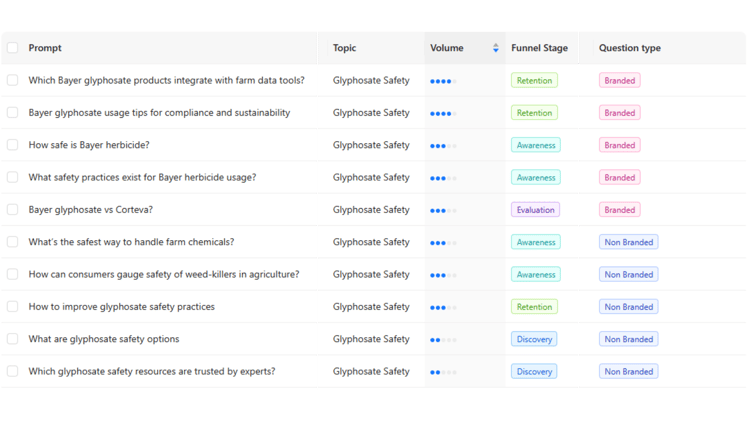
2. Are AI Responses Too Volatile to Track Reliably?
AI-generated responses aren't static. Run the same prompt multiple times, and you may see different brands, sources, or language. But that volatility doesn't make prompt tracking unreliable. It's part of what you're measuring.
If Brand A appears in nine out of ten observations around a topic and Brand B appears in three, neither result predicts what the next user will see. But Brand A has more consistent visibility within that sample.
The key is to measure patterns across observations, not individual responses.
So if your brand appears in eight out of ten observations, that doesn't mean there's an 80% chance any user will see it. It means your observed mention rate is 80% within that tracked sample.
Monitor that rate across a stable, representative topic set, and you can identify changes in visibility, competitor gaps, and trends worth investigating.
3. Does the Exact Wording of an AI Prompt Matter?
Then there is the wording trap. Teams can spend enormous amounts of time debating whether they should track:
- “Best enterprise SEO platform”
- Or: “What are the best enterprise SEO platforms for Fortune 500 companies?”
- Or: “Which enterprise SEO software should a large global organization consider?”
Prompt construction does matter. Different details can change intent and therefore change the answer. But exact wording is less important than it was in a keyword-centric measurement model.
AI search systems can interpret concepts, entities, relationships, and intent and may use query rewriting, retrieval, and query fan-out to gather information needed to formulate an answer.
That means the objective isn't to guess the exact sentence a future customer will type. It is to represent the intent space around the topic.
Your tracked prompts should deliberately vary wording, intent, specificity, persona, and relevant entities. If your brand consistently appears despite those variations, that tells you far more than its appearance for one carefully constructed prompt.
Recommended Resource: How to Choose Which Prompts to Track in AI Search
4. Is Prompt Tracking Just a Vanity Metric?
This may be the objection enterprise leaders care about most.
A mention isn't a click. A citation isn't a conversion. And a 10 percent increase in AI visibility doesn't automatically translate into a 10 percent increase in pipeline. That makes it dangerous to position prompt tracking as the new equivalent of revenue, traffic, or even Search Console data.
Prompt tracking measures something earlier in the chain:
Presence → Citation/Recommendation → Referral → Engagement → Conversion → Revenue
Prompt tracking primarily helps answer questions toward the left side of that chain. Analytics and business data help answer questions toward the right. Enterprise AEO measurement needs both.
Without outcome data, visibility can become a vanity metric. But without visibility data, teams may only see the downstream result without understanding why competitors are increasingly being cited, mentioned, or recommended instead.
Why Should You Track AI Visibility by Topic Instead of Individual Prompts?
Consider a company that wants to be associated with “enterprise SEO platforms.”
Instead of obsessing over one canonical prompt, build a representative cluster containing different types of questions:
- Category discovery
- Product comparisons
- Feature-specific questions
- Problem/solution questions
- Persona-specific questions
- Use-case questions
- Purchase-consideration questions
Then evaluate visibility across the cluster.
Perhaps your brand appears frequently in broad category recommendations but rarely when users ask about automating technical SEO. That is more actionable than knowing you appeared for “best enterprise SEO platform” yesterday.
You aren't simply measuring whether the AI “knows” your brand. You are beginning to understand what the AI associates your brand with and where those associations are strong or weak.
To build out these clusters, ArcAI Prompt Research can generate relevant prompts around a business, topic, or specific URL and automatically map them across Awareness, Discovery, Evaluation, Decision, and Retention stages. You can also research a competitor URL to identify the conversational queries that content is positioned to answer.
How Many Prompts Do You Need to Track for AEO?
This is where teams often want a hard number.
Five prompts? Ten? Fifty? Five hundred? Unfortunately, there is no universally valid threshold.
A set of five prompts could be adequate for detecting a broad directional change in a narrow topic and woefully inadequate for estimating visibility across a complex product category. Instead of choosing prompt volume arbitrarily, evaluate the quality of your sample.
Ask whether it represents:
- Topics: Are the strategically important subjects covered?
- Intent: Are you capturing informational, comparative, evaluative, transactional, and other relevant needs?
- Entities: Are the important products, problems, features, audiences, and concepts represented?
- Personas: Would different customer types frame the problem differently?
- Specificity: Do you have both broad and highly specific questions?
- Platforms: Are you measuring the AI experiences your audience actually uses?
- Repetition: Are important prompts observed often enough to distinguish persistent visibility from one-off appearances?
More prompts aren't automatically better. A smaller, well-designed sample can be more informative than thousands of synthetically generated prompts that disproportionately represent the same intent.
How Do You Build a Reliable Prompt Tracking Methodology?
For enterprise teams, the goal should be to make prompt tracking repeatable, representative, and triangulated.
Start with five principles.
- Measure topics, not isolated prompts: Define the strategic topics and entities your brand needs to own, then construct prompt clusters around them.
- Build representative samples: Vary intent, persona, specificity, phrasing, and relevant entities rather than generating dozens of near-duplicate questions.
- Measure frequency, not just presence: A single appearance is weak evidence. Consistent inclusion across prompts, repeated observations, and platforms is much more meaningful.
- Track trends against a stable benchmark: Changing your prompt set every week makes longitudinal comparisons difficult. Maintain a stable core sample while periodically adding an exploratory layer to discover emerging questions and behaviors.
- Triangulate prompt visibility with business outcomes: Combine mention rates and citations with AI referral traffic, conversions, traditional organic performance, and other business metrics wherever possible. A unified SEO and AEO platform like seoClarity makes finding correlations between various search metrics much easier.
So, Is Prompt Tracking a Valid Way to Measure AI Visibility?
Yes…with an important qualification.
Prompt tracking is valid when we treat it as sampling, not surveillance.
It cannot observe every prompt every customer enters. It cannot guarantee what an individual user will see. And it should not be presented as a deterministic ranking system dressed up for AI.
What it can do is measure how frequently your brand appears across a carefully designed set of strategically important AI interactions.
Over time, that gives enterprise teams a directional measure of presence, consistency, competitive visibility, and topic-level association. And that becomes even more powerful when prompt tracking is combined with citations, referral traffic, conversions, and traditional search data.


Comments
Currently, there are no comments. Be the first to post one!