



The job description for SEOs has quietly changed, and nobody asked us if we were ready.
Between ChatGPT hitting 100 million users and the global rollout of AI Overviews, the foundation of search that we’ve stood on for 20 years is shifting.
But here is the good news: your SEO expertise is not a relic, it is the foundation of what actually works in AI search.
In this on-demand webinar, Tania German (Head of Marketing) and Chris Sacks (VP of Client Success) at seoClarity walk through a real framework to move from being an SEO practitioner to a strategic AI search architect.
Key Takeaways:
- Accuracy Is the New Battleground: AI visibility alone isn’t enough. Nearly 40% of responses contain inaccuracies, making brand control and correctness critical.
- Prompts Over Keywords: SEOs must shift from tracking keywords to monitoring prompts and identifying where their brand is missing from AI-generated answers.
- A Repeatable AEO Workflow: Winning in AI search requires a continuous loop of research, optimization, and protection to stay visible and accurate.
- Enterprise Success: Scaling AEO requires breaking down performance by business line, embedding AI visibility data into your internal tools, and aligning on Answer Certainty metrics like accuracy, coverage, and resolution speed.
Table of Contents:
- The Shift: From Ranking #1 to Controlling the Narrative
- The AI Answer Problem: Your Brand Used to Speak, Now It Gets Synthesized
- A Repeatable AEO Workflow: Research, Optimize, and Protect
- The Enterprise Edge: Scaling Your Strategy
The Shift: From Ranking #1 to Controlling the Narrative
Tania: Nobody warned us about what was going to happen over this last year plus. I feel it. The basics of what I’ve known for 20+ years feel uneasy. I’m looking for some hard rocks to stand on. But remember: just because the mechanism people use to discover brands has changed, it doesn't mean everything has changed. All the headlines and changes can make us feel like we are behind, but the reality is that nobody has the playbook yet.
The good news is that your SEO expertise isn’t obsolete. Everything your team already knows (crawlability, authority, structured data, and brand signals) still matters. In fact, it may matter more now because AI search has made SEO fundamentally more important.
However, there are different layers we need to think about and pull from. That’s what Chris and I are here to build with you today.
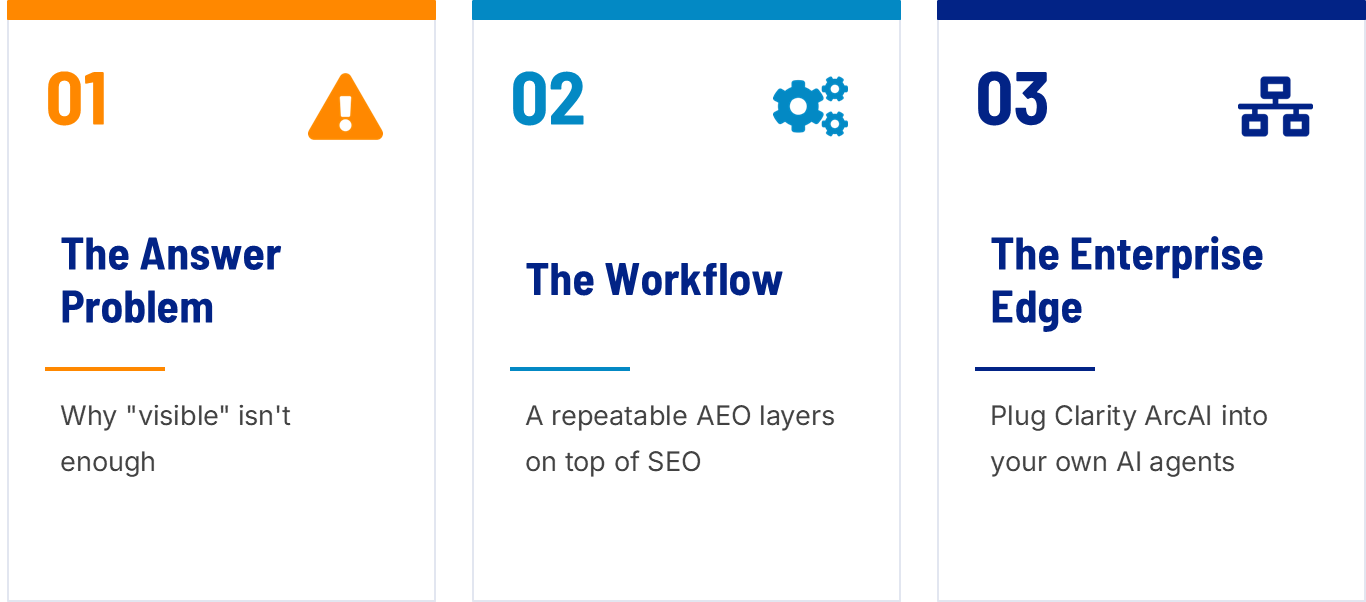
Here’s what we’re going to focus on:
- The Answer Problem: Understanding the core mental shift required to realize why being visible in an AI answer isn't the same as winning on the traditional SERP.
- The Workflow: Specific, actionable steps to transition your professional identity from a practitioner to a strategic architect.
- The Enterprise Edge: How to scale your testing and implementation across different business lines and communicate value to various stakeholders using Clarity ArcAI.
The AI Answer Problem: Your Brand Used to Speak. Now It Gets Synthesized.
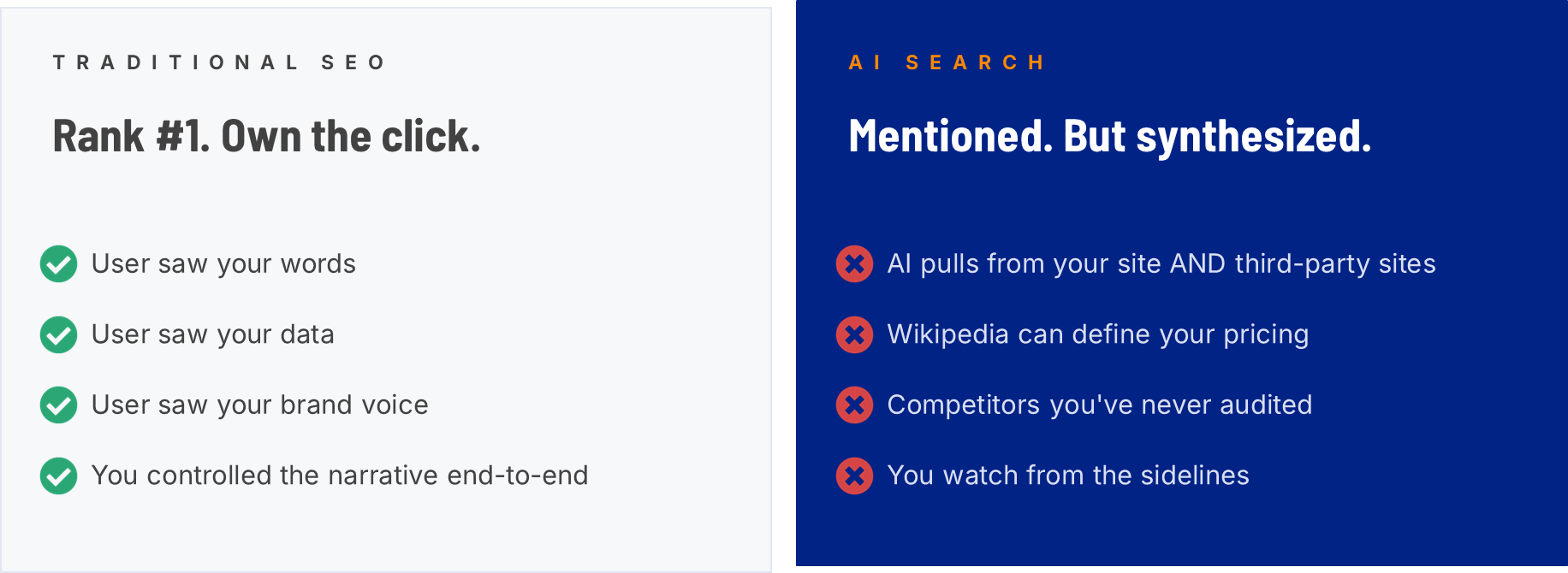
Tania: Think about how traditional SEO worked for 20 years. You created content, your site ranked, the user clicked, and they saw your words and your brand voice. That was the contract between you and Google.
Now, AI gives users one paragraph that blends everything together. You didn’t write it, you didn’t approve it, and if it's wrong, you’ve lost the sale before they ever visit your site. We are being cut out of the consideration phase.
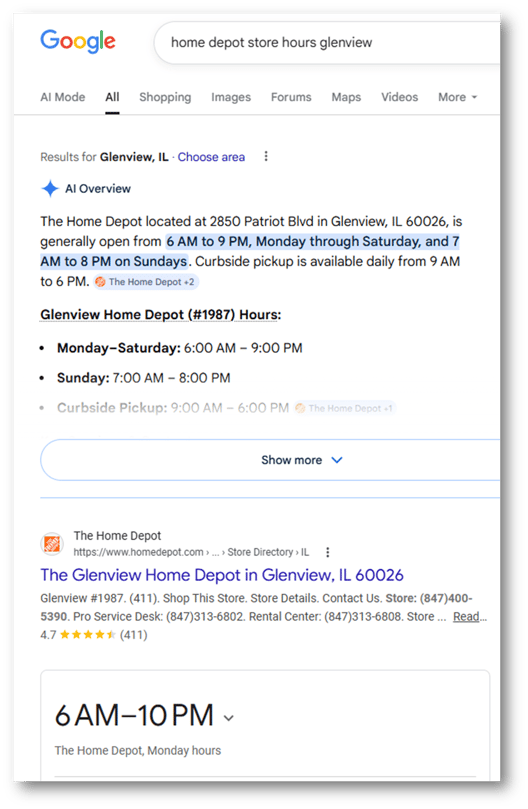
We’ve been running accuracy checks across thousands of prompts for eight months, and the results are shocking: 40% of AI responses contain an inaccuracy. This isn't just "how tall is Mt. Everest." These are brand-specific questions about pricing, store hours, and technical specs.
For example, we've seen AI Overviews give the wrong store hours for Home Depot or cite that a Gemini 3.5 model exists when it doesn’t.
Everyone has been saying that “AI visibility” is just about being mentioned. But the reality is that you can be visible in AI search and still lose. The real question we need to be asking when assessing our AI search success is three-part:
- Accuracy. Is the answer right? Does it match your Source of Truth — your pricing, your feature set, your current positioning?
- Brand Control. Is your brand the primary citation? Or is a competitor sitting right there in the AI answer, quietly defining who you are?
- Sentiment. How is your brand represented in the third-party sources that feed the models? Because that’s where the real narrative is being built, not on your own site.
A Repeatable AEO Workflow for the Strategic Architect
Chris: What I’m going to show you isn’t theoretical; it’s a system I’ve watched work in large enterprises over the last 12 months.
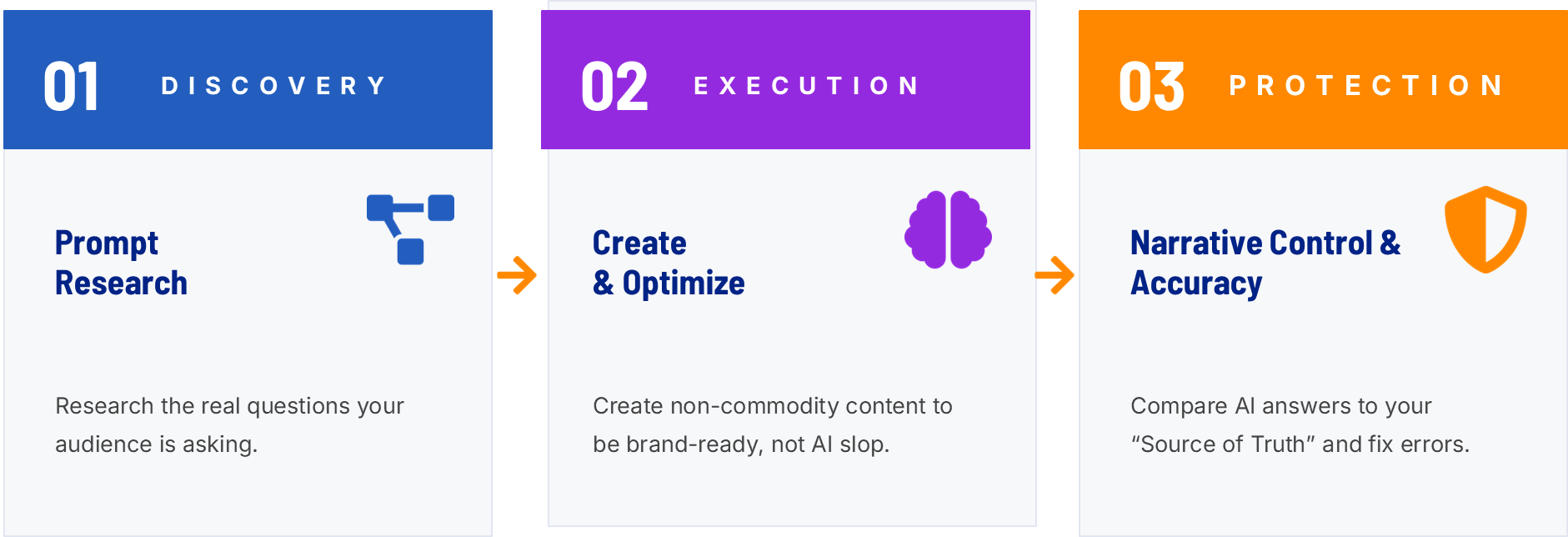
This workflow breaks down into just three simple steps: Research, Optimize, and Protect.
This isn't a one-time project or campaign. It’s a system that allows you to manage the evolution of search as we're seeing it now.
Here’s an overview of the playbook:
- Step one is discovery: Figuring out what prompts people are actually asking about your category.
- Step two is execution: Rewriting the content so it’s enterprise-grade and brand-alligned, not generic LLM output.
- Step three is protection: Closing the loop so the answers stay accurate over time, even when the models change under us.
Step 1: Discovery (Moving Beyond Keywords to Prompts)
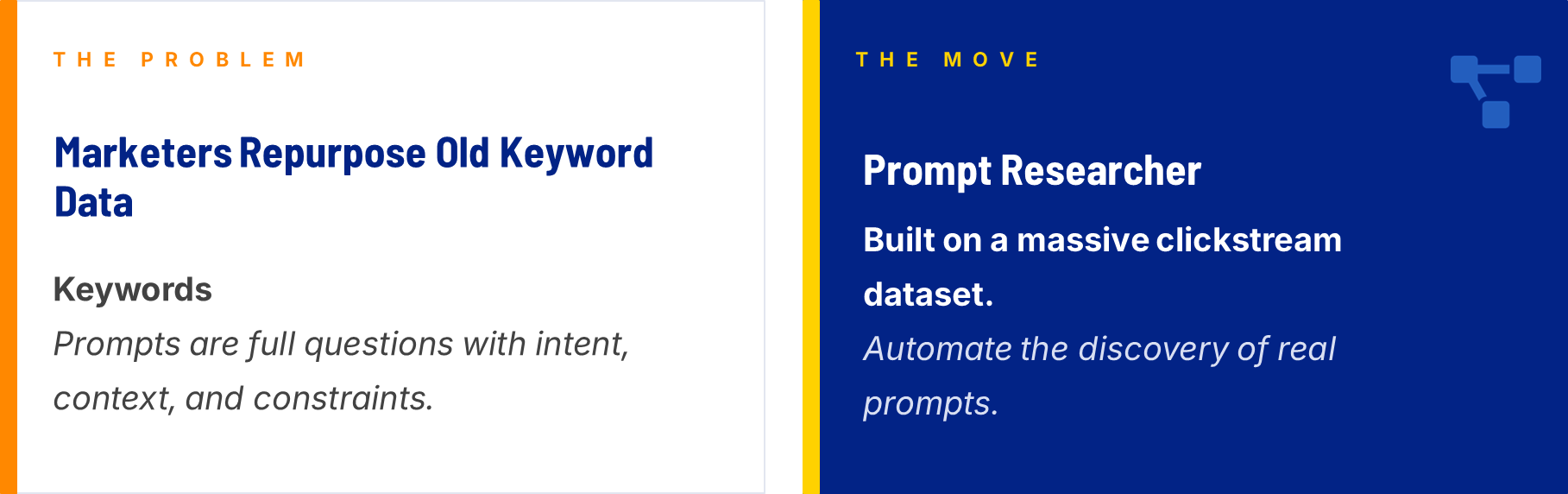
Chris: The first challenge enterprises face is the selection of prompts. Many teams try to repurpose old long-tail keywords. But people are pouring their hearts and souls into ChatGPT with long, complex questions.
You shouldn't be targeting "project management software"; you should be targeting "what is the best project management tool for a 10-person creative agency under $100?"
Our move here is using Clarity ArcAI’s Prompt Researcher. It’s built on a massive clickstream database so we aren’t guessing at what people are asking, we’re observing it at scale. It surfaces what I call "invisible presence.” These are the gaps where your competitors show up in the AI answer and you don’t. Those gaps are gold.
Step 2: Execution (Avoiding the 'AI Slop' Trap)
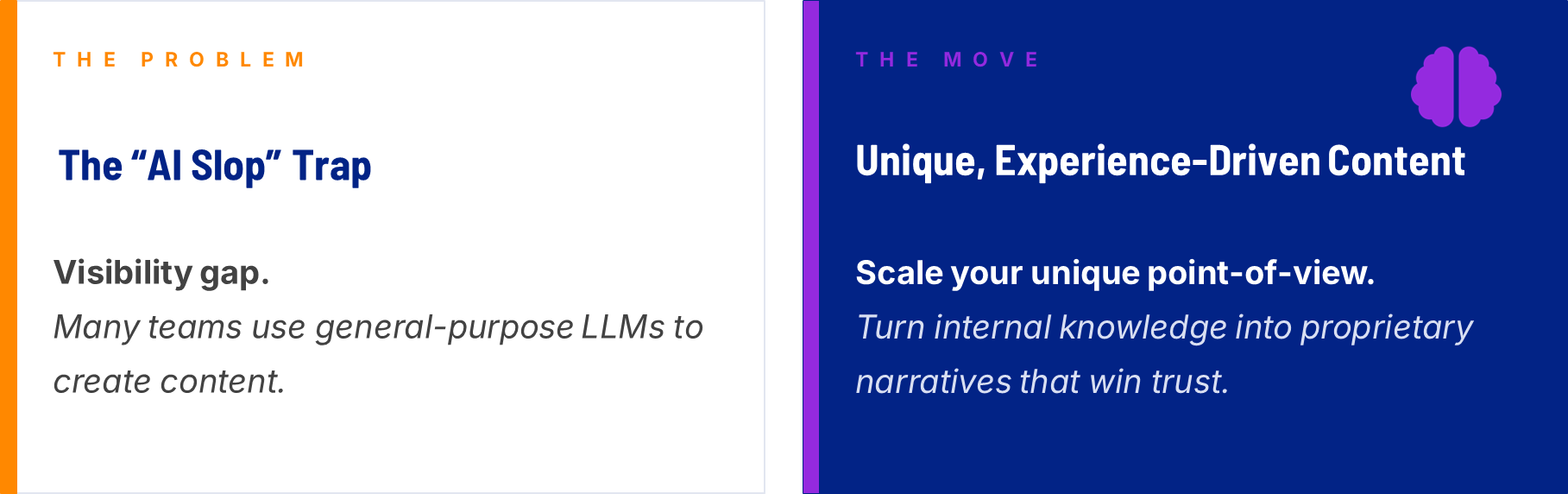
Chris: The second problem is the "AI Slop Trap." In a world of AI-generated noise, content is a commodity. If you let ChatGPT write a generic blog, a reader can sniff it out in half a sentence. It misses your brand’s soul.
You need to rewrite it in a way that the machines and competitors can’t mimic. SEOs have talked about E-E-A-T for a decade, but now it’s about injecting unique expertise. Don’t let your content feel generic or get stale.
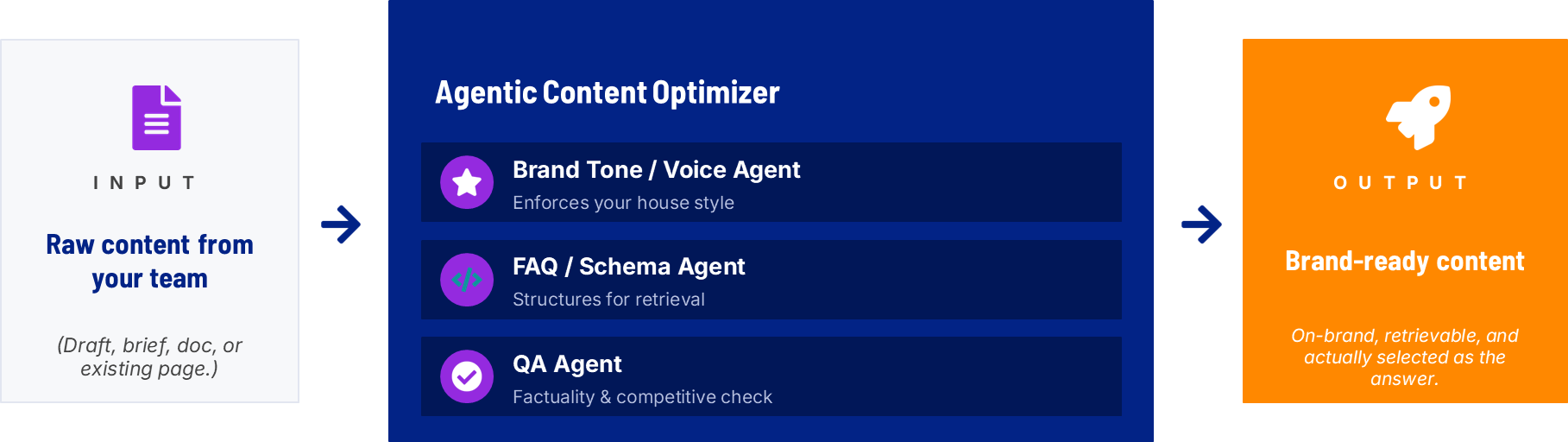
In ArcAI, we don’t just use one agent to help you write content. We have a pipeline of specialized agents:
- Brand Tone Agent: Enforces your house style.
- FAQ & Schema Agent: Structures content for retrieval.
- QA Agent: Checks factuality and competitive positioning.
This creates a brand-ready output that performs well for both human users and AI search engines.
Step 3: Protection—Closing the Loop on Accuracy
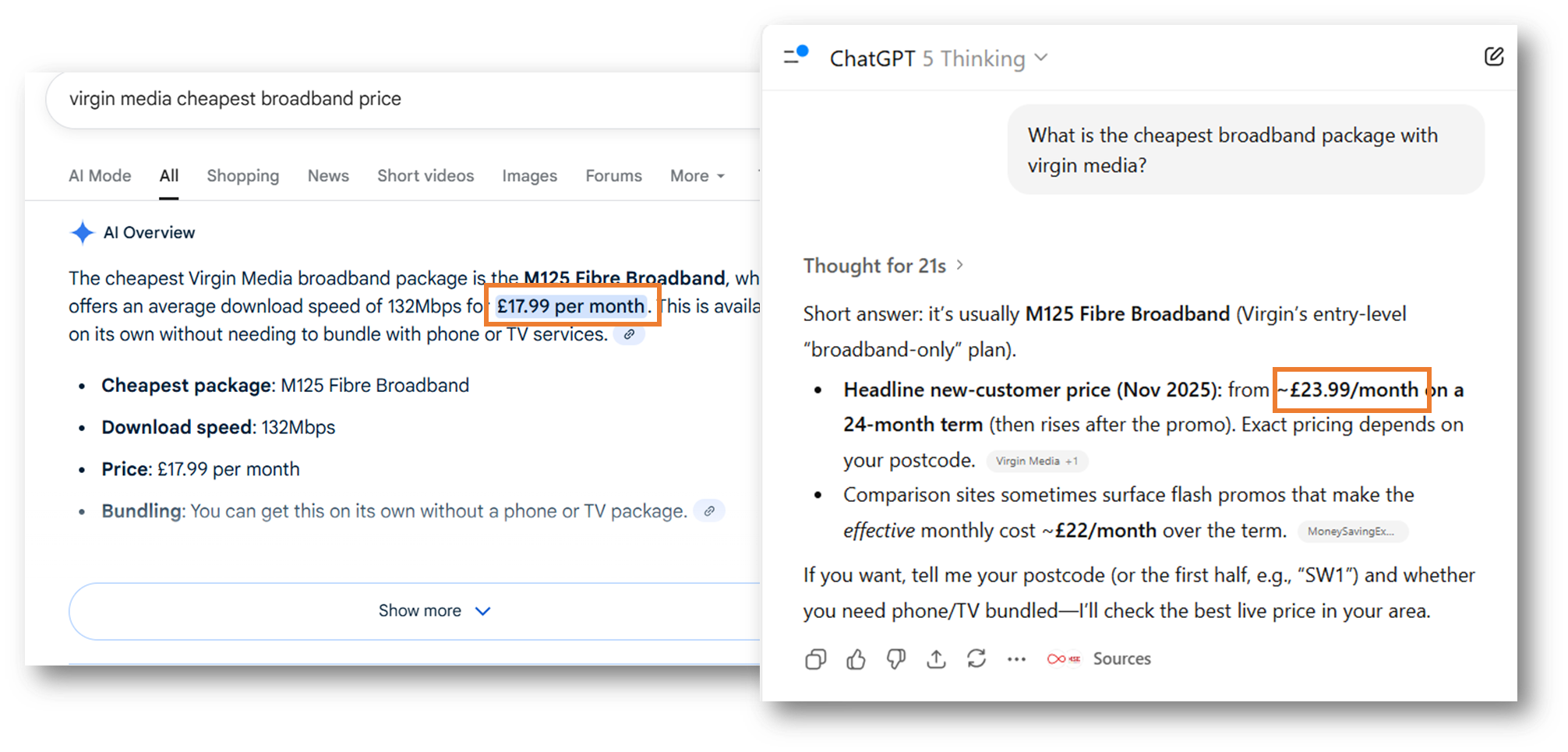
Chris: Visibility is worthless if the information is wrong. We saw an instance where Google’s AI Overview got a Virgin Media price right at £18, but ChatGPT cited £24 because it lifted the info from an outdated customer forum.
How do we fix inaccuracies in AI answers?
- Missing Information: Publish clear factual content so AI doesn’t have to guess.
- Wrong Tone: Update descriptions and headlines using words that better describe your brand.
- Incorrect Data: Use web tags and Schema to inform engines of the "official truth."
- Conflict of Sources: This is the hard part. You need to reach out to external sites or forums and ask them to correct information that AI is repeating.
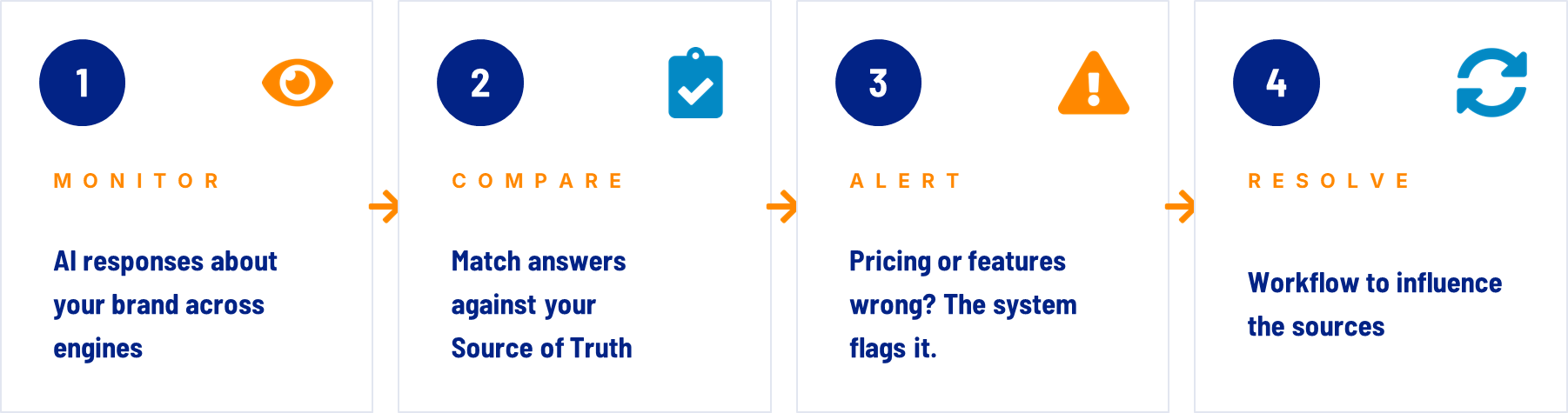
To find and fix inaccuracies at scale, Clarity ArcAI Accuracy monitors all AI responses across every major engine, compares them against your "Source of Truth" (your website), and flags any drift in real-time.
The Enterprise Edge: Scaling Your AEO Strategy
Chris: Adapting your AEO strategy for enterprise scale is where we separate the practitioners from the architects. This is where your CFO and the Board actually notice you.
Move One: Segment by Business Line. If you have a large site, you likely have multiple sub-brands and regions. Each has its own AI surface. If you only report on the main brand, you’re you’re averaging out a lot of pain (and you’re hiding it from leadership, even if you don’t mean to). By segmenting AI search performance by line of business, you can see exactly where a competitor is outperforming you in one LOB while you’re crushing them in another. Now you actually know where to put the work.
Move Two: Portability. We’ve built an MCP server so you can pipe real-time AI visibility data straight into your own internal AI tools or ChatGPT workspaces. 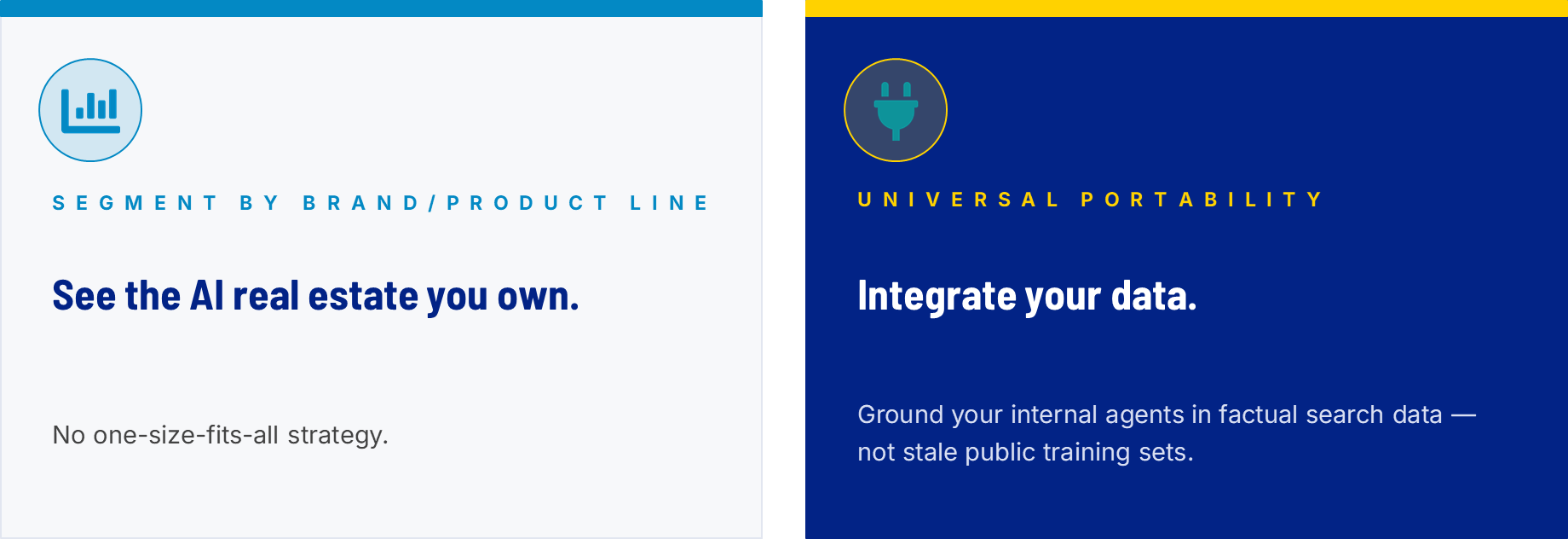
Finally, if there is one thing that you take back to your leadership, it is to stop reporting on visibility alone. Start reporting on Answer Certainty.
Your new boardroom metrics to measure this certainty are:
- 100% Source of Truth: Your brand should be the primary authority cited.
- Zero Invisible Presence Gaps: No prompts where competitors appear and you don't.
- Under 24-Hour Resolution: The time it takes to kick off a workflow once an AI search inaccuracy is detected.
Conclusion
The shift from traditional SEO to AI search means you no longer have total control over the first impression your customer receives.
To win in this new landscape, you must transition from a practitioner who manages keywords to an architect who manages Answer Certainty.
By implementing a system to discover complex prompts, eliminate "AI slop" through specialized agent pipelines, and protect your brand from accuracy drift, you ensure that your authority remains intact.
If you want to see how the ArcAI capabilities we discussed today work in a practical sense (and how you can use this data to drive your visibility within AI search) we’d love to show you.
Book a demo to explore the technology and start your transition to AI Architect.


.png)
Comments
Currently, there are no comments. Be the first to post one!