



AI search engines don’t only read what traditional search ranks. They send their own bots to crawl websites, and Cloudflare Radar data cited by seoClarity shows a noticeable increase in that activity.
Scrunch works on both sides of that shift. Like most AI visibility platforms, it reports how AI assistants describe your brand. Its Agent Pages layer adds something different: it serves those AI agents an optimized version of your pages while human visitors see the standard site. And in June 2026, Sitecore acquired the company.
That mix raises questions a monitoring-only evaluation wouldn’t. Who manages the edge configuration? Who approves what AI agents see? And what does Sitecore ownership mean if your site doesn’t run on Sitecore? This analysis works through those questions, along with Scrunch’s features, Brand and Agency pricing, and security documentation.
Editorial disclosure: seoClarity offers technology that may compete with Scrunch. We did not reach out to Scrunch directly for this article. This analysis is based on publicly available information, primarily Scrunch’s website and documentation, reviewed on September 29, 2026. Product details and pricing can change, so verify your requirements directly with Scrunch.
Key Takeaways
- Core plans are published, but narrow. Brand Core costs $250 per brand, per month, and Agency Core $500 a month (USD, checked September 29, 2026). Both cover four AI platforms and one country. The full platform list, unlimited countries, API access and SAML/OIDC single sign-on (SSO) sit on custom-priced Enterprise plans.
- Agent Pages goes beyond monitoring, and it’s Enterprise-only. It changes what AI agents receive from your site, so it brings your web and content teams into the evaluation.
- Usage is metered by responses, and refresh frequency isn’t published. That makes the real cost of a given tracking cadence hard to estimate from the pricing page alone.
- Security documentation is public. Scrunch says it has completed a SOC 2 Type II audit, and its Trust Center offers the report on request.
- Sitecore ownership leaves roadmap questions open, especially for sites that don’t run on Sitecore.
What Is Scrunch and How Does It Work?
Scrunch describes itself as “The AI Customer Experience Platform” and says it’s trusted by more than 500 brands and agencies. Its homepage groups the product into three areas:
- Monitoring: How your brand appears in AI answers, compared with competitors.
- Insights: Why AI engines cite what they cite, and what to change.
- Agent experience: How AI agents access and read your website.
The monitoring model will be familiar to anyone who has used an AI visibility tool. You set up prompts, the conversational questions buyers ask AI assistants. Then you add the competitors you want to benchmark and choose which AI platforms to track.
Scrunch adds personas to that model.
According to its features FAQ, you can create customer personas based on characteristics and geography, generate prompts from them, and then filter results by persona, funnel stage, topic, country and platform. Scrunch says it collects answers using “browser automation and official platform APIs.”
What Are Scrunch’s Core Capabilities?
Visibility, position and sentiment
Scrunch’s metrics guide defines its main measures:
- Brand Presence: The percentage of AI responses that mention your brand by name.
- Competitive Presence: The same measure, applied to each competitor.
- Position: Whether your brand appears in the top 25%, middle 50% or bottom 25% of the response text.
- Sentiment: Whether AI describes your brand as positive, mixed or negative.
The position method is worth understanding before you compare platforms. Scrunch measures where your brand appears in the answer text, not a numbered rank. So a “position” figure from Scrunch won’t be directly comparable with rank-based metrics from other tools.
Citations and source influence
Scrunch tracks how often your brand is cited as a source. It also reports citation share of voice: the share of responses citing a given source out of all responses that cite any source.
Its Influence Score combines how often a source is cited with how many distinct prompts cite it. For PR and content teams, that helps separate a source that shows up across many prompts from one that’s cited heavily for a single question.
Recommendations and workflow
Scrunch’s Insights area focuses on why AI engines cite what they cite and what to change, and Core plans include one page optimization a month. We couldn’t find public documentation on how recommendations are prioritized or whether they can be assigned in tools such as Jira.
AI search demand estimates
Scrunch’s Keyword Volume Estimator, launched in beta in July 2026, estimates how often US users ask AI assistants about a keyword each week. Scrunch says the figures are a “calibrated estimate” drawn from a panel of real consumer AI conversations and scaled to the US population. The estimator also reports demand and commercial-intent scores and a 20-week trend.
Treat these as directional, US-only estimates. We didn’t find the panel’s size in Scrunch’s published description, so test the figures against your own search data before you use them to prioritize prompts.
Agent traffic and AI referrals
Scrunch says it detects which AI platforms crawl your site, what they request and how often, using CDN and hosting integrations. It also says it can attribute human visits from AI platforms by connecting to GA4. The pricing page lists AI agent and bot traffic on all plans, with multi-domain tracking on Enterprise.
How Do Scrunch Agent Pages Work?
Agent Pages is Scrunch’s layer for serving an AI-optimized version of your website to AI agents while human visitors see the normal site.
Scrunch describes two ways to use it:
- Agent Pages on its own. Scrunch converts selected pages into JavaScript-free, prerendered HTML and applies technical fixes, such as removing clutter and adding missing structured data. The content itself doesn’t change.
- Agent Pages with Site Optimization. Scrunch also restructures and enriches page content, drawing on approved internal sources such as support docs, Notion, SharePoint and your digital asset management system. Scrunch says it provides new suggestions week over week.
You choose pages individually from a sitemap Scrunch builds by crawling your site. Scrunch’s launch post says updates are approved in Scrunch before they reach AI agents. Its earlier AXP documentation adds that, until content is approved, the layer passes your original page through unchanged.
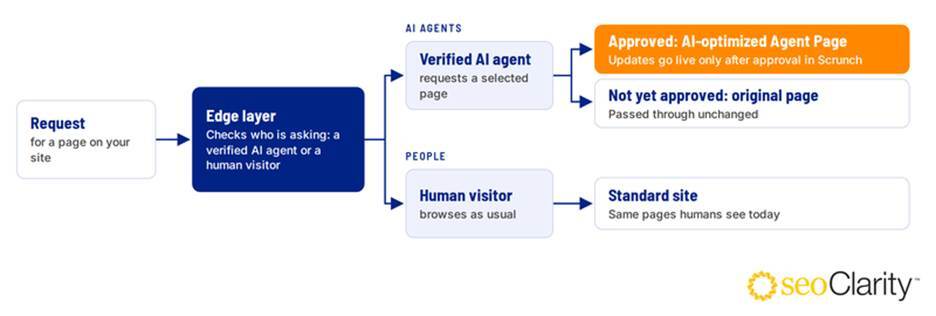
The pricing page lists Agent Pages (as AXP) on Enterprise plans only. Its July 2026 help documentation lists supported CDNs as Cloudflare, Akamai and AWS CloudFront, though that list predates the September relaunch.
An Agent Pages Readiness Checklist
Agent Pages sits between your website and AI agents, so it needs more owners than a monitoring tool does. Before you scope it, settle these questions inside your own team:
- Edge access: Who can approve configuration changes on your CDN?
- Page selection: Which templates and page types will you serve to agents first?
- Content approval: Who reviews AI-optimized versions before they go live, including brand, legal and product owners?
- Source governance: If you use Site Optimization, which internal sources may Scrunch draw on, and who keeps them current?
- Measurement: How will you separate the effect of Agent Pages from other changes to your content and site?
What Does Sitecore’s Acquisition Mean for Buyers?
Agent Pages technology also features in Sitecore’s plans for Scrunch. Sitecore announced its acquisition of Scrunch on June 3, 2026. The announcement describes plans to combine Scrunch’s agent experience technology with Sitecore’s digital experience platform. It also describes plans to automate Scrunch’s recommendations within SitecoreAI’s content management, marketing and digital asset management tools.
The announcement doesn’t say whether Scrunch will stay available as a standalone product for websites that don’t run on Sitecore. It also doesn’t say how pricing or the product roadmap might change.
That affects two groups of buyers differently. Sitecore customers may eventually get a tighter connection between AI visibility data and the tools where they publish content. For everyone else, the open roadmap makes price and access protections in the contract more important than usual.
How Is Scrunch Priced?
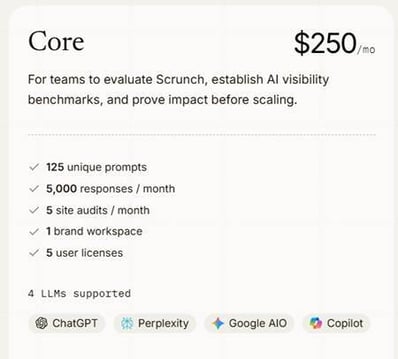
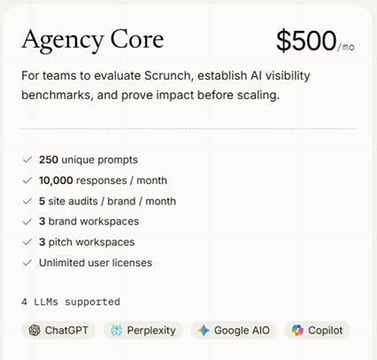
Scrunch publishes pricing for two tracks, Brand and Agency. Each track has a Core plan and an Enterprise plan. According to the pricing FAQs, pricing is charged per brand, per month, and each brand needs its own subscription. Standard plans support a single brand, and Scrunch directs multi-brand needs to Enterprise.
|
|
Brand |
Brand |
Agency |
Agency Enterprise |
|
Price |
$250 per brand/mo |
Custom |
$500/mo |
Custom |
|
Unique prompts |
125 |
Custom |
250 |
Custom |
|
Responses per month |
5,000 |
Custom |
10,000 |
Custom |
|
AI platforms |
4 |
9 |
4 |
9 |
|
Countries / languages |
1 / 1 |
Unlimited / custom |
1 / 1 |
Unlimited / custom |
|
Personas / competitors |
1 / 5 |
Custom |
1 / 5 |
Custom |
|
Site audits |
5/mo |
Full site audit(s) |
5 per brand/mo |
Full site audit(s) |
|
Page optimizations |
1/mo |
Custom |
1 per brand/mo |
Custom |
|
Workspaces |
1 brand |
Custom |
3 brand, 3 pitch |
Custom |
|
Users |
5 |
Custom |
Unlimited |
Custom |
|
Agent Pages (AXP) |
Not listed |
Listed |
Not listed |
Listed |
|
API access |
Not listed |
Listed |
“Partner Only” |
Listed |
|
SAML/OIDC SSO |
Not listed |
Listed |
Not listed |
Listed |
|
Support |
Email, self-serve onboarding |
Email and Slack, dedicated account team |
Email, about 30 minutes of training |
Email and Slack, dedicated account team |
Source: scrunch.com/pricing, checked September 29, 2026. Prices in USD.
A few pricing mechanics are worth knowing:
- Annual billing: Scrunch says annual discounts, equivalent to two months free, apply to Enterprise agreements paid upfront.
- Extra users: Additional seats cost $25 a month each, or $75 a month for five.
- Overages: Scrunch says you won’t lose access if you exceed plan limits, and that its team will suggest a better-fitting plan if usage stays high.
- Free trial: A seven-day trial is available, and Scrunch’s trial FAQ says it requires a credit card.
Platform coverage by plan
Core plans list ChatGPT, Perplexity, Google AI Overviews and Microsoft Copilot. Enterprise plans add Claude, Gemini, Meta AI, Google AI Mode and Grok. Scrunch’s platforms FAQ still lists eight platforms, with Grok “coming soon,” so the two pages don’t fully agree.
What the response allowance means in practice
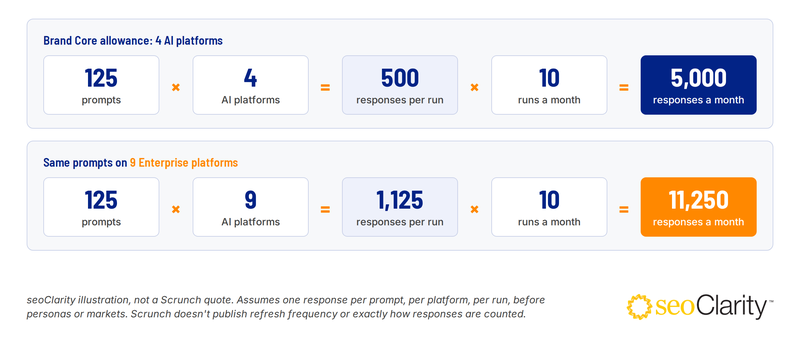
Scrunch meters Core plans by prompts and by responses collected each month. Here’s what the Brand Core allowance supports. This is our illustration, not a Scrunch quote.
- 125 prompts × 4 AI platforms = 500 responses for one full run of every prompt
- 5,000 responses a month ÷ 500 = about 10 full runs a month
The Agency Core plan works out the same way: 250 prompts × 4 platforms = 1,000 responses per run, and 10,000 a month covers about 10 runs.
Moving the same 125 prompts to nine Enterprise platforms raises each run to 1,125 responses. At 10 runs a month, that’s about 11,250 responses, before you add personas or markets. This assumes one response per prompt, per platform, per run. Scrunch doesn’t publish how often prompts refresh or exactly how responses are counted, so treat this as a sizing aid, not a schedule.
What drives enterprise cost
Put together, enterprise cost scales with the number of brands you track, the platforms, markets and personas each one covers, and how often prompts refresh. Add internal time for prompt governance, content approval and reporting, especially if you deploy Agent Pages.
What Should Enterprise Teams Evaluate Beyond Features?
Data access and integrations
The pricing page lists Looker Studio, Query API and Advanced API access on Enterprise plans. Agency Core includes Looker Studio and MCP access, and it lists Query API access as “Partner Only.” Scrunch’s developer documentation describes Query, Responses, Agent Traffic and Configuration APIs.
Scrunch’s MCP server lets you query your Scrunch data inside AI assistants such as Claude, ChatGPT and Microsoft Copilot. Its MCP documentation says it works with “a Scrunch account (any plan).” The pricing page doesn’t list MCP on Brand Core, so the two sources disagree for that plan.
Identity, access and security
Scrunch’s security FAQ says Scrunch “has successfully completed a SOC 2 Type II audit conducted by an independent third-party auditor,” and that it’s GDPR and CCPA compliant. Its Trust Center offers the SOC 2 Type 2 report on request and lists Google Cloud Platform, Clerk and Neon as US-based subprocessors.
On the access side, Scrunch lists:
- SSO: SAML and OIDC single sign-on on Enterprise, with just-in-time provisioning and domain enforcement (Google sign-in is available on all plans).
- Roles: Role-based access with Admin, Editor, Viewer and Guest roles, plus per-brand permissions.
- Audit logs: Logs of user actions.
Onboarding and support
Support ranges from email and self-serve onboarding on Brand Core to Slack support, strategy calls, a dedicated account team and executive reporting on Enterprise.
Scrunch says many customers, “including large enterprises,” start collecting data within a day. That refers to monitoring.
Agent Pages needs the additional setup described above.
Historical data
Scrunch’s public materials didn’t state a data retention period or explain how prompt history is handled when prompts change. Because monitoring data generally starts when prompts are set up, retention and export terms decide how much history you keep if you later change tools.
What Do Customer Reviews Say About Scrunch?
When checked on September 29, 2026, Scrunch held a 4.6 out of 5 rating from 73 reviews on G2.
That’s a moderate sample for an enterprise decision. G2 lets you filter reviews by company size, so read reviews from organizations like yours before you draw conclusions about enterprise-scale use.
Where Scrunch May Fit and What to Verify
Based on the public evidence, Scrunch may suit:
- Sitecore customers who want AI visibility data connected to the tools where they manage content
- Teams that want to act on the website itself, and have the CDN access and approval workflows that Agent Pages needs
- Agencies that manage several client brands and want pitch workspaces and unlimited users on the entry plan
Scrunch publishes its plan limits, security documentation and developer docs, which gives buyers a lot to work with before a first call.
Fit is harder to confirm when a program needs the Enterprise-only coverage and controls described above, or when your site doesn’t run on Sitecore. In those cases, the evaluation usually turns on three areas, and the questions below are grouped around them: plan coverage, Agent Pages, and Sitecore and commercial terms.
Questions to Ask During a Scrunch Demonstration
Plan and coverage
- Which AI platforms are included in our proposed plan, and which require Enterprise?
- How often are prompts refreshed, and how are responses counted against our allowance?
- How many brands, countries, languages and personas does our proposed agreement cover?
- Which CDNs are supported today, and what changes does our web team need to make?
- Is Site Optimization included, or priced separately?
- What approval workflow controls what AI agents receive, and can we roll changes back?
- Which plans include API and MCP access, and what rate limits apply?
- How are recommendations prioritized, and can they be assigned through tools such as Jira?
- How long is historical data retained, and can we export all of it if we leave?
- Can we review the current SOC 2 Type II report and the full subprocessor list?
- How are users provisioned and deprovisioned under SSO, and is SCIM supported?
Sitecore and commercial terms
- What is the product and pricing roadmap for customers who don’t use Sitecore?
- What will our configuration cost annually, and what protections apply at renewal?
How seoClarity ArcAI Approaches Enterprise AI Visibility
Because seoClarity publishes this analysis and may compete with Scrunch, it’s useful to explain how ArcAI addresses the criteria discussed above.
Coverage and prompt strategy. Clarity ArcAI makes all supported AI engines available across its plans. ArcAI prompt research is grounded in real search demand and maps prompts to buyer-journey stages, from awareness through retention. ArcAI can track prompts daily, weekly or monthly, with weekly as the default.
Recommendations and workflow. ArcAI turns visibility data into prioritized recommendations that teams can assign through built-in task management or Jira.
Brand risk. ArcAI tracks how AI answers describe your brand. It also checks AI-stated facts against your own trusted content, to flag inaccurate or outdated information. ArcAI Accuracy is available as an add-on.
Support. seoClarity subscriptions include a Client Success team at no extra cost, covering a client success manager, onboarding and training, and technical support through live chat, email and phone.
Data access and pricing. ArcAI’s API and MCP server are available in all paid subscriptions. ArcAI pricing is custom. Usage is measured by prompts, where each prompt tracked on one AI engine in one location counts as one.
We’d encourage you to ask seoClarity the same 13 questions above.

Comments
Currently, there are no comments. Be the first to post one!