



Every marketing team is asking the same question right now: “How do we get our brand cited by AI Search Engines?”
Most of the answers are vague. Build authority. Create better content. Earn trust. All true, but none of it tells you what practical steps to actually take.
The answer is simpler than most people think: it starts with ranking.
Before an AI search engine can cite your content, it has to find it. And the content it retrieves is often the same content that already performs well in traditional search. That's why retrievability is the "new" ranking signal; it determines how easily AI systems can discover and cite your pages.
Below is the simple workflow we use to increase citations for our content in AI search. We call it Rank-to-Get-Cited.
Key Takeaways:
- Retrievability is the new ranking signal because AI search engines often pull directly from traditional top-10 organic results to generate their live retrieval-augmented generation (RAG) citations.
- Winning AI citations requires your team to direct foundational SEO best practices toward closing competitive visibility gaps.
- Mapping competitor AI citations to organic ranking keywords gives your editorial team a precise blueprint for content optimization.
- To scale your AI search strategy, use seoClarity’s advanced APIs to automatically turn massive amounts of citation data into clear, execution-ready content plans.
Table of Contents:
- How Do You Get Your Brand Cited In AI Search? 5-Step Workflow
- How Do You Turn SEO Ranking Data Into an AEO Content Production Plan?
- Why a Data-Driven Retrievability Framework Beats Traditional AI Content Advice
- How to Automate Your AI Citation Workflows at Scale Using seoClarity’s APIs
Why Is Ranking the Key to Getting Cited In AI Search?
It helps to know that answers from AI Search Engines come in two forms:
- Answers from memory. The engine answers from what it already “knows.” Winning here is slow. It’s about becoming well-known across the web over time.
- Answers from search. The engine runs a live search, reads the top pages, and writes a prompt response with links to its sources. This is how AI search engines like AI Overviews, Perplexity, and ChatGPT search back up most of what they say.
The second type is the one you can win right now, and it’s refreshingly simple. If your page is near the top of the SERP for the prompt’s main topic, it’s a candidate to be cited as a source. If it isn’t ranking, the engine may never see it.
So you don’t have to guess what “authoritative content” means to an AI search engine. You just have to know which searches make a page findable, and then rank for them. That’s work your team already does.
How Do You Get Your Brand Cited In AI Search? 5-Step Workflow
The good news is that retrievability is built on the SEO fundamentals your team already knows.
Here are the five steps to go from “how do we show up in AI?” to a clear list of pages to build and improve.
Step 1. Find the Prompts Where a Competitor Is Cited, But You’re Not
Start where you’re losing. Look at the prompt responses where a competitor’s page is cited as a source, and your brand is nowhere to be seen.
Here’s an example of how you can view this in the Competitive Opportunities tab in ArcAI Visibility.
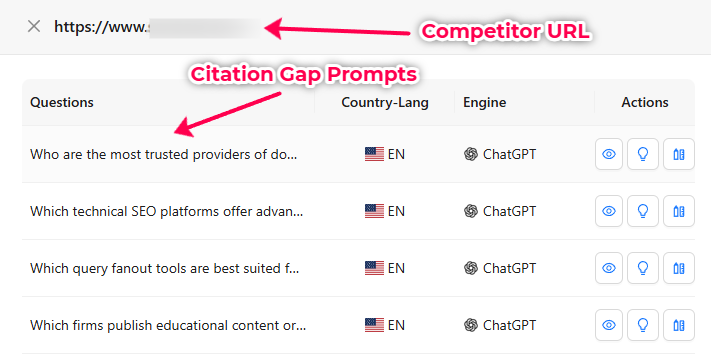
To keep this data highly actionable, apply two quick validation checks:
- Does it keep happening? Focus on sources that show up again and again, not a one-time citation that disappears next week.
- Are you already mentioned on the cited page? If your brand is already mentioned within that competitor's cited source page, it isn't an outright visibility gap. Skip it for now.
What’s left is a clean list of the source URLs that are beating you across the AI search engines.
Step 2. See What Those Source Pages Rank For
Take each of those competitor source URLs and ask a simple question: what searches does this page rank for in Google?
Pull the list, along with how many people search for each term and how hard it is to rank for. Do the same for your own site so you know where you already stand.
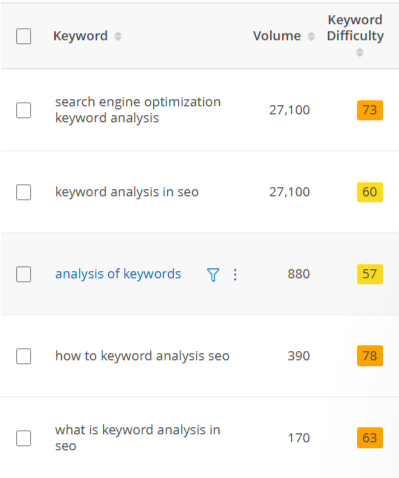
View of the keywords ranking for a competitor’s URL in seoClarity’s Research Grid.
This is where a fuzzy problem turns into a plain list you can act on.
Step 3. Cross Off What You Already Win
Not every term is worth chasing. The rule is simple: A term only matters if a competitor source ranks for it and you don’t rank in the top 10.
- Already in the top 10? You’re in a strong position where the AI engine can already find you. Leave it alone.
- Stuck on page 2 or lower? You’re close. A push into the top 10 makes you findable.
- Not ranking at all? You have found a true content gap. You need to build a dedicated content asset for this specific topic.
Step 4. Keep Only the Terms that Fit Your Business
This is where most keyword lists go wrong. Left unfiltered, they fill up with loosely related terms that send your team chasing traffic that never turns into customers.
So keep only the queries that cleanly align with your core product or service categories, and move the off-topic phrases to a secondary backlog. The result is a focused, high-intent list you can hand to a writer without a second round of cleanup.
Step 5. Group Target Keywords Into a Defined Editorial Page Plan
A raw list of keywords is just homework for a busy content team. The final stage of this workflow turns the data into an actionable plan. Group your filtered terms by semantic topic, and make one of two strategic production decisions for each cluster:
- Improve a page you already have: if you already rank for the topic, expand that page to cover the missing terms. No new page needed.
- Create a new page: if you don’t have any existing content assets that relate to the topic, build one: a comparison page, a “best of” guide, a simple FAQ, and so on.
Prioritize the terms with the highest monthly search volume and clearly note the competitor source URL whose visibility you are actively targeting, so the goal is clear.
How Do You Turn SEO Ranking Data Into an AEO Content Production Plan?
Following the execution of the five-step workflow, your content production and optimization engine shifts from dealing with abstract concepts to executing against a scannable, structured to-do list.
The framework converts ambiguous data points into a clear operational matrix. Here’s an example:
|
Search Term |
Monthly Search Volume |
Keyword Difficulty |
Where You Stand |
Competitor Source Beating You |
What to Do |
|
enterprise headless ecommerce |
1,200 |
Medium |
Not Ranking |
Create new deep-dive architectural guide |
|
|
b2b ecommerce platform cost |
450 |
High |
Position #14 |
Optimize current pricing page to secure Top 10 |
|
|
retail order management features |
850 |
Low |
Position #22 |
Optimize existing product feature matrix page |
A big, ambiguous question becomes a simple to-do list: rank for these terms by building this page or improving that one, and take the spot that your competitor holds today.
Why a Data-Driven Retrievability Framework Beats Traditional AI Content Advice
The teams winning in AI search aren’t guessing. They’re working backwards from the answers. This Rank-to-Get-Cited framework works better than traditional AI visibility recommendations for the following reasons:
- It’s specific. “Create better content for AI search” becomes “rank for these terms, with this page, to take that competitor’s spot.”
- It uses skills you already have. No new team, no new tools to learn from scratch. You’re pointing your normal SEO work at a new payoff.
- It’s based on data, not opinion. Real search numbers decide what comes first, not a guess about what AI “likes.”
How to Automate Your AI Citation Workflows at Scale Using seoClarity’s APIs
Doing this by hand for a few prompts is easy enough. Doing it across your whole site for every prompt response, every competitor source, every keyword, and manually updating your data as things change week-to-week is not something you want to do in a spreadsheet.
To streamline the process, seoClarity’s AI Search Visibility API (ArcAI) and ResearchGrid API do the heavy lifting for you. They show you where AI Search Engines cite your competitors instead of you, pull the real search data behind those sources, and hand your team the plan to close those citation gaps automatically.
Recommended Reading: Scraping vs. API: Best Method to Track AI Search Visibility
1. Use ArcAI API to Find the Citations Where You Have a Competitive Gap
Point the ArcAI API at your prompts. For each prompt, it returns the prompt responses across the AI Search Engines you track, along with the citations and sources behind each answer.
From there, filter down to your citation gaps: the prompts where a competitor is cited as a source and your brand isn’t.
Keep the sources that show up consistently, and set aside any that already mention your brand. The output is a clean list of competitor source URLs containing the exact pages winning the citations you want.
2. Use ResearchGrid API to Find the Keywords Those Source URLs Rank For
Now take that programmatically generated list of competitor source URLs and feed it into the seoClarity ResearchGrid API. For each URL, it returns the keywords that page ranks for in Google with real search volume and difficulty.
For every target URL provided, the API instantly returns the exact organic keywords that the page ranks for on Google, complete with real-time search volume metrics and keyword difficulty scores.
That’s the whole bridge: ArcAI tells you which pages are being cited instead of you, and ResearchGrid tells you which keywords made those pages findable. Compare them against your own rankings, keep the on-topic gaps, and you have your Rank-to-Get-Cited list built straight from the APIs.
Conclusion:
Getting cited in AI search responses largely relies on the core SEO fundamentals your team already executes every single day. By pivoting your traditional organic footprint to focus directly on retrievability, you ensure that your assets are easily discovered, read, and cited by AI crawlers.
Let’s review the core workflow to scale your visibility:
- Locate Citation Gaps: Identify the distinct informational prompts where your competitors win AI citations, and your brand is missing.
- Reverse-Engineer the SERP: Extract the traditional organic target keywords that make those competitor source pages easily findable.
- Build an Actionable Page Plan: Filter out low-intent terms and execute a data-driven content plan to optimize existing pages or produce fresh, comprehensive assets.
- Automate at Scale: Use the ArcAI and ResearchGrid APIs to programmatically monitor and close optimization gaps across your entire site.
The marketing teams currently dominating the AI search landscape are not guessing what machine learning algorithms prefer. They are simply working backward from real search data.

.png)

Comments
Currently, there are no comments. Be the first to post one!