



AthenaHQ tracks how AI search engines such as ChatGPT, Perplexity, Gemini, and Google AI Mode describe your brand, and offers agents and recommendations to help improve those answers. Unusually for this category, it publishes a self-serve price, and every plan is metered in credits, where one AI response uses one credit.
That makes the real cost a function of how many prompts, models and markets you track. It also means most of the controls large organizations need, from multi-country tracking to SAML single sign-on (SSO), sit on a custom Enterprise plan.
Below, we estimate how far the Starter plan's credits stretch, set out what AthenaHQ’s fact-checking needs before it runs, explain what its MCP server can change in your account, and close with 13 questions for a demonstration.
Editorial disclosure: seoClarity offers technology that may compete with AthenaHQ. We did not test AthenaHQ directly for this article. This analysis is based on publicly available information, primarily AthenaHQ’s website and documentation, reviewed on October 26 and 27, 2026. Product details and pricing can change, so verify your requirements directly with AthenaHQ.
Key Takeaways:
- Starter costs $295 a month, or $245 a month billed annually, with 3,600 credits. Enterprise pricing is custom.
- One credit equals one AI response, so the number of models, run days, and markets you track drives cost.
- Most enterprise controls are on the Enterprise plan, including multi-country tracking, persona targeting, SAML SSO, and audit logs.
- Fact-checking needs setup. AthenaHQ’s Oracle feature compares AI answers with a Knowledge Base of at least 25 verified facts.
- The MCP server can write as well as read, so plan who gets access before you connect AI tools to your account.
Table of Contents:
- What Is AthenaHQ?
- What Does AthenaHQ Track in AI Search?
- How Does AthenaHQ Help Teams Act on Visibility Data?
- How Is AthenaHQ Priced?
- What Should Enterprise Teams Evaluate Beyond Features?
- What Do Customer Reviews Say About AthenaHQ?
- Questions to Ask During an AthenaHQ Demonstration
- How seoClarity ArcAI Approaches Enterprise AI Visibility
What Is AthenaHQ?
AthenaHQ is a platform that supports Answer Engine Optimization (AEO) and Generative Engine Optimization (GEO). Both build on traditional SEO rather than replacing it. AthenaHQ’s pricing page groups its features into three areas:
- Monitoring: visibility, sentiment, competitor and citation tracking across AI models.
- Action: content agents, on-page and off-page recommendations, outreach tools, and crawler access controls through robots.txt and llms.txt.
- Organization: seats, roles, SSO, audit logs and support.
The documentation also covers a Knowledge Base, an Oracle fact-checking feature, Site Health audits, and Shopping Insights. AthenaHQ’s changelog showed frequent releases in October 2026.
What Does AthenaHQ Track in AI Search?
AI Models Covered by Plan
The pricing page lists five models on the free Essential plan: ChatGPT, Perplexity, Google AI Overviews, Gemini and Copilot. Starter lists 11: those five plus Google AI Mode, Claude, Grok, DeepSeek, Meta AI and Mistral. AthenaHQ says more models are “available upon request.”
Other AthenaHQ pages name different sets of models, so the pricing page is the most reliable plan-level reference. We couldn’t confirm how AthenaHQ collects responses, such as through model APIs or consumer interfaces, in the public materials reviewed. That can affect how closely tracked answers match what your customers see.
Prompts, Schedules and Demand Estimates
AthenaHQ’s setup guide suggests starting with 50 to 100 prompts, imported from a CSV file or generated by its Discover feature. It names a connected Google Search Console account as the most useful input.
Prompts run on weekly or monthly schedules. Weekly schedules run on the days you select and can repeat every one to four weeks; monthly schedules run on one or more chosen days. You can also run prompts once on demand. The app shows an estimated credit cost before you save a schedule. On Enterprise, you can create several schedules and filter them by topic, tag, prompt type, or country.
Both paid plans include numerical prompt volume estimates. AthenaHQ attributes these to its Query Volume Estimation Model, which it says draws on public, partner, and proprietary data. It hasn’t published the method, so treat the estimates as directional and check them against your own search data.
Visibility, Sentiment and Value Metrics
AthenaHQ’s API and MCP tools return share of voice, mention rate, citation rate, position, and brand attribute metrics. Each brand mention gets a sentiment label of positive, neutral, negative, or “not analyzed.” Response views also show the searches a model ran while preparing its answer, which helps explain why a source was cited.
AthenaHQ also reports AI Search Value, which it says is “grounded in real Google keyword economics” and shows as a range. The share of voice used in this metric is weighted by position and excludes branded topics, so it won’t necessarily match the standard share-of-voice figure. The formula isn’t published.
For retailers, Shopping Insights tracks product visibility, position, prices, and retailers in AI shopping answers, such as those in ChatGPT, AI Mode, and Gemini. The documentation doesn’t say which plans include it.
Fact-Checking With Knowledge Base and Oracle
The Knowledge Base stores verified facts about your brand, grouped into topic “pillars” and linked to their sources. Facts can come from AthenaHQ’s research on your site, URLs and documents you supply, and AI responses. Claims it can’t verify wait in a review queue.
Oracle checks your latest AI responses against those facts. It flags confirmed inaccuracies, possible Knowledge Base issues, and conflicts between models. Before you can run it, you’ll need:
- Oracle access on your plan
- At least 25 verified facts in the Knowledge Base
- A completed prompt run
- Website admin access
The Knowledge Base is plan-gated, and the pricing page lists it with Oracle on the Enterprise plan. Acknowledging an Oracle finding records it but doesn’t change what AI models say. Correcting the inaccuracy happens through content and outreach, which AthenaHQ’s action tools are designed to support.
How Does AthenaHQ Help Teams Act on Visibility Data?
Both paid plans include a base content optimization agent, on-page and off-page recommendations, citation intelligence, and brand-voice enforcement. Enterprise adds the Athena Recommendation Engine, an advanced content agent, and the Athena Citation Engine (ACE). AthenaHQ describes ACE as “autonomous agents that create and optimize content to win AI citations.” Outreach tools find authors and draft pitch messages for off-site work.
Content can be published through integrations with WordPress, Webflow, Shopify, Wix, Framer, Contentful, Sanity, and Payload. GA4 and Search Console integrations bring site traffic and search data into the platform.
Site Health audits your tracked pages weekly and tracks each issue until a later audit verifies the fix. It doesn’t push changes to your site. It produces fixes and developer tickets for your team to apply, so plan for web-team time.
How Is AthenaHQ Priced?
AthenaHQ bills in credits. Its pricing page states that “1 credit = 1 AI response.” Its MCP documentation notes that some other actions also use credits, including approving content briefs, backfilling competitor data, and running outreach tools.
| Essential | Starter | Enterprise | |
|---|---|---|---|
| Price | Free | $295/month, or $245/month billed annually | Custom |
| Monthly credits | 300 | 3,600 | Negotiated |
| AI models listed | 5 | 11, more on request | Not itemized on the pricing page |
| Countries | Not stated | One | Multiple, with multiple languages |
| API access | Not listed | Paid add-on | Included |
| Extra credits | Not listed | Paid add-on | In contract |
| Sign-in | Not listed | Google and Microsoft OAuth | Adds SAML SSO |
| Seats | Unlimited users | Unlimited, with roles | Unlimited, with roles |
Source: AthenaHQ pricing page, checked October 26 and 27, 2026. Add-on prices aren’t published.
Starter covers sentiment tracking, unlimited competitors and topics, and GA4, Search Console, Shopify and Webflow integrations. Unlimited seats on every plan mean adding users doesn’t change the price. The comparison table reserves several features for Enterprise: persona targeting, configurable dashboards, BI support for Tableau, Power BI and Looker, audit logs, a dedicated Slack channel, a two-hour SLA and white-glove setup.
For most large organizations, that makes Enterprise the realistic plan. Treat the Starter price as a reference point, not a budget estimate.
How Far Do 3,600 Credits Go?
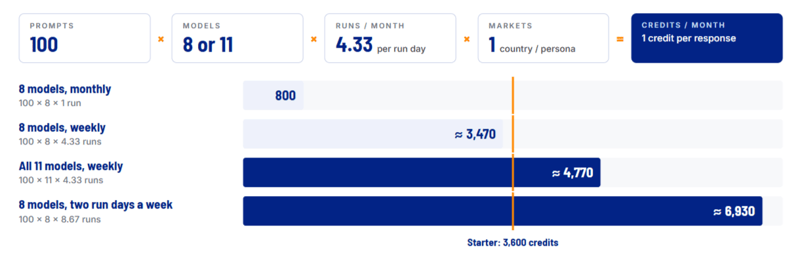
This is our illustration, not an AthenaHQ quote. It assumes one credit for each response, one response per prompt per model per run, and a weekly schedule set to one day a week, which averages about 4.33 runs a month (52 weeks ÷ 12).
- 100 prompts on 8 of the 11 Starter models, weekly: 100 × 8 × 4.33 ≈ 3,470 credits a month. That’s close to Starter’s 3,600, with little left for discovery or content work.
- The same prompts on all 11 models, weekly: ≈ 4,770 credits, which is more than Starter includes.
- 100 prompts on 8 models, monthly: 800 credits.
Selecting more than one run day a week multiplies these totals. On Enterprise, each added country or persona is likely to do the same.
Several third-party reviews still quote “Lite” and “Growth” plans that no longer appear on AthenaHQ’s pricing page, and AthenaHQ’s own pages also mention Growth, Scale, and Agency plans. Older price comparisons may not reflect current packaging.
What Should Enterprise Teams Evaluate Beyond Features?
Data Access and MCP Governance
The REST API uses API keys that can be limited to specific websites. On Starter, API access is a paid add-on. AthenaHQ’s MCP server connects to Claude, ChatGPT, Optimizely Opal and other MCP clients. Model Context Protocol (MCP) is the open standard that lets AI assistants connect to outside tools and data.
Besides reading data, the MCP server’s tools can create and publish content, change prompts, and add or delete Knowledge Base facts. Signed-in users can write only where their role allows, and deleting brand knowledge is limited to admins. API keys, however, act with admin privileges within their scope, and AthenaHQ says authorized calls execute immediately unless your AI client asks for approval. AthenaHQ also says every write is validated and audit-logged. Decide which people and keys can write before you connect AI assistants.
Identity, Security and Data Handling
AthenaHQ’s SSO documentation says SAML 2.0 and OIDC single sign-on are “available on AthenaHQ Enterprise plans.” Setup goes through AthenaHQ’s support team. SCIM handles user provisioning, though the documentation says group provisioning isn’t implemented.
AthenaHQ’s Trust Center lists GDPR and SOC 2 Type 1 and Type 2, along with a 2025 SOC 2 Type 2 report and an October 2026 bridge letter, both available on request. Its Enterprise page gives different SOC 2 dates. The listed subprocessors include Vercel, Google Cloud, and AWS for hosting and AI model inference, all with US or global locations, which is worth reviewing with your privacy team.
Crawler Allowlisting
AthenaHQ reads your public pages with its own crawler. It doesn’t publish fixed IP addresses, so firewall rules must match its user agent, AthenaHQ-Bot. If that bot is blocked, the crawler retries once with a standard browser user agent. Tell your security team before onboarding.
What Do Customer Reviews Say About AthenaHQ?
AthenaHQ holds a 4.9 out of 5 rating from 39 reviews on G2, checked October 26, 2026. The rating is strong, although the small sample makes it hard to draw broad conclusions, and we couldn’t confirm how many reviewers work at enterprise companies. Ask AthenaHQ for references from organizations of your size and industry.
Questions to Ask During an AthenaHQ Demonstration
Plans and Credits
- Which plan are we quoted on, and how many credits does it include?
- Can you model monthly credit use for our prompts, models, run days, countries, and personas?
- What do extra credits and API access cost?
Models and Data Collection
- Which AI models does our plan include?
- How are responses collected, and how often are model versions updated?
- How is prompt volume estimated?
Fact-Checking and Measurement
- Which plans include the Knowledge Base, Oracle, and Shopping Insights, and do Oracle scans use credits?
- How are AI Search Value and its position-weighted share of voice calculated?
- How does the GA4 integration report traffic and conversions from AI referrals?
Data Access and Governance
- Can we restrict MCP write tools by role, and issue API keys with less than admin privileges?
- Which BI connectors are included in our plan?
Security and Support
- Can we see the current SOC 2 Type 2 report and the period it covers?
- Does AthenaHQ use customer data to train AI models?
How seoClarity ArcAI Approaches Enterprise AI Visibility
seoClarity ArcAI makes all supported AI engines available across its plans, and clients can select the engines most relevant to their audiences and markets. Usage is measured in Question Queries, where each prompt tracked on one AI engine in one location counts as one Question Query. ArcAI pricing is custom. Contact seoClarity sales for a quote.

ArcAI prompt research is grounded in real search demand, and maps prompts to buyer-journey stages, from awareness through retention. Prompts can be tracked daily, weekly, or monthly, with weekly as the default. ArcAI lets each business unit report against its own competitor set, tracks how AI answers describe your brand through sentiment analysis, and compares conversions from AI-referred traffic with traditional organic search.
For brand accuracy, ArcAI Accuracy builds a source-of-truth index from the sections of your site that contain factual claims about your brand, products, services, and policies. It then checks the AI answers tracked in ArcAI Visibility against that index and flags direct conflicts, quantitative mismatches, missing qualifiers, and insufficient evidence. ArcAI Accuracy is available as an add-on.
ArcAI’s API and MCP server are available in all paid subscriptions. seoClarity is SOC 2 Type II compliant, supports single sign-on (SSO), and lets administrators set user access levels for large teams.

Comments
Currently, there are no comments. Be the first to post one!