



Google is turning Search from a wayfinder into the place where things get done, and Connected Apps is the mechanism. Announced in preview on October 28, 2026, it lets any approved brand plug an MCP server into AI Mode in Search and the Gemini app. Users can then check an account, book a reservation, or order without ever leaving Google.
Here's our take on the importance of this: after ranking and being the answer, the next layer of visibility is being the action.
Brands built websites for humans. They now also need connectors that give AI agents access to their data and services. Google has the audience to make this mainstream: about 90% search share and AI Mode above 1 billion monthly users. Brands that connect early will be available in the conversation; brands that don't may only show up as a link.
Our recommendation: start one connected use case now on a reusable MCP server like the seoClarity MCP server, measure it as a channel, and make the website agent-ready as well.
Table of Contents
- What Is Google Connected Apps and How Does It Work?
- How Is Connected Apps Different From Existing Signed-In Search Features?
- What's the Difference Between Google Connected Apps, WebMCP, and MCP Connectors?
- Why Does Google Connected Apps Matter for Search Visibility?
- Why Should Brands Build a Google Connected App?
- What Are the Marketing Benefits of Google Connected Apps?
- Google Connected Apps Use Cases by Industry
- How to Get Started With Google Connected Apps
- Should Your Brand Invest in Google Connected Apps?
What Is Google Connected Apps and How Does It Work?
The Connected Apps Platform is one MCP-based path for third-party apps to plug into AI Mode in Search and the Gemini app. More than 50 Connected Apps are already live across Search and Gemini, in productivity, event ticketing, and health and fitness. (Data Studios, DEV / Scalevise)
How Do Users Access Connected Apps in AI Mode and Gemini?
- A user links an app to their Google account once; after that, it is available whenever it's relevant.
- They invoke it in conversation, with @ plus the app name or by mentioning it, and it stays in context for the session.
- Read actions run freely. Write actions, such as ordering, booking, or changing data, need explicit user confirmation.
- Apps can return interactive UI (MCP Apps), shown in a sandboxed frame right in the conversation.
How Do Brands Build and Register a Connected App?
Google has published complete instructions for creating and registering your app.
Launch partners: Adobe, Experian, Localiza, and Peloton are live in Gemini and will come to Search "in the coming weeks." Calm is launching across both. Access to the preview is through an interest form and opens in phases.
Not yet disclosed: markets and languages, review timelines, rate limits, monetization, and how Search decides when to surface a Connected App versus organic results.
How Is Connected Apps Different From Existing Signed-In Search Features?
Connected Apps generalizes a pattern Google and Bing have run for years: when you're signed in, the results page shows your data from a linked service, not just the public index.
| Precedent | What the signed-in user sees | Since |
|---|---|---|
| Search Console in Google results | Verified site owners searching a query their site ranks for get a private box with 28-day clicks, impressions, and average position, plus tips. Works for any property the account can access. | Several years (rollout covered by Search Engine Land) |
| "Your Google Ads Summary" | Advertisers signed in to an active Ads account see a preview of their ad and "your ads can show for this search." | Rolled out in 2023, per Google |
| Microsoft Search in Bing | Signed in with a work account, Bing returns that organization's files, SharePoint sites, people, and Teams conversations next to web results, e.g. "my files." | Long-standing Microsoft 365 feature |
The difference now is scale and openness. These were first-party widgets for Google's or Microsoft's own products. Connected Apps opens the same surface to any approved third party, and it can take actions, not just show data.
What's the Difference Between Google Connected Apps, WebMCP, and MCP Connectors?
These three get blurred, but the distinctions are important. Each one puts brand data and actions in front of AI in a different place.
| Where the AI meets the brand | Who starts it | What the brand builds | |
|---|---|---|---|
| Google Connected Apps | Inside AI Mode in Search and the Gemini app. The user never visits the site. | The user links the app once, then calls it with @app or a prompt. | A remote MCP server (or Android AppFunctions), registered in Google Connected Console |
| WebMCP | On the brand's own website, through the browser (Chrome) | A browser agent visiting the page | Structured tools declared on the site: HTML forms (declarative) or JavaScript (imperative). Early preview since Feb 2026. |
| MCP connectors in ChatGPT, Claude, and others | Inside a third-party assistant | The user adds the connector in that assistant | An MCP server, usually the same one that can serve Connected Apps |
The strategic point: one well-built MCP server can feed both Connected Apps and the other assistants. WebMCP is a separate layer that makes the website itself agent-operable. A complete "agent-ready" brand eventually needs both.
Why Does Google Connected Apps Matter for Search Visibility?
For 25 years, search has been a wayfinder: query, results, click, go somewhere else to get the thing done. Connected Apps makes Search the destination. You want something, and it's delivered without leaving Google. Sundar Pichai has said it directly: "a lot of what are just information-seeking queries will be agentic in Search," and Search "would be an agent manager in which you're doing a lot of things" (Search Engine Roundtable, Apr 2026).
Visibility has moved three times. Each stage adds to the one before rather than replacing it:
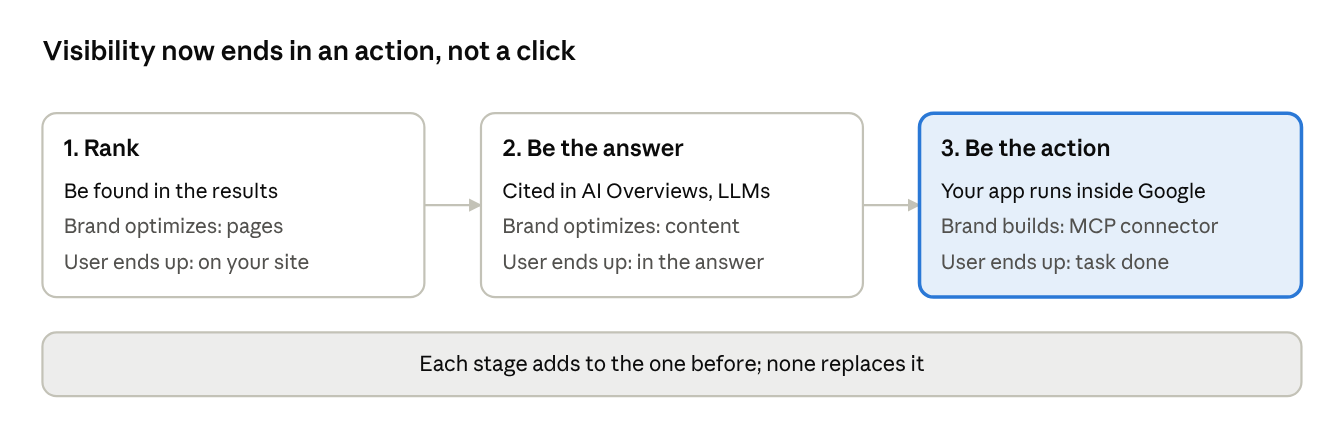 Connected Apps is stage three: the brand's service runs inside Google, and the user finishes the task without a visit.
Why Google, not only the LLM apps. Brands have been using MCP connectors for ChatGPT and Claude. Google is the biggest player to enter, and it has the audience: about 90% of worldwide search share, AI Mode above 1 billion monthly users, and the Gemini app at 950 million in the Q2 2026 update (Alphabet's report). If people can run their apps from the search box they already use several times a day, a lot of "go to an AI app" behavior could fold back into Google.
Websites were built for humans; connectors are built for agents. Brands built websites so people could browse and act. Now they also need connectors (MCP servers, Connected Apps, WebMCP) so AI agents can reach their core data and actions, regardless of page design. That's a whole new surface to own, measure, and optimize.
Search reaches behind the walled garden. Connected Apps bring logged-in, first-party data (accounts, orders, bookings, analytics) into the same results page as public content. The brand that's connected is in the conversation. The one that isn't may only appear as a link.
Why Should Brands Build a Google Connected App?
- Be there when the user is ready to act. When a task can be finished inside AI Mode, the brand that can finish it wins. A link to your site is a detour; a Connected App is the shortest path.
- Don't leave the action to a competitor. If someone asks AI Mode to book, order, or check something, Google can only use the apps that are connected. A competitor that connects first can complete the task while you appear as a link, if you appear at all. (Google hasn't said how it chooses between apps and organic results.)
- Turn first-party data into visibility. Anyone can publish content. Only you have your inventory, availability, pricing, and customer accounts. Connected Apps is one of the few ways that proprietary data can appear in search, and competitors can't copy it the way they can copy content.
- Keep a lasting place inside Google. Users link an app once, and after that it's available whenever it's relevant and stays in context for the session. That works more like an installed app than a search result.
- Control accuracy. A connected app answers from your live, authoritative data. The alternative is AI summarizing old pages or third-party listings, which leads to wrong prices, hours, and policies.
- Reuse what you're already using. The same MCP server can serve ChatGPT, Claude, and internal agents. If you're using one already, adding Google costs mostly registration and compliance work.
- Learn while the field is still small. About 50 apps are live, and access opens in phases. Early movers learn which prompts trigger their app and how users behave before their category gets crowded.
What Are the Trade-Offs of Google Connected Apps?
Fewer site visits, which means fewer on-site cross-sells, ad impressions, and retargeting signals. Google also controls how the experience looks. How apps get surfaced and how the program will be monetized are still undisclosed, and building and governing the server takes ongoing effort. Our view: users are moving these tasks into AI either way, so being absent is the bigger risk.
What Are the Marketing Benefits of Google Connected Apps?
- A shorter path to conversion. The query and the action happen in one place, with fewer steps where users can drop off.
- Brand awareness that leads to action. Users invoke an app by name (@brand). A known brand gets picked directly, which gives brand investment a measurable action to point to.
- Retention and loyalty. Account tasks like checking status, points, renewals, or orders keep existing customers engaged with you instead of drifting to another provider.
- Personalized answers. Once linked, answers reflect the user's own history, tier, and preferences, not generic content.
- A richer branded experience in AI. MCP Apps can show interactive UI, such as product cards, seat maps, or booking widgets, so your brand isn't reduced to a text summary.
- A new demand signal. The prompts that trigger your app, and the requests it can't handle, show you real customer intent. That feeds content, product, and prompt-tracking strategy.
Google Connected Apps Use Cases by Industry
| Industry | Read-only starter tools | Actions | Marketing payoff |
|---|---|---|---|
| Ecommerce & retail | In-store or online availability, order tracking, size and fit from past purchases, loyalty balance | Reorder, add to cart, start a return, back-in-stock alert | Wins the "where can I buy X" moment; easy reorders drive repeat revenue |
| Financial services (credit, investing, insurance) | Credit score and factors, portfolio summary, coverage lookup, pre-qualification check | Request a quote, start a claim, set alerts | Personal answers to "can I afford it / am I covered" build trust; pre-qual turns a research query into a lead |
| Banks | Balances, recent transactions, spending by category, rates, branch and ATM hours | Transfer between own accounts, lock a card, schedule a payment, book an advisor | Frequent, useful contact keeps the bank top of mind; service moments like "lock my card" build loyalty |
| Travel (airlines, OTAs, car rental) | Flight status, fare calendar, itinerary, miles balance, rental availability | Book, change seats, add bags, check in | Captures trip planning already happening in AI Mode; opens ancillary upsells |
| Hospitality (hotels, restaurants, venues) | Room rates and availability, amenities, menus, wait times, reservation details | Book a room or table, request late checkout, order ahead | A direct-booking channel inside Google, which could shift some bookings away from commission-based OTAs |
| Subscriptions, media & fitness | Plan details, usage, recommended content or classes | Start a session, upgrade, pause, renew | Keeps subscribers engaged and makes upgrades easy (the Peloton and Calm model) |
Note for regulated industries: banks, insurers, lenders, and health brands should run tool design and any cross-sell messaging through compliance before applying. Write actions and personalized offers carry the most risk.
How to Get Started With Google Connected Apps
Treat connectors as a channel, as you would the website or app. Start with a single high-value use case, built on an MCP server that can serve Google as well as other assistants, like seoClarity's MCP server.
Which Brands Should Adopt Connected Apps First?
- Transactional consumer brands (travel, retail, food, ticketing, subscriptions, fitness): users want to book, order, track, or change something. This is the category Google is showcasing.
- Brands with unique data or a logged-in experience (financial services, SaaS, health, loyalty programs): "what's my balance, status, or score" queries are made for this. Experian is a launch partner.
- Brands already using MCP servers for ChatGPT, Claude, or internal agents: the incremental cost to reach Google is mostly registration and compliance.
Steps to Launch Your First Connected App
- Inventory jobs to be done. List the top tasks customers come to the site or app to complete, and the data they log in to see. These are the candidate tools.
- Pick one or two atomic tools. Start with read-only tools (status, availability, account data) before write actions, which need confirmations and carry more risk.
- Use one MCP server everywhere. The seoClarity MCP server has already been designed to meet Google's rules, so you can deploy once across Google and other assistants.
- Apply for the preview. Use Google's interest form and prepare the Connected Console listing: verified domain, logo, a description under 30 words, at least three capabilities and three example prompts, ToS and privacy URLs.
- Make the website agent-operable too. Evaluate WebMCP for key flows, so agents in Chrome can act on the site.
- Measure it as a channel. Track Connected App usage alongside AI search visibility, citations, and organic. Watch which prompts trigger your app versus a competitor's. seoClarity users will be able to track Connected App activity in Bot Clarity, provided that activity is included in the server logs they share with us.
- Govern it. Security review, data minimization, prompt-injection hygiene, and a versioning process (Google requires a new version for any tool change).
Should Your Brand Invest in Google Connected Apps?
Search is shifting from pointing people somewhere to getting things done for them, and Connected Apps is how brands take part in that shift. Rankings and AI answers still matter, but the next layer of visibility goes to the brands that can complete the task. Start with one read-only use case on a reusable MCP server, measure it like any other channel, and make your site agent-ready while the field is still small.

Comments
Currently, there are no comments. Be the first to post one!