



Two tracking tools can report different ChatGPT visibility scores for the same brand and the same prompt, and both can be right. ChatGPT doesn’t give every user the same answer. The model depends on the user’s plan, web search runs on some answers and not others, product questions can return Shopping results, and location shapes what gets cited.
That makes the sampling method the first thing to evaluate in a ChatGPT tracker, ahead of the dashboard. It matters more now that OpenAI shows businesses some of this data itself. Since November 10, 2026, brands that claim a profile through Businesses in ChatGPT can see how often ChatGPT mentions them and how many clicks those mentions get, but not the prompts behind them or how competitors compare.
This guide explains what changes a ChatGPT answer, what OpenAI’s free data covers, how eight trackers document their ChatGPT sampling, and which teams each tool may suit. For coverage of other AI engines, see our enterprise AI visibility platforms comparison.
Editorial note: This is a research-based comparison. seoClarity publishes ArcAI, one of the eight tools listed, and we didn’t test the other seven. Every competitor detail comes from public documentation reviewed between September 24 and November 16, 2026, and pricing can change after that date.
Table of Contents
What Changes a ChatGPT Answer
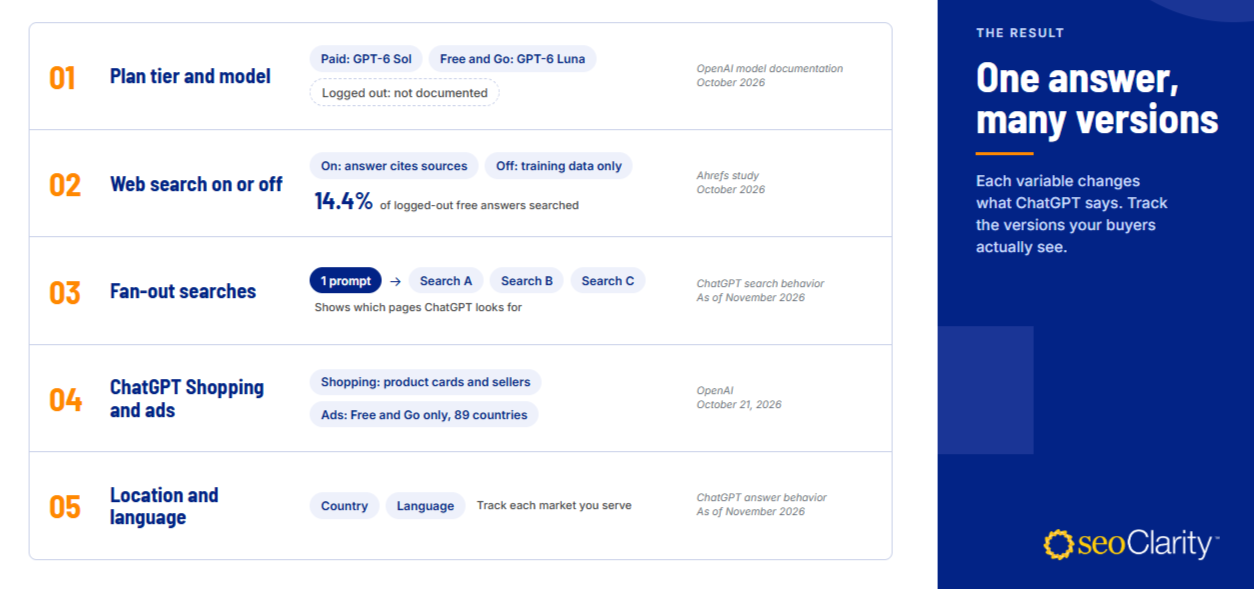
A tracker can only report the ChatGPT it queries. Five variables change what that ChatGPT says.
Plan and model. Since October 2026, paid ChatGPT plans use GPT-6 Sol by default, while Free and Go users get GPT-6 Luna, according to OpenAI’s model documentation. A tool that samples one tier can’t stand in for the other. OpenAI doesn’t document which model logged-out users see.
Web search. Some ChatGPT answers come from a web search, with citations; others come from the model’s own training. According to Ahrefs’ October 2026 study, 14.4% of the logged-out free-tier answers it analyzed used web search. Only search-backed answers cite sources, so a page can influence some answers directly and others only through training data.
Fan-out searches. When ChatGPT does search, it often splits one prompt into several background searches before answering. Those fan-out queries show which pages ChatGPT looks for, which is useful when deciding what content to create.
Shopping and ads. Product prompts can return ChatGPT Shopping results with product cards and sellers. ChatGPT ads run only on the Free and Go plans and had reached 89 countries by October 21, 2026, according to OpenAI. Organic product visibility and paid placements need separate tracking.
Location and language. Answers change by country and language, so multi-market brands need tracking in each market they serve.
Pro tip: treat ChatGPT referral numbers as a floor. In mid-October 2026, ChatGPT links briefly lost their utm_source tag, and referrer data was still missing afterward, according to third-party trackers. OpenAI made no statement. Your analytics tools may undercount visits that started in ChatGPT.
What OpenAI’s Business Hub Shows, and What It Doesn’t
Businesses in ChatGPT launched as a beta on November 10, 2026. A business that claims and verifies its profile gets a Business Hub that shows:
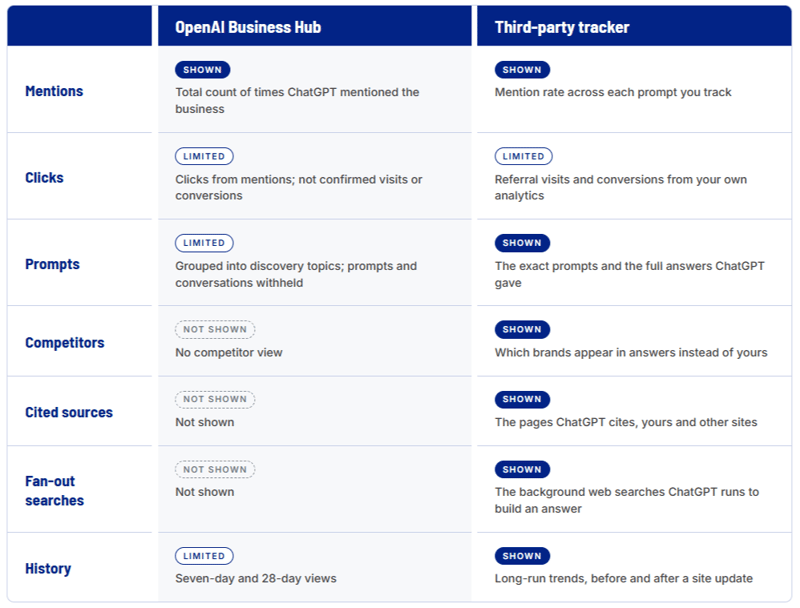
- How often ChatGPT mentioned the business
- Clicks to its website from those mentions
- Discovery topics, which group the conversations that produced mentions
- Seven-day and 28-day views
OpenAI doesn’t share the prompts or conversations behind these counts, offers no competitor view, and shows data only once there are enough conversations, a threshold it doesn’t quantify. OpenAI also notes that “clicks don’t confirm website visits or conversions.” Business Agents, a separate feature, are limited to eligible US businesses.
For a brand that wants to know whether ChatGPT mentions it at all, the Business Hub is a sensible free starting point. It doesn’t answer the questions that drive content decisions: which prompts produce mentions, which competitors appear instead, which sources ChatGPT cites, and how answers change after a site update. That’s the gap a paid tracker should fill, and it’s the lens for the comparison below.
How We Evaluated These Tools
We assessed each tool on nine ChatGPT-specific criteria, using its public documentation:
- How ChatGPT answers are collected (interface or API, signed-in or not, plan tier or model)
- Answer types covered (search-backed and model-only answers, ChatGPT Shopping)
- Visibility into fan-out searches
- Where prompts come from, and whether demand data is attached
- Markets and languages
- Tracking frequency and samples per prompt
- Metrics and answer evidence
- Data access and enterprise controls
- Pricing unit and published price
Tools appear in alphabetical order, and the order isn’t a ranking. “Best” in this guide means best fit for a stated use case. Where a vendor’s documentation doesn’t cover a criterion, we say so; that means the information isn’t public, not that the capability is missing. We didn’t run the competitor tools ourselves, so this guide can’t assess data accuracy.
ChatGPT Tracking Tools Compared
|
Tool |
How ChatGPT answers are collected |
ChatGPT fan-out searches |
Frequency and samples |
ChatGPT Shopping |
Published starting price (unit) |
|
Ahrefs Brand Radar |
Free public ChatGPT interface (vendor-stated); sign-in state not disclosed |
Fan-out queries listed; ChatGPT scope not confirmed |
Index: monthly refresh. Custom prompts: daily (vendor FAQ also lists weekly or monthly) |
Could not confirm |
Custom prompts from $50/mo; AI Visibility Index $199/mo (checks) |
|
AirOps |
Not publicly disclosed |
Could not confirm from reviewed documentation |
Daily; one answer per prompt by default, more on Enterprise by request |
Could not confirm |
Solo plan (ChatGPT only) free to start; paid prices not published (tasks) |
|
AthenaHQ |
Not publicly disclosed |
Captured search queries shown |
Weekly, monthly or one-off; custom schedules on Enterprise |
Shopping Insights |
Free Essential plan; Starter $295/mo (credits; 1 credit = 1 response) |
|
Peec AI |
Mainly the user interface, not the API (vendor-stated); sign-in state not disclosed |
Query Fanouts |
Daily on self-serve plans; daily or weekly on Enterprise |
Shopping view listed |
Starter $95/mo (prompts; 3 models on self-serve plans) |
|
Profound |
“Front-end experiences that normal users see” (vendor-stated); sign-in state not disclosed |
Query Fanouts |
Daily |
ChatGPT Shopping on Enterprise |
Free 7-day trial; Enterprise by quote (prompt runs) |
|
Scrunch |
Browser automation and official APIs (vendor-stated); ChatGPT method not specified |
Not stated on current pricing page |
Not publicly disclosed |
Could not confirm |
Starter $250/mo billed annually, $300 monthly (prompts) |
|
Semrush AI Visibility Toolkit |
Not publicly disclosed |
Not stated in reviewed documentation |
Daily |
Could not confirm |
$99/mo with 25 tracked prompts (prompts) |
|
seoClarity ArcAI |
Mainly the ChatGPT interface, not the API; sign-in state not disclosed |
Query Fanout view |
Daily, weekly, or monthly (weekly default) |
Shopping view and filter |
Custom pricing (Question Queries) |
Sources: vendor pricing pages and documentation, reviewed September 24 to November 16, 2026. “Not publicly disclosed” and “Could not confirm” mean we didn’t find the information in public documentation. Ask the vendor.
ChatGPT Tracking Tool Profiles
Ahrefs Brand Radar
Brand Radar runs a large index of prompts built from Ahrefs’ keyword and People Also Ask data through ChatGPT’s free public web interface, according to its methodology page. The index refreshes monthly and reports a 90-day window, with markets weighted by Ahrefs’ keyword data. Custom prompts, tracked separately, refresh daily on the plan table, though the FAQ says cadence can be set to daily, weekly, or monthly.
Reports cover mentions, citations, AI share of voice, and estimated impressions, which weight visibility by the search volume behind each prompt. The product page also lists fan-out queries and sentiment without saying whether they apply to ChatGPT.
Pricing is in checks. Custom prompts start at $50 a month, and the AI Visibility Index is $199 a month, with overage at $0.02 per check.
May suit: teams already on Ahrefs that want a market-wide view of ChatGPT answers tied to search demand.
Confirm: whether ChatGPT is sampled signed in or signed out, which model is used, and whether fan-out queries are reported for ChatGPT.
AirOps
AirOps pairs AI search tracking with content production. Its free-to-start Solo plan tracks ChatGPT only, so a team can begin there. Paid plans don’t list prices.
AirOps documents its sampling more fully than most. By default, it collects one answer per prompt per platform per day, and Enterprise customers can ask for multiple answers. Monthly answers per prompt are counted as platforms × regions × (1 + named personas) × 30, and a ChatGPT answer costs one unit. Reports cover mention rate, share of voice, average position, citations, and theme-based sentiment, and AirOps lists ChatGPT ad intelligence “where enabled.”
Tracking and content work draw on one task allowance, so heavy content production reduces what’s left for tracking. AirOps’ pricing and product pages state different task and prompt limits for the same plans.
May suit: content teams that want ChatGPT tracking and production in one workflow. Confirm: how ChatGPT answers are collected, fan-out reporting, and current plan limits in writing.
AthenaHQ
AthenaHQ meters everything in credits: one credit buys one AI response. The free Essential plan includes ChatGPT with 300 credits, and Starter costs $295 a month ($245 billed annually) for 3,600 credits. Tracking runs weekly, monthly, or one-off; the documentation doesn’t list a daily option, and Enterprise customers can build custom schedules.
Responses show the search queries AthenaHQ captured, which serves as a fan-out view. Metrics include share of voice, mention and citation rates, position, and per-mention sentiment. Shopping Insights tracks product visibility, position, pricing, and retailers in ChatGPT shopping answers, though its plan availability isn’t stated. Multiple countries, persona targeting, and SAML SSO are Enterprise-only.
May suit: teams that want per-response pricing they can forecast and don’t need daily runs.
Confirm: collection method and sign-in state, whether captured queries cover all ChatGPT answers, and which plan includes Shopping Insights.
Peec AI
Peec has a dedicated ChatGPT tracker page, and its AI Instructions page says it collects answers mainly through each engine’s interface rather than the API. Self-serve plans track daily, and Enterprise customers can choose daily or weekly.
Self-serve plans start at $95 a month (Starter), with Pro at $245 and Advanced at $495, according to Peec’s pricing page as of September 2026. Each self-serve plan lets you “choose 3 models,” and the largest tops out at 350 prompts, so a ChatGPT-focused team can concentrate its allowance.
Query Fanouts show the searches engines run before answering, and each prompt gets a relative 1-to-5 volume score. Peec doesn’t publish how that score is weighted. API access and SSO are on Enterprise.
May suit: teams that want published self-serve pricing and daily ChatGPT tracking.
Confirm: sign-in state and model, how the volume score is built, and current security attestation (a July 2026 page described SOC 2 as in progress).
Profound
Profound says it queries “the front-end experiences that normal users see” and runs every tracked prompt daily. According to its pricing page, Profound retired its self-serve Starter and Growth plans for brands, priced at $399 and $499, in September 2026. The page now lists a free seven-day trial (50 prompts a day, including ChatGPT) and a quote-priced Enterprise plan.
Profound documents Shopping analysis as available only for ChatGPT, on the Enterprise plan. Query Fanouts and modeled prompt volumes, built from licensed consumer-panel data, are also documented. Each persona added to a prompt counts as another prompt run, which raises volume. API access, exports, and SSO are Enterprise features.
May suit: large brands, especially in ecommerce, that want daily ChatGPT and ChatGPT Shopping tracking under one contract.
Confirm: sign-in state and model, how prompt runs are counted, and contract pricing at your volume.
Scrunch
Scrunch says it collects data through “browser automation and official platform APIs” but doesn’t say which method it uses for ChatGPT. Its Starter plan costs $250 a month billed annually, or $300 month-to-month, according to its pricing page, with 350 custom prompts and up to 1,000 industry prompts across the plan’s AI platforms, ChatGPT among them. A seven-day free trial of Starter doesn’t require a credit card.
Scrunch’s earlier plan table listed fan-out data as “Limited” on its Core plan and full on Enterprise; the current pricing page doesn’t mention fan-out. Metrics include brand presence, position (top, middle, or bottom of the answer), sentiment, and citation share of voice. Scrunch’s Agent Pages serve a prerendered version of a site to AI agents, and its documentation names ChatGPT-User and OAI-SearchBot among the user agents detected. That’s an Enterprise feature. Sitecore announced its acquisition of Scrunch in June 2026.
May suit: brands that want ChatGPT tracking alongside a way to serve content to OpenAI’s crawlers.
Confirm: ChatGPT collection method, refresh frequency, fan-out data by plan, and plans after the Sitecore acquisition.
Semrush AI Visibility Toolkit
Semrush’s Prompt Tracking covers ChatGPT with daily updates across 220+ countries and territories, according to its knowledge base. The toolkit costs $99 a month with 25 tracked prompts; Semrush One plans include 50, 100, or 200, and 50 more cost $60 a month. In corporate accounts, each user needs their own $99 toolkit license; Semrush’s general user seats (from $45 a month) don’t include toolkit access.
For ChatGPT, results can be filtered by answer layout, such as answers that include citations. The documentation reviewed doesn’t describe how answers are collected or whether fan-out searches are shown.
May suit: SEO teams already using Semrush that want ChatGPT prompts next to their rankings.
Confirm: collection method, whether the prompt allowance is shared with other engines, and per-user costs for larger teams.
seoClarity ArcAI
Clarity ArcAI collects ChatGPT answers mainly through ChatGPT’s interface. It tracks when and how your brand appears in those answers, through mentions and citations, and reports mention and citation share of voice in ChatGPT against the competitors you map. It also shows which domains and URLs ChatGPT cites most often, and its Query Fanout view lists the searches ChatGPT ran for each prompt.
Prompt research is grounded in real search demand and mapped to buyer-journey stages. Prompts can be tracked daily, weekly, or monthly, and a filter separates answers with and without shopping results. Usage is counted in Question Queries (one prompt on one engine in one location), pricing is custom, and the API and MCP server are included in all paid subscriptions.
May suit: enterprise SEO teams that want ChatGPT visibility tied to demand-based prompt research.
Confirm: whether your target markets and languages are covered, which tracking frequency your program needs, and the Question Query volume and pricing your prompt count requires.
Which Tool Fits Which Team
Tools are listed alphabetically within each use case.
- Starting with ChatGPT only → AirOps, AthenaHQ, Peec AI, Profound. AirOps’ Solo plan, AthenaHQ’s Essential plan, and Profound’s trial include ChatGPT at no cost. Peec’s self-serve plans let you pick ChatGPT as one of three models.
- Ecommerce and product visibility → AthenaHQ, Peec AI, Profound, seoClarity ArcAI. Each documents a ChatGPT shopping view, with different plan requirements.
- SEO teams on an existing suite → Ahrefs Brand Radar, Semrush. Both add ChatGPT prompts next to keyword and ranking data.
- Enterprise programs across markets → compare Enterprise plans. Most vendors put multiple countries, SSO, and API access on Enterprise or custom plans. Ask for a quote based on the prompts, markets, and tracking frequency you actually need.
Questions to Ask in a ChatGPT Tracker Demo
- Which ChatGPT plan tier and model do you sample, and are sessions signed in or signed out?
- Do you separate answers that used web search from answers that didn’t?
- How many times do you sample each prompt per run, and can we see the raw answers?
- Do you report ChatGPT’s fan-out searches for each prompt?
- Do you track ChatGPT Shopping results, and on which plan?
- Which countries and languages can we track in ChatGPT, and how is location set?
- If our allowance covers other engines, what does a ChatGPT-only setup cost?
- How do you report ChatGPT-referred traffic, given missing referrer data?
How seoClarity Approaches ChatGPT Visibility
Tracking shows where your brand stands in ChatGPT. The next step is knowing why, and what to fix. ArcAI Sentiment groups the opinions AI answers express about your brand into business themes, such as price, support, and trust.
Filtered to ChatGPT, it shows which themes ChatGPT praises or criticizes, with the quotes, prompts, and cited pages behind each one, for your brand and your competitors. The ArcAI Accuracy add-on checks ChatGPT answers against your own site content and flags conflicts, mismatches, and missing qualifiers.
From there, ArcAI turns findings into prioritized recommendations that teams can assign through built-in task management or Jira, and its reporting compares conversions from ChatGPT-referred traffic with organic search.
Request a custom ArcAI walkthrough to see how your brand currently appears across ChatGPT search and shopping results.

Comments
Currently, there are no comments. Be the first to post one!