



Google continues to shape search around trust, authority, and user preferences. One of its newest features, Preferred Sources, gives users more control over which publishers and websites appear throughout Google Search, including within AI-generated experiences like AI Overviews and AI Mode.
While the feature launched with a focus on news publishers, it signals something much larger: Google is creating stronger relationships between users and trusted content sources. That has significant implications for enterprise SEO and AEO teams investing in authority, brand visibility, and original content.
Here's what you need to know and how to position your site for success.
Key Takeaways:
- Google's Preferred Sources feature functions as a personalization layer that elevates user-selected brands across Top Stories, AI Overviews, and AI Mode.
- Users are twice as likely to click through to a Preferred Source, making explicit user opt-in a critical new organic traffic channel.
- Winning visibility in AI search requires converting existing brand loyalty into explicit Google Search preferences via integrated SEO, PR, and marketing campaigns.
- Technical SEO fundamentals—specifically sitemap health, schema markup, and canonical stability—remain necessary prerequisites to ensure AI models can crawl, parse, and cite your site.
Table of Contents:
- Why Does the Preferred Sources Feature Matter for Search Visibility in Google?
- What Google’s Preferred Sources Feature Signals for the Future of SEO & AEO
- Where Do Preferred Sources Appear and Who Is Eligible?
- How Can You Increase Your Chances of Being Selected As A Preferred Source in Google?
- Technical SEO Best Practices That Support Preferred Sources
- How Can You Measure Your Site’s Inclusion In Google’s Preferred Sources?
- How the Preferred Sources Feature Fits Into Google's AI Search Strategy
Why Does the Preferred Sources Feature Matter for Search Visibility in Google?
Google's AI search experiences increasingly summarize information instead of sending users directly to websites.
That means earning visibility isn't just about ranking on page one anymore. It's also about becoming a trusted source that Google's AI chooses to reference, and one that users actively opt into following.
Rather than changing Google's core ranking systems, Preferred Sources acts as a personalization layer. Users tell Google which publishers they value, and Google uses that preference to surface those sites more prominently across Top Stories, AI Overviews, AI Mode, and other personalized search surfaces when relevant.
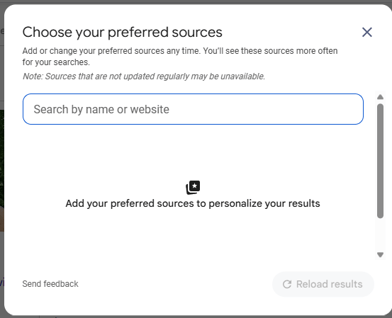
Preferred Sources introduces a new competitive advantage:
- Increased visibility within AI-generated responses
- Greater prominence in Top Stories
- Stronger brand recognition during informational searches
- More opportunities for repeat discovery from loyal audiences
According to Google, users are twice as likely to click through to a Preferred Source and over 345 thousand unique sources have already been selected by users globally since the feature’s launch.
For enterprise organizations with established brands, this represents another owned audience channel, not unlike email subscribers or social followers.
What Google’s Preferred Sources Feature Signals for the Future of SEO & AEO
1. The Era of "Good Enough" Content Is Over
For years, many SEOs treated E-E-A-T as a soft guideline or a checklist to appease quality raters. With the global expansion of Google’s Preferred Sources, trust is no longer just a guideline; it is hardcoded search architecture.
By giving users the power to explicitly whitelist the publishers they trust, Google is transforming brand loyalty into a literal ranking signal. Crucially, this preference doesn’t just apply to traditional search results; it flows directly into the source selection for AI Overviews and AI Mode.
For enterprise SEO and AEO teams, the message is clear: you can no longer hack your way to visibility with commodity content. You need to build a brand that users actively seek out and prefer.
2. PR, Brand Marketing, and SEO Must Converge
Google's rollout of the Preferred Sources feature signals a structural shift in how digital visibility is won: the ultimate SEO moat is now brand preference.
That means SEO, PR, brand marketing, customer advocacy, and thought leadership can no longer operate independently. Every campaign that builds credibility and brand affinity now has the potential to improve discoverability across both traditional search and AI-powered experiences.
In addition, becoming a Preferred Source doesn’t just happen passively. Google is actively encouraging publishers to ask their audiences to whitelist them. Google even provides a specific link format (google.com/preferences/source?q=yourwebsite.com) that brands can drop directly into their newsletters, social media posts, and website promos.
This requires SEO teams to work with email marketing and social teams to convert existing subscribers into Google Search preference signals.
Where Do Preferred Sources Appear and Who Is Eligible?
Once selected by a user, Preferred Sources receive visual labeling and enhanced citation visibility across Top Stories, AI Overviews, and AI Mode to highlight trusted content. As Google expands AI-powered search, these placements offer growing value for organic traffic and brand exposure.
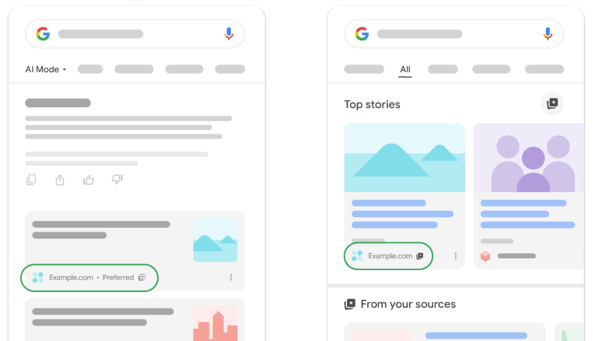 Image source: https://developers.google.com/
Eligibility is set at the root domain or subdomain level (e.g., example.com or news.example.com), excluding individual subdirectories like /blog/. Consequently, most enterprise organizations require no technical restructuring as long as their primary domain already hosts the relevant content.
How Can You Increase Your Chances of Being Selected As A Preferred Source in Google?
Google doesn't provide an application process or ranking checklist for Preferred Sources. Instead, organizations should focus on building audience trust and making it easy for users to follow them.
1. Verify Eligibility
First, confirm your domain is indexed inside Google's source preferences tool. To do this, navigate directly to the preference manager using your root domain:
https://google.com/preferences/source?q=yourdomain.com
If your brand surfaces within the search field's auto-suggest list, your platform is officially eligible, meaning users can begin selecting your brand as a preferred source.
2. Encourage Existing Audiences
Many organizations spend significant effort growing newsletter subscribers and social followers.
Preferred Sources should become another audience touchpoint.
Consider adding calls-to-action on:
- newsletters
- article pages
- resource centers
- homepage modules
- author pages
The goal is simple: encourage loyal readers to designate your organization as one of their trusted sources inside Google.
3. Publish Original, Citable Content
Google continues rewarding content that contributes something genuinely new.
Whether that's proprietary research, industry benchmarks, expert analysis, or original reporting, unique content is more likely to earn citations from other websites and become a trusted source within Google's ecosystem.
Organizations should focus on creating content that others naturally reference, not simply repackaging information already available elsewhere.
4. Build Topical Authority, Not Just Rankings
Preferred Sources reinforces Google's growing emphasis on trusted brands.
Organizations that consistently publish comprehensive, original content around their core subject areas are more likely to become recognizable authorities over time.
Rather than chasing individual keywords, enterprise SEO and AEO teams should invest in building topical depth across their most important subject areas.
seoClarity's Content Fusion and Topic Explorer help organizations identify content gaps, uncover related topics, and build comprehensive content strategies that strengthen topical authority over time.
Technical SEO Best Practices That Support Preferred Sources
Although Preferred Sources is user-driven, technical SEO remains foundational for inclusion. Google still needs to efficiently crawl, understand, and trust your content before it can surface it in AI-powered search experiences.
Enterprise SEO and AEO teams should prioritize:
- XML sitemap health
- Structured data
- Cannonical stability
These three elements directly map to Google’s AI indexing pipeline: enabling rapid discovery through clean sitemaps, clear entity comprehension via structured data, and consolidated authority signals through stable canonicals.
1. XML Sitemap Health
Maintain clean, accurate sitemaps that contain only indexable URLs.
Broken URLs, redirect chains, and outdated sitemap entries reduce crawl efficiency and can limit discoverability.
Scale with seoClarity: Instantly isolate sitemap errors, redirect chains, and crawl inefficiencies across massive enterprise sites using seoClarity Site Audits.
- Structured Data
Implement appropriate schema markup, including:
- Article or NewsArticle
- Author
- Organization
- Breadcrumb
Structured data helps Google better understand your content and determine eligibility for enhanced search features.
Scale with seoClarity: Generate and deploy valid schema instantly without relying on development queues by using Schema Optimizer for no-code technical execution.
2. Canonical Stability
Avoid unnecessary URL changes.
Stable canonical URLs preserve backlinks, authority, and citation signals that contribute to long-term visibility.
Scale with seoClarity: Programmatically monitor canonical consistency across large websites via seoClarity's automated site monitoring, catching duplicate content issues and broken canonical pathways before they degrade your authority signals.
How Can You Measure Your Site’s Inclusion In Google’s Preferred Sources?
Google does not currently provide a native analytics dashboard or publisher metric for Preferred Sources, making it difficult to measure exactly how often your content benefits from user preferences.
Instead, enterprise SEO teams should monitor broader indicators of visibility, including:
- AI Overview appearances
- Top Stories visibility
- Share of Voice across strategic topics
- Growth in branded search demand
- Organic traffic to informational content
- Editorial backlinks and external citations
Tracking Preferred Source Button Clicks in GA4
If your site includes a CTA encouraging users to add you as a Preferred Source, measuring click volume requires outbound link event tracking via Google Tag Manager.
-
Enable Click Variables: In GTM, navigate to Variables > Built-in Variables > Configure. Enable Click URL — and optionally Click Classes or Click ID if your button carries specific identifiers.
-
Create the Trigger: Add a new trigger. Select Just Links under Click type, then apply the condition: Click URL > contains > google.com/preferences/source. Name it something unambiguous, like Click – Google Preferred Source.
-
Create the GA4 Event Tag: Create a GA4 Event tag connected to your Measurement ID. Set a clean, descriptive event name such as click_preferred_source. Optionally add parameters: link_url mapped to and button_location to capture placement context (header, article footer, newsletter, etc.). Attach the trigger from Step 2.
-
Test and Publish: Run GTM Preview mode, click the button on your live site, and confirm the tag fires in Tag Assistant. Submit and publish. The event surfaces in your GA4 Events report within 24–48 hours.
With this in place, you can segment click volume by page, traffic source, and device - giving your team a direct read on which placements and campaigns are converting readers into declared Preferred Source followers.
How Clarity ArcAI Helps Monitor Performance in Google’s Preferred Sources
seoClarity's AI Search Visibility Tracking help teams understand how their content performs across traditional and AI-powered search experiences, providing a more complete picture than rankings alone.
How the Preferred Sources Feature Fits Into Google's AI Search Strategy
Preferred Sources isn't an isolated feature, it's part of Google's broader shift toward AI-powered search experiences that prioritize trusted, authoritative content.
As AI Overviews and AI Mode become more prevalent, Google's systems increasingly evaluate not only whether a page answers a query, but whether it comes from a source users recognize and trust.
This aligns closely with Google's emphasis on Experience, Expertise, Authoritativeness, and Trust (E-E-A-T). Organizations that consistently publish original, high-quality content while maintaining strong technical SEO are better positioned to earn visibility across both traditional search results and AI-generated answers.
Conclusion:
Preferred Sources isn't simply another Google feature. It's an indication that search is becoming increasingly personalized, brand-driven, and AI-assisted.
Becoming a Preferred Source isn't something organizations can directly optimize for, but they can optimize for everything that makes Google and users trust them.
That means investing in technical SEO, producing original content, building topical authority, and creating exceptional user experiences.
seoClarity helps organizations bring these initiatives together—from technical SEO and content optimization to AI search visibility and performance measurement—giving enterprise teams the insights they need to stay ahead.



Comments
Currently, there are no comments. Be the first to post one!