



Optimizing for large language models (LLMs) isn't the same as traditional SEO.
LLM outputs are non-deterministic, highly volatile, and dependent on complex retrieval-augmented generation (RAG) pipelines. To find out what actually influences AI search engines, you must run controlled AEO tests.
But what is actually worth testing on your site, and how should you measure the results? That’s what we’re here to help you uncover.
Here are seven actionable AEO testing ideas your search team can execute today to see what drives AI citations, mentions, and visibility in your specific industry and niche.
Table of Contents:
- Why Does Controlled Split Testing Matter for AEO?
- What Are the Most Effective AEO Split Tests To Run?
- 3 Golden Rules for Flawless AEO Test Data
- How to Turn AEO Experiments into AI Search Growth
Why Does Controlled Split Testing Matter for AEO?
Generative engines process web pages differently than traditional search crawlers. RAG systems parse indexed content, extract dense factual passages, and synthesize conversational answers.
Yet, LLM responses fluctuate regularly. Search engines update their retrieval models, crawler schedules, and indexing caches constantly.
Running controlled split tests isolates your content changes from background engine updates. Comparing matched test and control groups reveals whether your page changes drove a citation win or if the AI engine was simply shifting its baseline behavior.
What Are the Most Effective AEO Split Tests To Run?
To help you choose which AEO experiment to run first, here is a quick comparison of all of the tests we will cover in this blog, the effort involved, and the clarity you can expect after running it.
| Experiment Name | Tested Content Variable | Implementation Effort | Expected Signal Clarity |
|---|---|---|---|
| 1. Entity FAQ Expansion | Added entity Q&A modules | Medium | Very High |
| 2. Page Summaries | Bulleted key takeaway cards | Medium | High |
| 3. Listicle Content | Added numbered listicle | Medium | High (with large datasets) |
| 4. Schema Markup | Structured JSON-LD schema | Low to Medium | High |
| 5. Raw Markdown | Stripped markdown for AI bots | High (without automation) | High |
| 6. Structural Tweaks | Headings, tables, plain language | Low | Moderate to High |
| 7. Direct Meta Descriptions | Metadata "spoilers" | Low | Moderate / Volatile |
Now that you have a general idea of the types of tests you can run, let’s dive into what each one entails, how to implement it, and what to measure.
Test Idea #1: Entity FAQ Expansion Modules
The Core Hypothesis
Adding structured Q&A modules covering specific third-party entities (such as related brands, products, or industry policies) to high-authority pages increases domain citation rates when users prompt the LLM about those specific entities.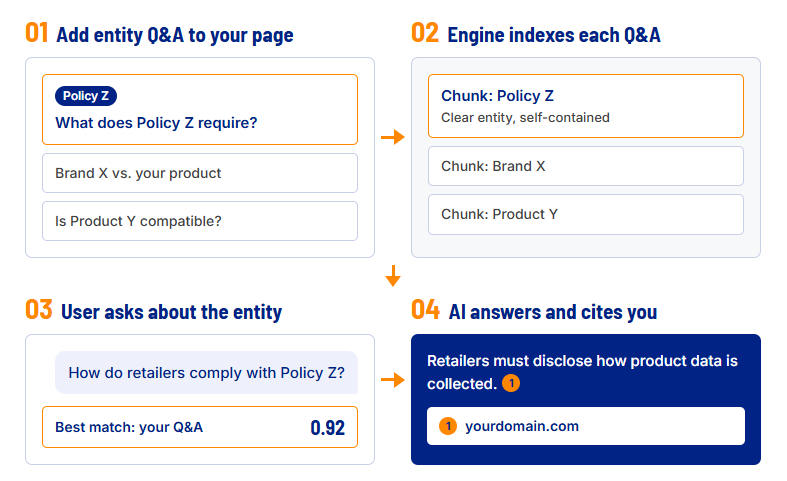
How to Run the Test
- Select High-Authority Pages: Identify a group of strong informational or category pages on your domain.
- Add Entity-Focused FAQs: On test group pages, implement structured FAQ sections covering related third-party entities such as pricing models, management policies, or feature comparisons.
- Keep Control Pages Unchanged: Retain your existing page copy on control pages.
- Target Entity Prompts: Track specific prompts matching the added entities to measure performance (e.g., "How is the corporate work-life balance at [Company Name]?" or "Does [Product A] support custom integrations?").
What Real-World Data Shows
In controlled split tests, many of our clients have found that adding dedicated entity FAQs generated immediate citation gains over control pages. Crucially, when teams reverted the change on a subset of pages, citations dropped right back down. Reversion proves true causation, giving search teams undeniable proof for executive stakeholders.
Execution Tip: Building enterprise FAQs at scale can be challenging. You can use ArcAI Content Agents to generate entity FAQs, deploy them via our SEO and AEO Split Tester, and push winning variations live.
Test Idea #2: Structured "At-a-Glance" Page Summaries
The Core Hypothesis
Adding structured "At-a-Glance" summary cards to long-form landing pages increases citation frequency across multi-stage search funnels.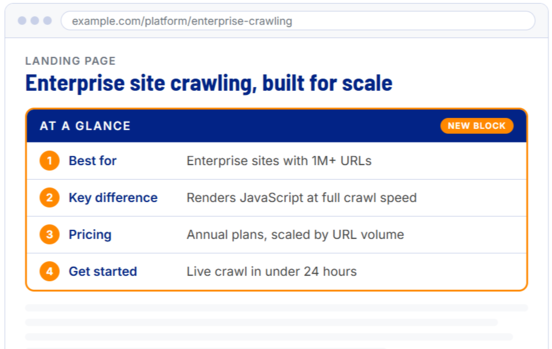
How to Run the Test
- Build a Summary Module: Create a clean container featuring 4 to 6 concise bullet points summarizing key takeaways, stats, or attributes.
- Deploy on Test Pages: Place the summary block near the top of your test group pages.
- Map Multi-Stage Prompts: Uncover conversational queries across your conversion funnel using ArcAI Prompt Researcher to measure the performance of your test:
- Top-of-Funnel: "What are the primary duties for a [Job Title] role?"
- Mid-Funnel: "How does [Product] structure its remote work features?"
- Bottom-of-Funnel: "What is the starting salary range on [Company]'s listing?"
Test Idea #3: Adding Listicle Content
The Core Hypothesis
Adding a structured, numbered listicle to an existing page may give conversational engines clearer, more extractable information about specific products, services, or entities, increasing the likelihood that the page is cited in relevant responses.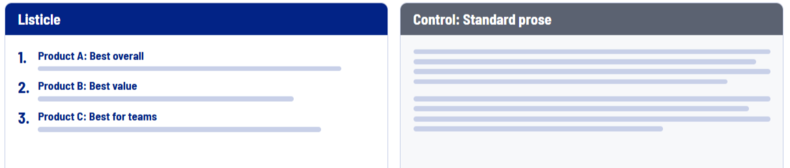
How to Run the Test
- Add a Listicle: Add a numbered listicle to the test pages using a clear, consistent structure (e.g., 1. Product A — Best Overall). Keep the rest of the page largely unchanged.
- Maintain a Control Group: Leave comparable control pages unchanged, without adding listicle content.
- Track a Sufficient Prompt Set: Measure changes in citations and AI visibility across prompts relevant to the listicle. Aim to track at least 100 prompts per category when possible. Smaller prompt sets can make it harder to identify meaningful trends.
What Real-World Data Shows
Before running the test, check whether your brand is already being cited for the prompts you plan to monitor.
For one client, we found that the brand was already consistently cited across many of the target prompts before they began the test. That left little room for improvement, making it difficult to determine whether adding the listicle had any meaningful positive impact.
Test Idea #4: The Schema Markup Experiment
The Core Hypothesis
Injecting structured schema markup (Product, FAQ, or Article schema) improves LLM source selection by providing explicit machine-readable entity relationships.
How to Run the Test
- Inject Schema: Add structured JSON-LD schema to your test group pages.
- Match Control Pages: Keep control pages identical in topic, copy, and layout, but omit the schema markup.
- Measure Lift: Track citations and brand mentions across a 6-to-8-week window.
If schema boosts citations, prioritize it sitewide. If it shows no impact, save your engineering resources for higher-impact projects.
Execution Tip: Use seoClarity’s Schema Optimizer to easily build, test, and deploy structured data across millions of pages in minutes without requiring any dev resources.
Test Idea #5: Raw Markdown vs. HTML for AI Crawlers
The Core Hypothesis
Serving stripped-down raw Markdown directly to AI bot user-agents speeds up RAG parsing and improves citation extraction compared to serving full HTML documents.
AI crawlers often strip HTML down to basic text before processing. This experiment tests whether eliminating HTML overhead gives bots a cleaner extraction path.
How to Run the Test
- Target AI User-Agents: Serve clean Markdown files exclusively to recognized AI crawler user-agents on test URLs.
- Maintain Control URLs: Serve standard HTML to both human users and AI bots on control URLs.
- Track Bot Retrieval: Measure AI bot hit frequency and subsequent citation lift.
Technical Solution: Building custom user-agent rendering pipelines usually requires dev resources. You can use Bot Optimizer to serve Markdown formats to AI search crawlers automatically.
Test Idea #6: Rapid Structural Content Tweaks
The Core Hypothesis
Small structural changes to existing content can make key information easier for conversational engines to identify, extract, and use in generated responses.
How to Run the Test
Make targeted structural changes to a test group of blog posts, product pages, or category hubs while leaving your control group unchanged.
Test changes such as:
- Question-Style Headings: Rewrite generic H2s (e.g., “Product Overview”) as conversational questions that reflect how users actually prompt AI engines (e.g., “Is [Product] worth the price?”).
- Comparison Tables: Add structured tables that clearly organize facts relevant to comparison prompts, such as “Brand A vs. Brand B.”
- Content Simplicity: Replace corporate jargon and complex phrasing with direct, plain-language statements that clearly communicate key facts.
- Bulleted Takeaway Lists: Turn dense narrative sections into concise, scannable bullet points that make individual takeaways easier to identify.
Measure changes in AI citations and visibility across a consistent set of relevant prompts, comparing your test pages against the unchanged control group.
Execution Tip: Once you’ve identified a structural change you want to test, ArcAI Content Agents can help you execute the experiment faster across a larger set of pages. The agents can apply changes like new headings, comparison tables, simplified copy, or bulleted takeaways to thousands of pages at once while adhering to your brand guidelines. Your team stays in control, reviewing and approving changes before they go live.
Test Idea #7: Direct Answer Front-Loading in Meta Descriptions
The Core Hypothesis
Rewriting meta descriptions to front-load direct, factual answers will make key information easier for AI models to identify and surface.
How to Run the Test
- Rewrite Meta Descriptions: Update the meta descriptions in your test group so they consist of a clear, factual answer rather than a general summary.
- Maintain Control Baselines: Keep the existing, standard meta descriptions unchanged for your control group.
- Target Direct Fact Prompts: Track performance for factual queries related to the information included in the meta descriptions (e.g., “What is the average response time for [Service]?”).
What Real-World Data Shows
Meta description tests like this frequently yield neutral results for our clients. While early passage signals matter in HTML body copy, meta descriptions alone often carry insufficient weight in RAG extraction pipelines. Testing this on your domain reveals whether lead-text tweaks move the needle in your niche.
3 Golden Rules for Flawless AEO Test Data
Testing for AI search requires a different approach than standard SEO split testing. Follow these three golden rules to ensure valid data:
#1: Scale Your Prompt Volume
LLMs yield non-deterministic responses. Running a test with only 5 or 10 prompts creates statistical noise. A single model fluctuation will distort your conclusions. Always build broad prompt sets across your test categories.
#2: Filter Out Pre-Existing Wins
Track your target prompts for 2 to 4 weeks before launching your test. If an LLM already cites your domain consistently on a prompt, remove that prompt from your test dataset!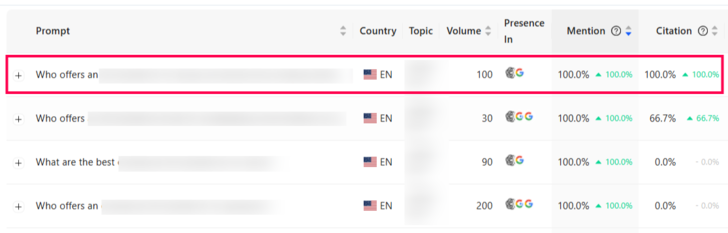
Crucial Rule: If your domain wins 100% of citations on a prompt pre-test, you have zero margin to measure an uplift. You can only stay flat or lose ground.
#3: Allow the Test to Run For At Least 6 to 8 Weeks
AI web crawlers visit sites on varying schedules. Generative caches refresh on irregular cycles. Allow your AEO tests to run for at least 6 to 8 weeks post-launch before measuring net citation gains against your control baselines.
Using seoClarity’s SEO and AEO Split Tester automates this process:
- Identify: Automatically builds test and control groups using correlated pages.
- Deploy: Pushes changes live across thousands or even millions of pages.
- Analyze: Calculates statistical significance so you can report clear outcomes to executive leadership.
How to Turn AEO Experiments into AI Search Growth
Succeeding in generative search isn't about guessing algorithm preferences. You need to run controlled experiments to prove what works.
By testing factors like entity FAQ expansion, technical schema markup, markdown rendering, and prompt-matched headings, your team can build an ongoing discipline for scaling brand visibility across AI search surfaces.
- Uncover conversational intent: Map real prompts across your target keywords.
- Run structured split tests: Isolate true content wins from LLM volatility.
- Scale proven winners: Push winning content formats sitewide.
Ready to measure and grow your brand's share of voice in ChatGPT, Gemini, and Google AI Overviews? Schedule a demo with seoClarity today!


Comments
Currently, there are no comments. Be the first to post one!