seoClarity Research Study
Tracking the Volatility of ChatGPT’s Citations:
A Global Trend Analysis
By Mitul Gandhi, Chief Architect & Co-Founder of seoClarity
Updated: June 19, 2026
.png?width=350&name=ChatGPT%20Citations%20Decline%20Doodle%20(transparent).png)



By Mitul Gandhi, Chief Architect & Co-Founder of seoClarity
Updated: June 19, 2026
Our initial findings identified two specific dates where algorithmic changes resulted in significant declines in the number of sources ChatGPT cited in its responses, one on March 8 and another on April 19.
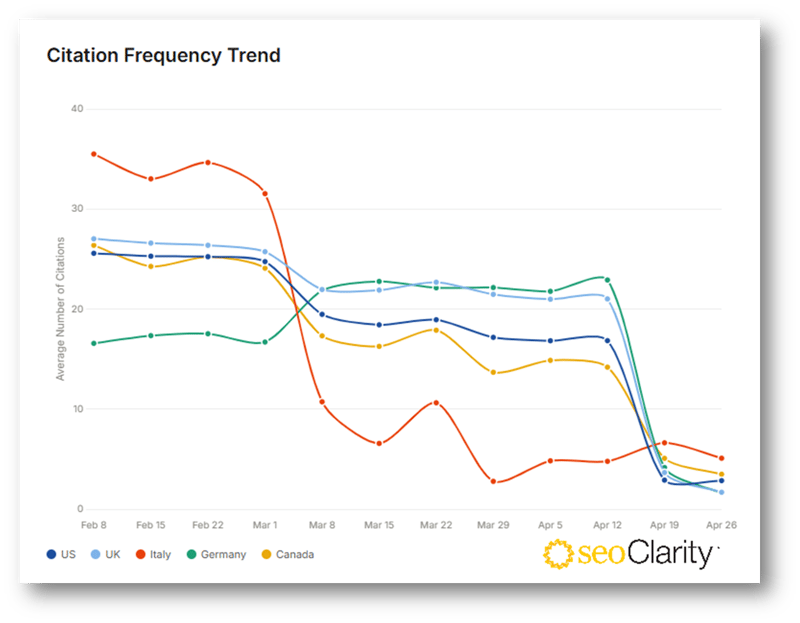
Average number of citations per prompt in ChatGPT from February 8 - April 26, 2026
These rapid-fire changes at the time indicated that OpenAI may be moving toward a model that relies on internal training rather than live web citations, effectively narrowing the "window" for AEO as a traffic channel.
After a precipitous drop during March-April 2026, citations rebounded in ChatGPT, settling at new levels across the five major markets.
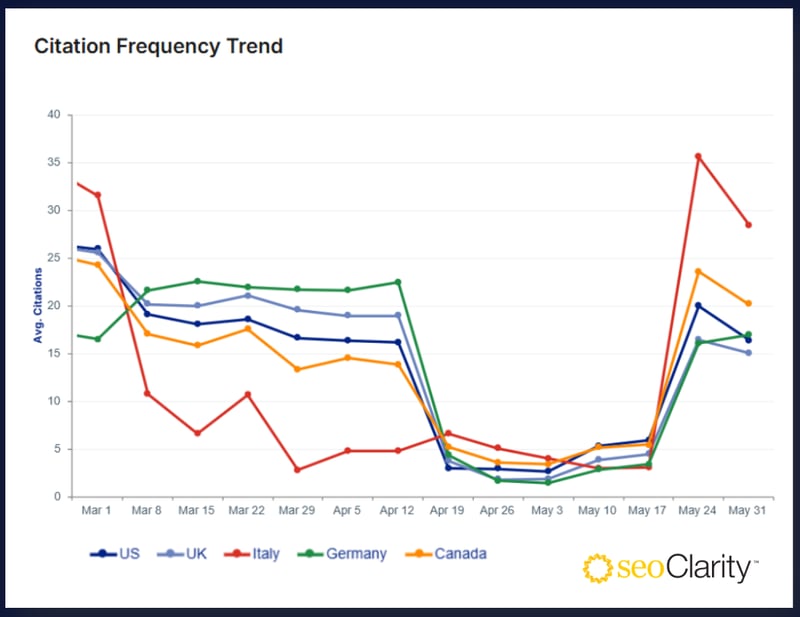
Average number of citations per prompt in ChatGPT from February 8 - April 26, 2026
What this means for marketers: With citations dropping and rebounding on OpenAI's timeline, they can't be treated as a stable channel. The durable play is brand authority that holds up through the swings — ensuring AI search engines know, trust, and recommend your brand whether citations are abundant or scarce.
The first drop in ChatGPT citations on March 8 impacted four out of five markets, signaling what is likely a major algorithmic shift. However, the update on April 19 was far more significant, with the US, UK, and Germany each seeing citation volumes fall by over 80%.
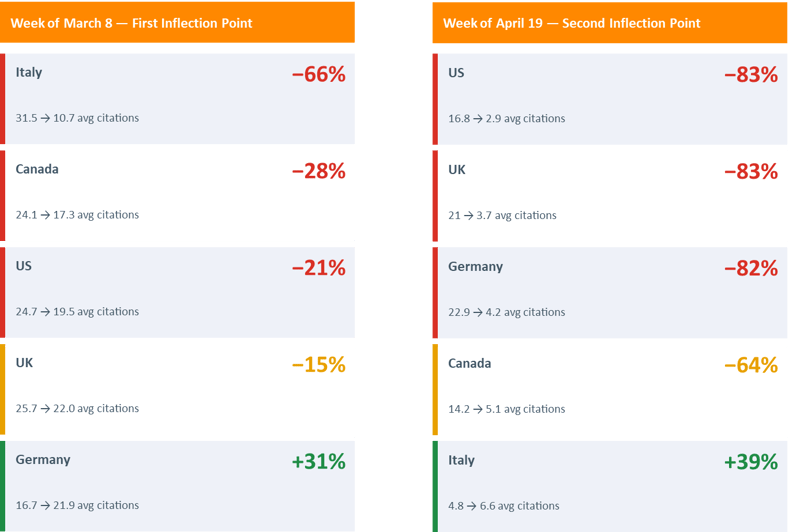
What this means for marketers: We encourage marketers to use these inflection points (the March 8 and April 19 drops, and the subsequent May rebound) to "set the record straight" with stakeholders.
By mapping your own traffic or visibility data against these dates, you can clearly demonstrate that the swings are likely driven by OpenAI's algorithmic changes rather than a decline in your content quality or competitive standing.
The main business takeaway is that AEO is becoming a play for brand visibility rather than direct site visits. Success should now be measured by how often your brand is mentioned, trusted, and recommended as a top-tier answer, regardless of whether a link is provided.
The initial drop in March was almost entirely driven by "zero-citation" responses.
ChatGPT didn't necessarily cite fewer links per cited response; it simply stopped citing anything for a much larger portion of queries. For example, the US zero-citation rate doubled in March, moving from 28% to 48%.
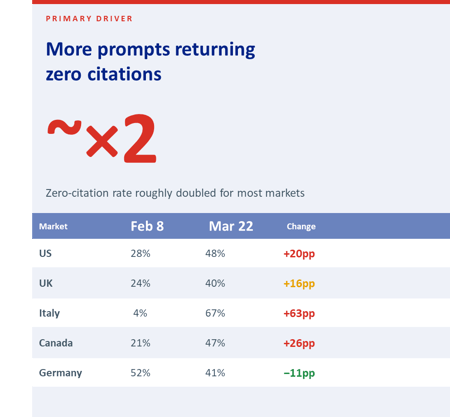
The decline in ChatGPT citations may suggest that the model's "confidence threshold" (the point at which it decides it knows enough to answer without a source) has been significantly lowered.
What this means for marketers: Marketers now face a reality where their brand can win or lose an enterprise deal inside an AI answer, but they will never see the referral click in their analytics. This reinforces the notion that AI search should be treated more like an influence and measurement opportunity going forward rather than a standard acquisition channel.
The April 19 update introduced a new, more difficult dynamic for digital marketers.
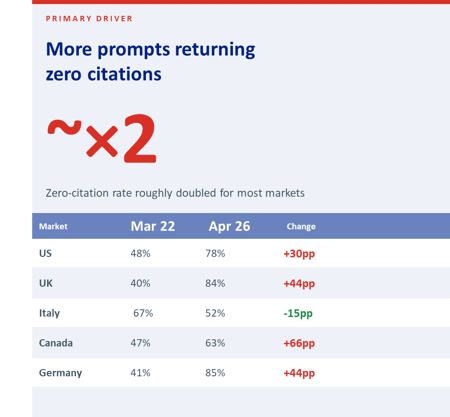
Not only did the zero-citation rate surge again (reaching 85% in Germany), but the average number of citations per cited response also collapsed.
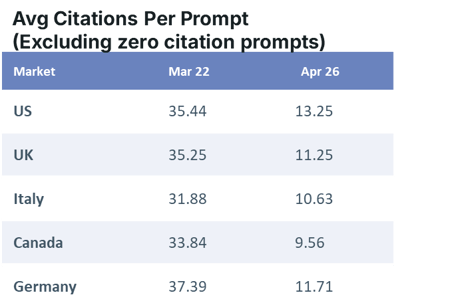
What this means for marketers: This means even when your brand appears in a cited response, you are competing for fewer total slots. Both levers (frequency of citations and number of citations) are now moving downward simultaneously, compounding the impact on brand visibility.
We believe that this may indicate that ChatGPT is now relying more on its training data and less on the live web. As a result, your strategy should move upstream. Embedding your brand in the model’s core knowledge has likely become critical for maintaining visibility.
The story took an unexpected turn in May. After tracking the steep March and April declines, our team observed ChatGPT citations rebounding, with both the share of responses showing citations and the number of citations per response recovering toward their pre-March levels.
Because seoClarity was the first in the industry to report the original collapse in cited sources back in March, seeing the metric snap back this quickly reframes what we're really looking at.
This is not a single, permanent step-down in how ChatGPT uses the live web. It is volatility: sharp moves in both directions, on OpenAI's timeline rather than the market's.
We're continuing to watch closely to see whether the reversal holds. But the broader lessons stand regardless of where the number ultimately settles:
Germany provided a fascinating case study in volatility. During the first March update, while other markets were declining, Germany actually saw a decrease in zero-citation rates (52% to 41%), briefly bucking the global trend.
However, this "defiance" was short-lived. By the April update, Germany’s zero-citation rate surged to 85%, the highest of all markets, completely erasing its earlier gains and resulting in one of the most severe collapses in visibility.
The data revealed significant regional differences in how these updates were absorbed. The UK ended the study period with the sharpest overall decline in citation volume.
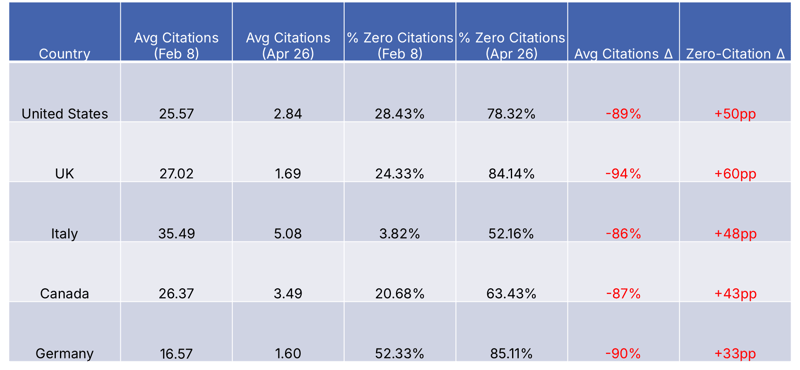
Conversely, Italy was the only market to show resilience; after experiencing significant declines in March (-66%), it was the only market to bounce back in April.
Italy uniquely saw its zero-citation rate improve (falling from 67% to 52%) during the same period other markets were collapsing, suggesting a localized or language-specific algorithmic adjustment.
The old AI search question was: “How do we get cited?” The better question now is: “Does the AI know, trust, and recommend our brand when no citation is provided?”
That changes the marketer’s job.
AI visibility is becoming less about winning individual links and more about building durable brand authority inside the model’s understanding of a market. In other words, brands need to be more than discoverable. They need to be “memorable” to the machine.
The main risk is not simply losing referral traffic from AI answers. The bigger risk is being absent from AI-shaped consideration.
Buyers are using AI search engines to compare vendors, understand categories, build shortlists, validate choices, and pressure-test recommendations. If those answers increasingly appear without sources, the brand still wins or loses influence, but the marketer may never see the click.
That makes AI search a measurement problem as much as a visibility problem.
Traffic is no longer enough. Marketers need to understand whether their brand is being mentioned, recommended, described accurately, and positioned against competitors in the answers that shape demand.
Our data strongly suggests that the decline in ChatGPT citations reflects a fundamental change in how the platform operates, not a reflection of individual brand performance.
Because this is a platform-level shift, your response shouldn't necessarily be to "fix" your content, but to recalibrate your strategy.
This means focusing on authoritative content, earned media, and consistent presence across the broader web to ensure the model "learns" your brand as a default authority for your niche.
Clarity ArcAI enables brands to shift their strategies following ChatGPT’s citation collapse through capabilities designed to build and track long-term brand authority.
In an increasingly source-less AI search environment, brands need to answer these three questions:
When AI search engines keep the traffic and drop external links, you still need to know if your brand is being mentioned in the answer. ArcAI helps you measure this visibility through:
Without a link leading back to your website, the AI answer becomes the sole narrator of your brand story. You must ensure it gets the facts right.
When the AI search engine recommends fewer sources, you need to ensure your brand is the one it chooses for the buyer's shortlist.
Don’t let your brand be filtered out. Connect with our team to discover how our full suite of ArcAI capabilities can help you track, manage, and protect your enterprise’s share of voice in the age of source-less AI search.

.png?width=192&height=192&name=Mitul%20Gandhi%20-%20Author%20Snippet%20(1).png) About the Author: Mitul Gandhi
About the Author: Mitul GandhiAs a longtime data-driven serial entrepreneur, information architect and SEO veteran, Mitul has developed a blend of vast technical expertise and intense marketing insight. His variety of experience, gained in positions in in-house SEO, search marketing, and software development, affords him the ability to efficiently assess how to use software tools to meet challenges and drive ROI. As the Co-Founder and Chief Architect of seoClarity, Mitul currently oversees day-to-day operations, and provides strategic direction to all departments. His well of knowledge includes 10+ years of consulting experience with Fortune 500 and top Internet retailers concerning online search marketing. He has several patents pending for analyzing cause and effect in SEO. Mitul holds an MBA in direct marketing from Rochester Institute of Technology. Additionally, he has spoken at conferences in the United States and the U.K., including SES, SMX and Pubcon. He has also been quoted in MSN Money, USA Today, Time Online, Search Engine Watch, Search Engine Land and Web Pro News. Connect with him on Twitter or LinkedIn.