



The way shoppers find their next favorite product is changing.
The reality today is that greater than 50% of all searches happening worldwide have
some sort of AI-generated response.
Our data also shows that roughly 10% to 15% of searches happen directly on AI search engines, up from less than 1-2% a year ago, while 40% of our tracked keywords trigger an AI Overview. From AI Overviews to ChatGPT carousels and Google's free product listings, there's just so much organic traffic that's being lost right now to all those other features.
So, how can retailers stay visible and competitive? It starts with what they can control: their website's technical readiness, the quality of their product data, and how they measure performance.
Key Takeaways:
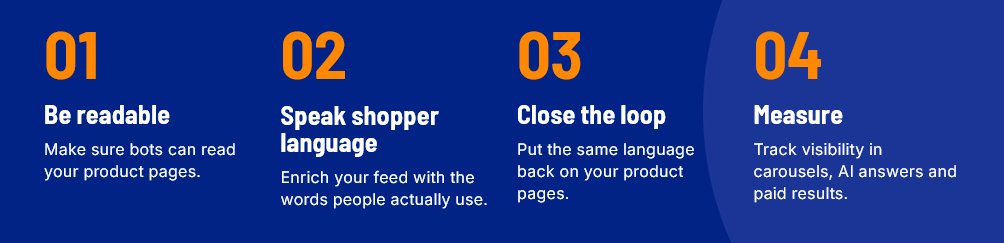
- Be Readable: Serve pre-rendered HTML so AI crawlers can read every product page. If a bot can't read it, nothing else matters.
- Speak Shopper Language: Enrich your feed with the words shoppers actually use. Management gets you approved. Optimization gets you chosen.
- Close the Loop: Write the same language back to your product pages. Feed, page, and AI answers should agree
- Measure: Track carousels, AI answers, and paid feed results. Prove it with an enriched vs. untouched split test.
Table of Contents:
- Winning the Shelf That Pays Now: The Power of the Product Grid
- The Shifting Consumer: Why Branded Search is No Longer a Given
- Four Moves to Make Your Products Ready for AI Search
Winning the Shelf That Pays Now: The Power of the Product Grid
While AI overviews are dominating the conversation, we can't forget about the massive free product listings. Today, 70% of all e-commerce-related keywords trigger a product grid.
A couple of years ago, when these grids exploded in popularity, retailers struggled to explain why their impressions and clicks were down even though their SEO was improving. That displacement continues today.
That being said, optimizing for these product grids is exactly how you get into AI chatbots.
A recent Search Engine Land study of over 40,000 products revealed that 83% of the products shown in ChatGPT's carousel come directly from Google Shopping. While ChatGPT has its own feeds (capable of taking up to a million SKUs per advertiser), it still relies heavily on Google to ensure it shows the right products in the right context.
We know shopping agents are the future, but you have to win in the shelf that pays now. Google still commands the majority of all searches, and the AI Overview is the most-seen AI answer globally. Those free product listings are still a prime opportunity for your brand to gain visibility and improve conversions just by utilizing different product attributes.
The Shifting Consumer: Why Branded Search is No Longer a Given
For the last 15 years, SEOs have taken branded keywords for granted. Head terms always had high demand, and if you captured the top positions for your branded keywords, you were rewarded with a high volume of traffic. The long-tail, informational queries were harder to capture but highly converting.
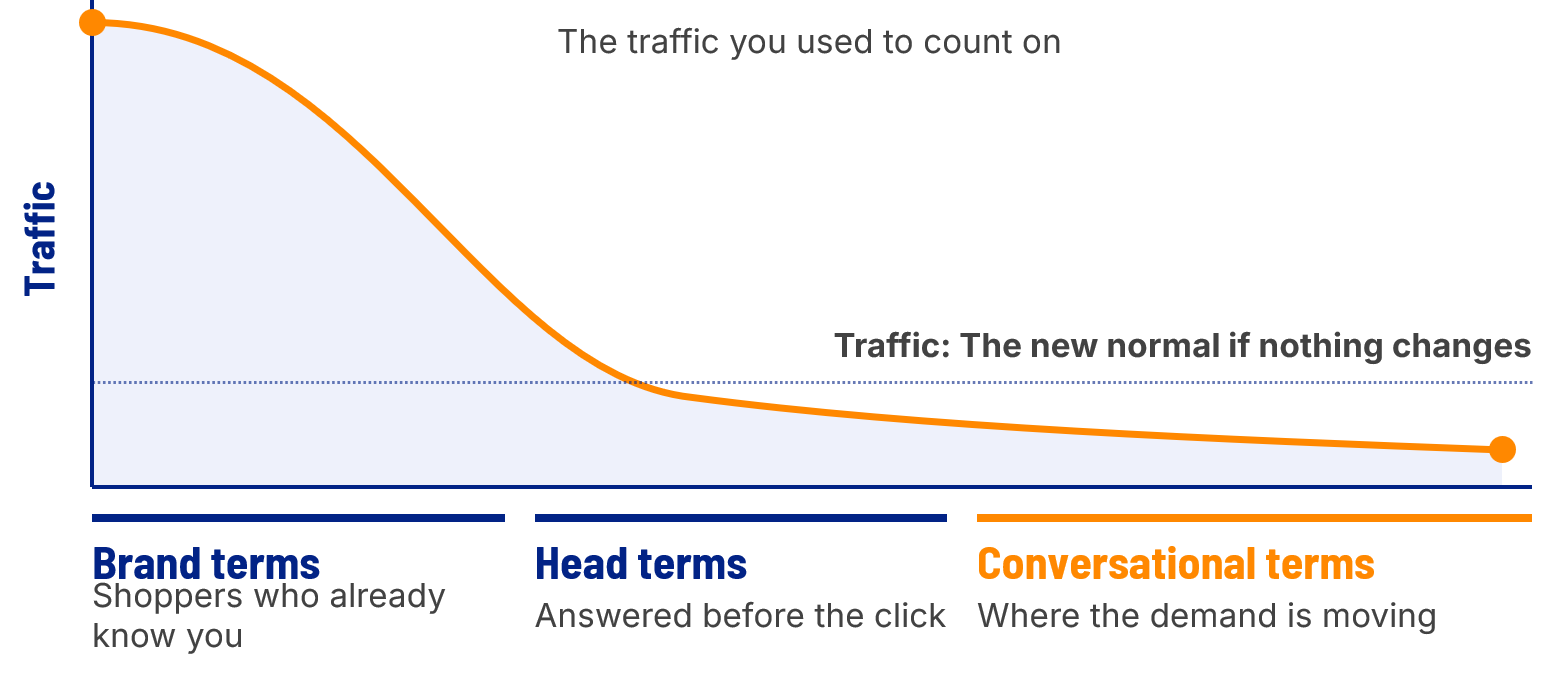
That old curve is gone. Brand search is no longer a given.
How AI is Replacing Direct Brand Trust
AI is intermediating the trust consumers traditionally had with brands. Five years ago, if you wanted a waterproof jacket and liked a brand's eco-credentials, you’d search directly for Patagonia. Today, shoppers pour their hearts into incredibly complex prompts: "I’m looking for a puffy jacket. I’m going to the mountains in December, I might sleep in it, what’s the best option?"
Suddenly, brand affinity is out the window. The AI will serve up three or four companies that match those exact principles and use cases. The playing field is completely evened out.
Four Moves to Make Your Products Ready for AI Search
To win in this environment, you must prioritize two principles:
- Focus on what you can control: The health of your site and the content you put on it (or send offsite).
- Focus on what you can influence: How your brand is positioned and the visibility of your products.
Here are four moves to put those principles into action.
Move 1: Ensure Technical Readability for AI Bots
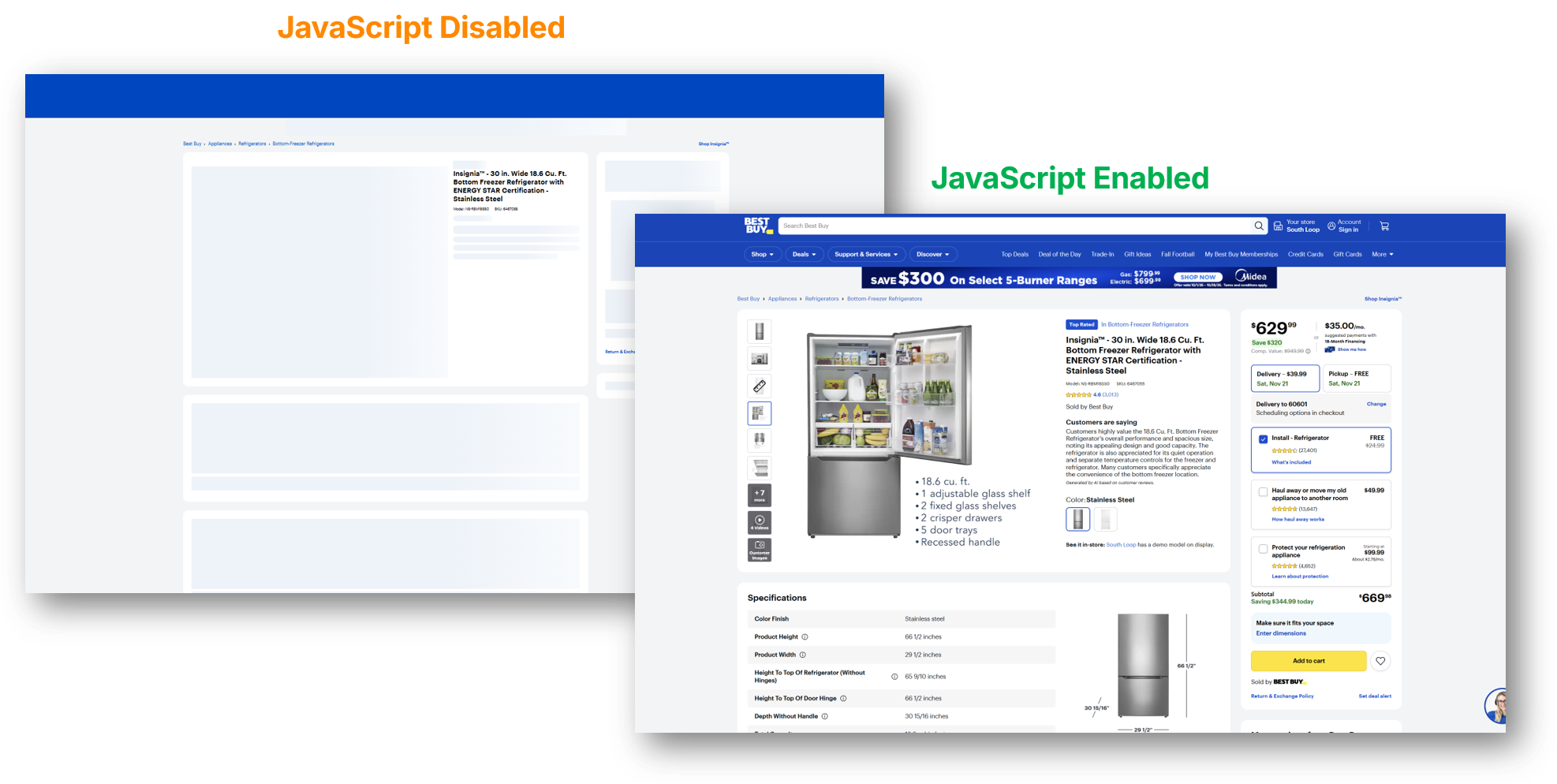
If a bot (whether that's ChatGPT or Google) comes to your site and cannot read your page, nothing else matters. All your great content development is for naught.

For years, we've neglected JavaScript optimization because Google was so good at rendering it. That is no longer the case. ChatGPT and Claude will simply not crawl heavily obfuscated information. Even Google AI Overviews have compute limits; if you have 20,000 tokens of JavaScript junk at the top of your page, the bot will likely skip it entirely because crunching through a massive page is simply too expensive.
Solutions for Immediate Retrievability
We are back to 2005: you have to serve quick, low-latency HTML. You have a few options:
- Fix the code: Use your in-house team to strip out JavaScript junk and publish clean HTML templates.
- Pre-render for bots: If enterprise dev queues make immediate code changes impossible, utilize a solution like seoClarity's Bot Optimizer. It intercepts JavaScript, renders it into HTML, and caches it exclusively for bots. It has proven time and again to not only make sites much lighter from a page-speed standpoint but also guarantee your pages are fully retrievable for AI engines.
Move 2: Speak in Shopper Language and Enrich Your Feeds
When companies initially rushed to put paid feeds into Google Merchant Center and ChatGPT, the engines pushed back. A feed containing 10,000 pairs of socks with the only descriptions being "yellow" or "cotton" isn't good enough for AI.
Google’s advice is clear: optimize your product feed by pre-answering questions. Literally bake an FAQ into your product feed.
Anticipate and Answer the AI's Criteria
If a customer asks an AI for winter socks that are bright pink, a specific height, and made of a bamboo/wool blend that won't sweat, the AI doesn't want to guess which product fits. It will look for the feed that explicitly states: "This blend of bamboo and wool means you will not have funny odors, it’s a non-sweat mix, and you won't get too hot or cold."
AI wants help. It values specific attributes. If you link to reviews in your feed proving that hikers have worn your socks for years without getting holes, the AI recognizes that as a core customer value. You win the recommendation, even against a larger competitor with a cheaper, but sparse, listing. Use experiential language; if your shirt is "buttery soft," make sure the bot knows it.
seoClarity’s Product Feed Optimizer streamlines this process by automatically optimizing every feed so that it is complete, compliant, and enriched with the language real shoppers use.
Move 3: Close the Loop Between Your Feed and Your Site
Often, the paid or merchandising teams manage the product feed while a completely separate team handles the website's SEO. This disconnect will hurt you.
Google wants feeds to answer questions, but it doesn't always trust them for real-time data like pricing, which can change hourly. It will go back to your product page to verify.
If your feed is deeply enriched but your page lacks matching Schema markup (or if the bot can't figure out which of the three prices on the page is the actual product price) Google will assume it’s spam and drop your listing in favor of a competitor.
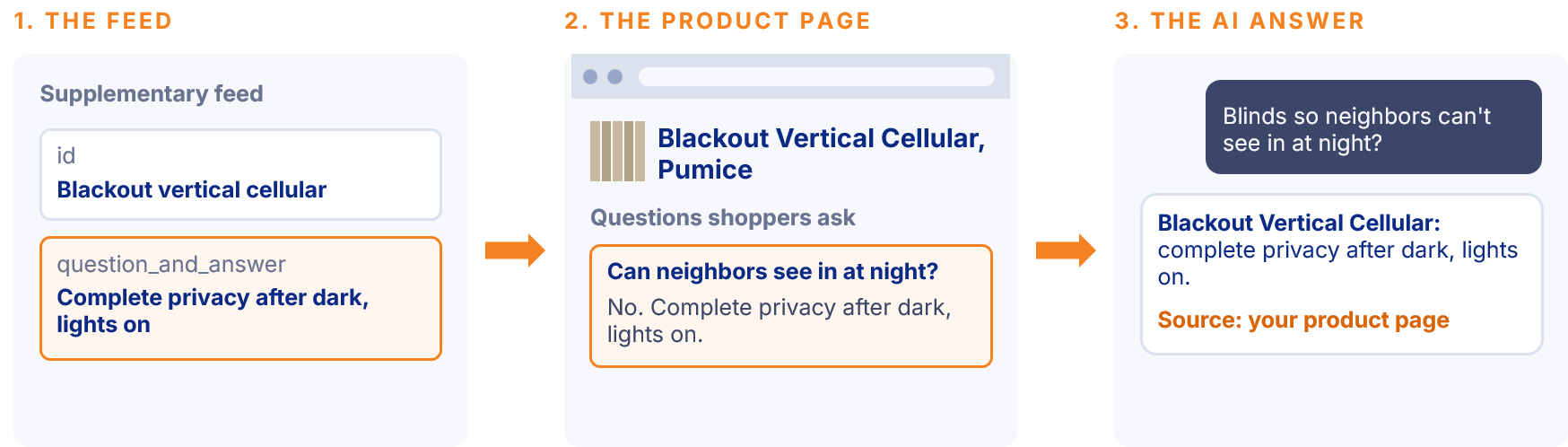
Take the enriched content you build for your feeds, apply it back to your site, and update your Schema.
This is exactly what Clarity Automate was built to solve. It offers a whole suite of execution tools, from our Page Optimizer to our Split Tester, that allows you to instantaneously deploy enriched feed content back to your category and product pages, ensuring bots get a coherent, consistent story across all platforms.
Move 4: Obsess Over Measurement and Testing
Any time you make big changes to product feeds or site structure, you need to know exactly how it impacts visibility.
Start by measuring your rankings simultaneously across your feeds, AI overviews, and organic search. Pay special attention to your AI mentions and citations. If you are being cited over your competitors for a product you all carry, it means you are successfully educating the AI with unique, authoritative content. That citation is proof you are answering exactly what the customer needs.
Using Supplementary Feeds for Testing
Additionally, take advantage of supplementary feeds. You don't have to alter your core feed to test these enrichments. You can set up a supplementary feed in Google Merchant Center as an experiment in a matter of minutes, measuring the campaign lift on both paid and organic visibility.
Agentic shopping is the ultimate unity moment for digital marketing. The AEO and paid teams must work together, because the effort put into enriching sites and optimizing feeds will simultaneously dominate organic AI answers and massive lift paid campaigns.
The best teams are the ones that obsess about testing. The faster you adapt your site's retrievability and enrich your content, the better positioned you will be to capture the shoppers who are actively asking AI for exactly what you sell.
Conclusion:
Winning visibility in AI-powered shopping requires retailers to focus on four priorities:
- Ensure technical readability. Make essential product content accessible in clean HTML so search engines and AI bots can retrieve it efficiently.
- Speak in shopper language. Enrich product feeds with descriptive attributes, FAQs, and customer insights that address specific shopping needs.
- Close the loop. Keep feeds, product pages, and schema consistent, and make enriched content available across the website.
- Test and measure. Track AI mentions, citations, organic visibility, and paid performance to understand what drives results.
Ready to improve your product visibility in AI search? Demo Clarity ArcAI to explore how seoClarity can help you make product content more accessible and actionable at scale.

Comments
Currently, there are no comments. Be the first to post one!