seoClarity Research Study
ChatGPT’s 3 Bots: What Their Crawl Patterns Reveal [Research]
By Saksham Ayush, Data Analyst at seoClarity
Published: September, 2026



By Saksham Ayush, Data Analyst at seoClarity
Published: September, 2026
ChatGPT doesn’t crawl the web with a single bot, and treating its traffic as one uniform stream can obscure what’s really happening with AI search visibility.
Our analysis of 308.6 million server log hits across enterprise websites found three distinct OpenAI bots with very different roles, access patterns, and responses to platform changes.
From February through June 2026, we tracked how ChatGPT-User, OAI-SearchBot, and GPTBot behaved through major citation swings and the GPT-5.5 rollout.
The findings reveal an important disconnect: crawl activity, citation visibility, and model releases don’t necessarily move together. For enterprise teams, understanding those differences can help prevent unintended bot blocking, anticipate infrastructure spikes, and make smarter decisions about technical investments in AI search.
Citation rates and crawl access are not the same metric and do not move together. This study found that after the March 8 citation collapse, search-bot crawl volume at the typical site roughly tripled. After the April 19 collapse, it fell by a third. The two moved in opposite directions.
If citations drop, the crawl infrastructure is likely not the problem. For what to do about citation volatility, read the companion research.
Audit bot access by user-agent, separately, for all three bots. ChatGPT-User (live browsing), OAI-SearchBot (search and citations), and GPTBot (training data) are three distinct crawlers with three distinct user-agent strings. A single WAF or robots.txt rule can block one without touching the others, and most sites have done exactly that by accident. Check each one individually.
Confirm your blocking is intentional. At the typical enterprise site, GPTBot succeeds only 71% of the time, OAI-SearchBot 83%, and ChatGPT-User 95%. If your site is restricting the training bot but not the search and live-fetch bots, that may be the right call. But most of the time, it is a side effect of a broad security rule, not a deliberate decision. Know which one you are in.
Plan server capacity around default model rollouts, not just major launches. When GPT-5.5 became the default model for all ChatGPT users on May 5, 2026, training crawl volume across enterprise sites rose roughly 33% and daily unique URLs crawled jumped 40%. That kind of spike did not happen when GPT-5.5 launched to paid tiers only two weeks earlier. Watch for when a model becomes the default for everyone, not just when it ships.
Make sure your security team knows what a model rollout surge looks like. A 30-40% spike in bot traffic from OpenAI's crawlers during a default model transition is legitimate traffic, not an attack. Set up alerting that differentiates known bot user-agents from anomalous traffic so the response is not a block.
Fix broken redirects and retired URLs being crawled. The typical enterprise site keeps its overall error rate at 2-3%, which sounds small, but at enterprise scale represents thousands of wasted crawl requests. It is a low-effort cleanup with a direct impact on crawl efficiency.
Re-audit quarterly, not annually. In the five months covered by this research alone, search-bot crawl activity at the typical site roughly tripled in one week, then fell by a third in another. A robots.txt policy set in January may already be wrong by March.
Treating AI bot traffic as an undifferentiated stream often leads to unintended access restrictions.
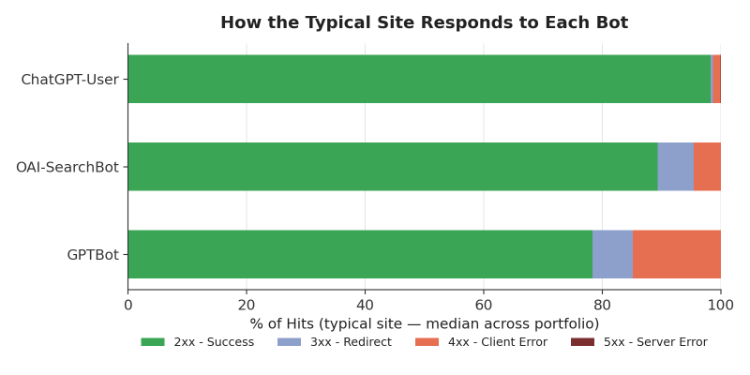
At the typical enterprise site, the bot fetching live pages mid-conversation (ChatGPT-User) succeeds ~95% of the time, while the search bot powering live citations (OAI-SearchBot) achieves an ~83% success rate. Conversely, the training bot (GPTBot) is the most heavily restricted, succeeding only ~71% of the time.
|
Bot |
What It Does |
Typical Success Rate |
What It Means |
|
GPTBot |
Collects training data for OpenAI's models |
~71% |
Most often restricted — worth checking this bot's access specifically |
|
OAI-SearchBot |
Powers ChatGPT's live search and citations |
~83% |
Usually welcomed, though gaps exist at some sites |
|
ChatGPT-User |
Fetches a page live when a person asks ChatGPT to read or browse it |
~95% |
Typically the most welcomed of the three bots |
Note: Figures reflect the median site experience across the portfolio to prevent large participant distortion.
It is likely that this variation occurs because organizations apply broad Web Application Firewall (WAF) or robots.txt rules without realizing they impact each bot differently.
We believe this is a result of security teams prioritizing data privacy by restricting training crawlers, unintentionally causing secondary blocking rules that hinder search and live-fetch crawlers.
It is worth noting that restricting GPTBot may be a deliberate and legitimate choice if data privacy or training concerns are a priority. The goal of auditing is not necessarily to open access to all three bots, but to confirm that the access each bot has reflects an intentional decision rather than an unintended side effect of a broader rule.
Fortunately, crawl budget waste remains low, with typical error rates (including broken redirects, 404s, and blocked requests) holding at 2–3%.
A drop in how frequently ChatGPT cites a domain does not mean the platform has stopped crawling or evaluating that site. In fact, the two major citation declines observed during the analysis period produced very different crawl responses.
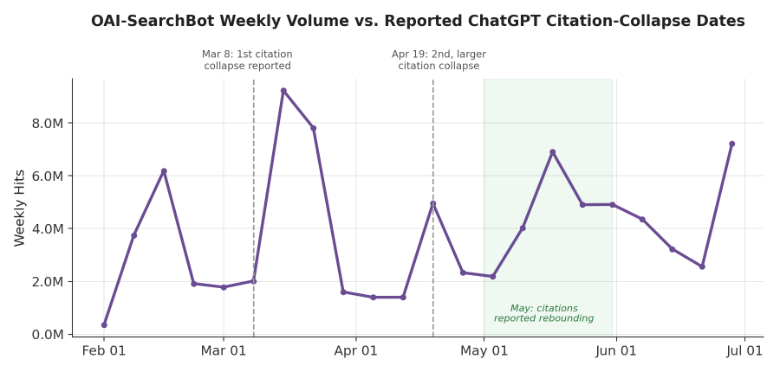
Following the reported March 8 citation collapse, search-bot crawl volume at the typical site roughly tripled. Conversely, after the larger April 19 citation collapse, search-bot activity fell by approximately one-third.
This contrasting behavior reinforces a central finding of the study: changes in citation visibility cannot be reliably inferred from changes in search-bot crawl activity, or vice versa.
|
Date |
Event |
|
Mar 8, 2026 |
First reported ChatGPT citation collapse |
|
Apr 19, 2026 |
Second, larger citation collapse |
|
Apr 23–24, 2026 |
GPT-5.5 Thinking and Pro ship (paid tiers only) |
|
May 5, 2026 |
GPT-5.5 Instant becomes ChatGPT's default model for all users |
|
May 2026 |
Citations reported rebounding toward pre-March levels |
Both swings were broad across the portfolio, though crawl-log data alone can't rule out other contributing factors such as seasonality or unrelated site changes during the same period.
We believe this divergence occurs because OpenAI’s web crawling, index construction, and real-time answer generation systems operate on distinct architectural layers. It is likely that during citation algorithm updates, background indexing increases even as output generation rules tighten.
As a result, measuring AI visibility solely through citation counts provides an incomplete picture of technical site discovery.
Training-bot activity closely correlates with OpenAI's major deployment milestones, though paid-tier releases and default model rollouts appear to impact traffic differently.
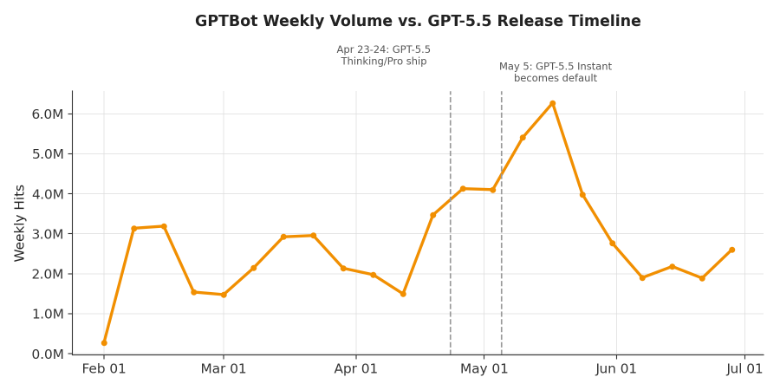
The release of GPT-5.5 Thinking and Pro on April 23–24 to paid tiers produced no portfolio-wide crawl surge. However, when GPT-5.5 Instant became the default model for all users on May 5, portfolio-wide training crawl volume rose by roughly one-third (a portfolio-wide aggregate rather than a per-site median, since weekly per-site figures are too volatile to be individually meaningful).
The contrast between the April paid-tier rollout and May default rollout suggests that not all model launches have the same infrastructure impact.
The significant change occurred when GPT-5.5 Instant became broadly available as the default experience rather than when Thinking and Pro first reached paid users.
Alongside the 33% increase in overall training crawl volume, the median count of daily unique URLs touched grew by approximately 40% between April and May.
Together, these metrics indicate that the post-rollout increase involved not only more bot requests but also broader crawling across enterprise sites.
Hit-count data alone can't tell us whether that reflects newly discovered pages, more frequent revisits to existing pages, or a mix of both.
It is likely that this pattern emerges because OpenAI performs broad re-indexing and data-refresh passes when expanding a model to its entire user base.
We believe this is a result of default models processing significantly higher request volumes, necessitating deeper and broader content extraction across the web.
This study analyzed 308.6 million bot hits across a multi-industry portfolio of enterprise websites between February 1 and June 30, 2026, extracted directly from server log data. To prevent skewed representations from extreme volume, one ultra-large site was excluded from the dataset.
Most figures represent median values across the portfolio (the typical site experience) rather than hit-weighted aggregates. Citation collapse dates and model rollout dates are derived from separate published research and public reporting, serving as temporal context for this independent log analysis.
Bot identification: Traffic from GPTBot, OAI-SearchBot, and ChatGPT-User was identified by User-Agent in server logs. Unlike automated crawlers, ChatGPT-User is triggered by user requests in ChatGPT and may exhibit different request patterns.
Managing AI search presence requires treating OpenAI’s three distinct bots as separate technical relationships rather than a single crawler.
While citation visibility remains subject to OpenAI’s internal model updates, maintaining technical access is within an enterprise's control.
Organizations should routinely audit user-agent access rules, prepare server infrastructure for default model rollouts, and evaluate crawl health independently from citation tracking.
Leverage Clarity ArcAI to continuously track AI bot activity, verify OAI-SearchBot and ChatGPT-User access, and position your enterprise content for maximum visibility across generative engines.