seoClarity Research Study
Google’s May 2026 Core Update:
The Disintermediation Update?
By Mitul Gandhi, Chief Architect & Co-Founder of seoClarity
Published: June 2, 2026




By Mitul Gandhi, Chief Architect & Co-Founder of seoClarity
Published: June 2, 2026
In comparing search data from May 13 (the pre-event baseline) to May 20 (the day before the official announcement), massive ranking volatility was already live.
Specifically, 33.7% of keywords captured a new position-one organic result in just one week.
In addition, 19.8% of the total search query volume monitored experienced a complete shift at the very top of the organic search results page.
The early data indicates that this update is structural rather than random.
Across multiple competitive industries, direct providers of services, products, and information experienced sharp upward trajectories in net organic visibility:
|
Website Category (Gaining) |
Net Organic Visibility Delta (May 13 - May 20) |
|
Video Platforms & Streaming Sites |
+26.3% |
|
Sports Brand Sites (Leagues, Team Brands) |
+19.3% |
|
Finance Brand Sites (Direct Banks, Brokerages, Insurers) |
+9.5% |
|
Direct Travel Brands (Airlines, Hotel Chains) |
+8.2% |
|
Retail Brand Sites (Direct Retailers, Marketplaces) |
+4.7% |
|
Reference Sites (Encyclopedias, Dictionaries) |
+3.7% |
Google’s algorithms appear to be preferencing authoritative, primary pages stemming from the actual end-destination. Whether it is a direct bank or an official sports league, the update seems to favor the native source of the information or service.
Conversely, intermediaries and platforms whose core value proposition relies on compiling, reviewing, or summarizing other people's data saw a uniform drop across the board.
|
Website Category (Declining) |
Net Organic Visibility Delta (May 13 - May 20) |
|
App Store & Corporate "About" Pages |
-33.4% |
|
Tourism Boards (City/State Destination Sites) |
-33.2% |
|
Travel Aggregators (OTAs, Booking Sites) |
-11.0% |
|
Finance Aggregators (Comparison, Affiliate, Advice Sites) |
-9.1% |
|
Social & UGC (Social Networks, Forums) |
-6.3% |
|
News Publishers (News, Tech, and Lifestyle Media) |
-6.2% |
The mirrored data between industries is impossible to ignore. In travel, direct brands rose 8.2% while Online Travel Agencies (OTAs) and aggregators dropped 11.0%. In finance, direct brand sites rose 9.5% while comparison and affiliate sites fell 9.1%.
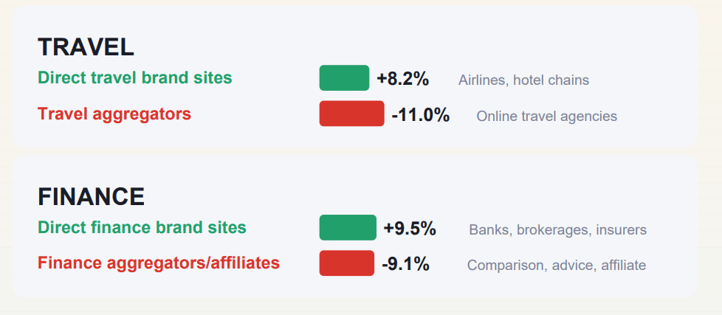
This data begs a critical question for enterprise search strategies: Is the aggregator’s value proposition being absorbed by search engines, or is this a temporary rebalancing?
It wasn't just individual websites that shifted; Google completely transformed how it displays its own search feature containers.
The frequency with which specific Google elements were rendered across the keyword universe changed drastically between May 13 and May 20:
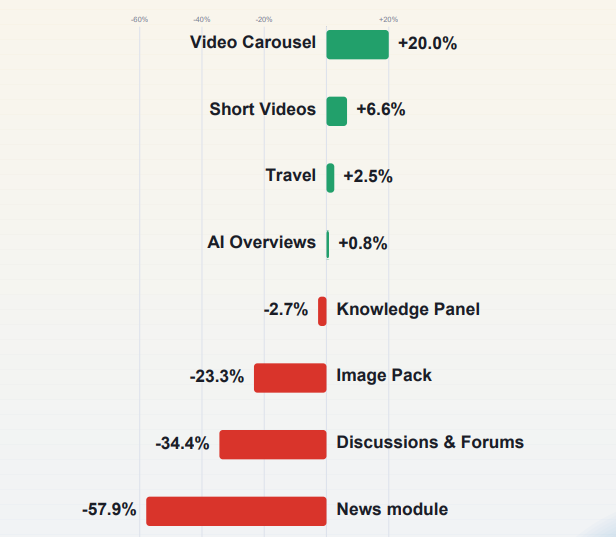
The steep drop-offs in the News module and Discussions & Forums showcase a pivot away from aggregate consumer chatter and third-party media reports, while visual, engagement-heavy media like video carousels received a massive structural boost.
.png?width=192&height=192&name=Mitul%20Gandhi%20-%20Author%20Snippet%20(1).png) About the Author: Mitul Gandhi
About the Author: Mitul GandhiAs a longtime data-driven serial entrepreneur, information architect and SEO veteran, Mitul has developed a blend of vast technical expertise and intense marketing insight. His variety of experience, gained in positions in in-house SEO, search marketing, and software development, affords him the ability to efficiently assess how to use software tools to meet challenges and drive ROI. As the Co-Founder and Chief Architect of seoClarity, Mitul currently oversees day-to-day operations, and provides strategic direction to all departments. His well of knowledge includes 10+ years of consulting experience with Fortune 500 and top Internet retailers concerning online search marketing. He has several patents pending for analyzing cause and effect in SEO. Mitul holds an MBA in direct marketing from Rochester Institute of Technology. Additionally, he has spoken at conferences in the United States and the U.K., including SES, SMX and Pubcon. He has also been quoted in MSN Money, USA Today, Time Online, Search Engine Watch, Search Engine Land and Web Pro News. Connect with him on Twitter or LinkedIn.