SEO Split Testing Playbook
Structured Data Increased Organic Clicks
on Listing Pages
By JP Jira, Client Success, ClarityAutomate
Structured Data | Product/PLP




By JP Jira, Client Success, ClarityAutomate
Structured Data | Product/PLP

CollectionPage markup with an embedded itemList gives Google a machine-readable inventory of what sits on the page. They wondered if removing the guesswork would improve how these URLs, and the products within them, were matched and surfaced, and that clicks would follow.
There was also a fair case against it. CollectionPage is not tied to a rich result, so on its own it changes no visible SERP feature, and Google already parses commerce templates well. Plenty of valid markup earns nothing in clicks. That uncertainty is why it was worth a controlled test rather than a sitewide bet.
The team used SEO Split Tester and started from the top PLPs with consistent traffic and split them evenly into test and control.
Test pages received CollectionPage structured data with an itemList of their products; control pages were left untouched.
The test ran for about seven weeks. They measured organic clicks from Google Search Console and analyzed them with Google's Causal Impact model, which forecasts how the test pages would have performed without the change by learning from the control group. Control correlation was validated as excellent before launch.
The test ran for four weeks across roughly 7,500 URLs, with clicks as the primary metric and impressions as a secondary metric of consideration. It was powered by SEO Split Tester within the seoClarity platform.
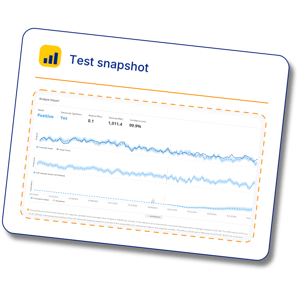
Verdict: Positive lift, significant at 99.8% confidence
Test pages vs forecast: about +10% clicks
Absolute effect: roughly +1,011 clicks over the test period
Control correlation: excellent, validating the baseline
.png?width=800&height=419&name=_STP%20-%203%20-%20Image%201%20(CollectionPage%20Structured%20Data).png)
Editorial Note: Because Causal Impact builds its forecast from the control group, the ~10% is not the test pages' raw growth. It is the gap between how they actually performed and how comparable, untouched pages behaved over the same window. That is the figure that matters, and it clears the 95% confidence bar most tests aim for with room to spare.
Structured data can earn clicks even when it triggers no visible rich result. Declaring a page's contents outright seems to help Google place a listing page, which is the page type where it otherwise has the most to infer.
For this automotive brand's test, they learned that wherever a page's structure is implicit in the HTML, it is worth testing whether making that structure explicit changes performance.
Extend CollectionPage and itemList markup to the remaining PLPs. A phased, monitored rollout is worth preferring over flipping every page at once, so the effect can be confirmed at full scale before it is banked.
This was a controlled split test, not a before-and-after guess. Comparable pages were held back as a control, so the lift reflects the change rather than seasonal swings or background noise.
It ran on seoClarity's SEO Split Tester with minimal setup and no extra tooling, proving the result before any sitewide rollout.
Structured data is just one idea worth testing. The same approach works for content, internal linking, or template changes you would rather prove than guess at.
Want to run a version of this test? See how seoClarity can help.