SEO Split Testing Playbook
Removing Top-of-Page Copy Lifted
Clicks on Category Pages
By Matt Greco, Sr. Technical Account Manager
Content Strategy | Category/PLP




By Matt Greco, Sr. Technical Account Manager
Content Strategy | Category/PLP
The question behind this test: does search performance follow what a shopper sees first? A shopping query is best answered with products, so a page that shows them immediately may be a better match for that intent, to searchers and to the signals Google uses to judge a result.
The case against is already in this Playbook. Adding copy above the grid lifted clicks for an enterprise tools retailer, on the logic that the text gives Google category-level language to rank on. Removing it risked weaker relevance for the broad queries these pages depend on.
The team used seoClarity's SEO Split Tester to split 46 category pages evenly into 23 test pages and 23 control pages.
The test pages lost the copy above the product grid, which moved the grid into the first screen. Bottom-of-page content stayed. Control pages kept both blocks as they were.
The test began in July and ran into September, on test pages that together earn over 4,000 organic clicks a day.
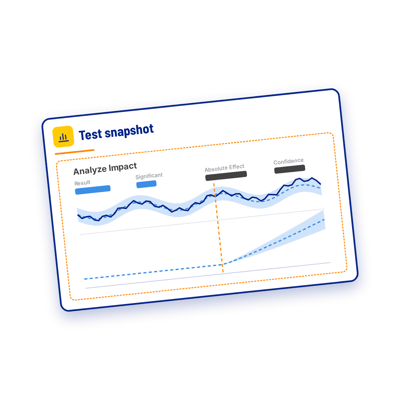
Verdict: Positive lift, significant at 99.9% confidence
Test group: +730 organic clicks vs. the model's predicted performance
.png?width=800&height=419&name=STP%20-%205%20-%20Image%201%20(Analyze%20Impact).png)
.png?width=800&height=419&name=STP%20-%205%20-%20Image%202%20(Test%20vs.%20Control).png)
* Editorial Note: Clicks declined in both groups during the test, so none of these figures is raw growth. The 12,760 clicks are the gap between what the test pages earned and what Causal Impact forecast from the untouched control pages. The 6.5-point gap is a simpler Search Console view of the same comparison.
For this retailer, what filled the first screen mattered. Products in view earned more clicks than copy above them, while the lower copy still gave each page descriptive text.
That doesn't overturn the earlier finding that adding top copy can help. The two tests ran on different sites, templates, and copy. Together they suggest top-of-page copy is worth testing in both directions, and that how far it pushes products down may matter as much as whether it exists.
Impressions are the qualifier. Test pages lost visibility against control even as their average position (3.91 to 3.75) and CTR improved, which would fit losing some peripheral queries the removed copy happened to match. The change was deployed through ClarityAutomate.
Extend the change across the rest of the PLPs in phases, starting where top copy pushes the grid furthest below the fold. Track impressions alongside clicks at each phase, since that is the metric that moved against the test pages.
This was a controlled split test, not a before-and-after comparison. Comparable pages were held back as a control, so the lift reflects the change rather than seasonal swings or background noise.
It ran on seoClarity's SEO Split Tester with minimal setup and no extra tooling, proving the result before any sitewide rollout.
Page layout is one idea worth testing (in either direction), and a held-back comparison can settle internal linking, structured data, or title tag questions the same way.
Want to run a version of this test? See how seoClarity can help.