SEO Split Testing Playbook
Linking Detail Pages to Their Location Pages Lifted Visibility
By Matt Greco, Sr. Technical Account Manager
Internal Linking | Product/PDP



By Matt Greco, Sr. Technical Account Manager
Internal Linking | Product/PDP

The bet was that linking to location pages from the job-detail pages related to them would pass authority and crawl signals downstream, lifting the linked location pages. The team also suspected the benefit could run both ways, with the detail pages gaining from a more connected structure.
It is a reasonable theory, but not a certainty. Internal links are a real ranking signal but a diluted one, and a few more can get lost in the noise. That uncertainty is why the idea was worth testing rather than shipping on faith.
The location pages were split into test and control groups. Location links were then added only to the job-detail pages tied to the test-group locations, leaving the control group untouched. That isolates the variable: any divergence between the groups traces to the added links, not to seasonality or sitewide changes that hit both alike.
The test ran for four weeks across roughly 7,500 URLs, with clicks as the primary metric and impressions as a secondary metric of consideration. It was powered by SEO Split Tester within the seoClarity platform.
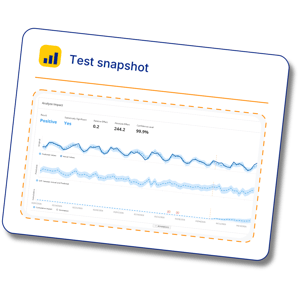
Verdict: Positive lift, significant at 99.8% confidence
Test pages: +1.3% clicks
Control pages: -17.9% clicks
Gap between groups: roughly 19 points in the test pages' favor
The test-group location pages rose 1.3% in clicks at 99.8% confidence, clearing the 95% bar with room to spare.
.png?width=800&height=419&name=STP%20-%201%20-%20Image%201%20(Linked%20vs%20Unlinked).png)
The comparison is what matters. Over the same four weeks, the control pages, which got no new links, fell 17.9%. The test pages rose while comparable pages dropped nearly eighteen points, so the effect of the links is that whole gap between the two groups, not the 1.3% by itself.
.png?width=800&height=419&name=STP%20-%201%20-%20Image%202%20(Test%20+%20Control).png)
Well-placed internal links tend to help both ends of the link: the pages they point to, and the pages they sit on.
A visibility problem does not always live on the underperforming page. Sometimes it lives in what links to it. The finding held up, too: the same approach, re-tested in two other country markets, produced the same result.
Add location links to every job-detail page that has a corresponding location page. Because that relationship is already defined by the site's structure, the change scales without manual, link-by-link work.
This was a controlled split test, not a before-and-after guess. Comparable location pages were held back as a control, so the lift can be trusted as the effect of the new links rather than background noise.
It ran on seoClarity's SEO Split Tester with minimal setup and no extra tooling, proving the win before any sitewide rollout.
Internal links are just one idea worth testing. The same approach works for content, schema, or template changes you would rather prove than guess at.
Want to run a version of this test? See how seoClarity can help.