Free Trial

Type “hotels in Berlin” into Google while you’re in Berlin. Then run the exact same search from Boston.

Since September 8, 2026, those two searches return two very different pages.

Google has rolled out a redesigned results page across the European Economic Area (EEA) to comply with the EU’s Digital Markets Act (DMA). For hotels, flights, ground transport, products, and local businesses, the familiar Google-owned features are gone. In their place are new units built around third-party aggregators and direct suppliers.

Here’s the catch: the index, the crawler, and most ranking systems haven’t changed. What changed is the page itself, and only for searchers in certain markets.

We call it one Google, two SERPs.

Key Takeaways

  • Since September 8, 2026, EEA searchers see aggregator and supplier units in place of Google’s own hotel, flight, transport, shopping, and local features.
  • Only aggregators approved as Vertical Search Services get the rich, expanded unit. Direct suppliers appear in a thinner carousel without live prices.
  • The change applies to the 30 EEA countries only. The UK and Switzerland keep the standard layout.
  • Enterprise teams need reporting split by market, device, and brand vs. non-brand to explain what is happening to visibility and CTR.

How Did We Get From the 2024 Carousel to the 2026 Fine?

The DMA bars gatekeepers like Google from ranking their own services above comparable third-party services.

Google’s first response to the DMA, rolled out in March 2024, added new units such as a Comparison Sites carousel. But it kept its own Hotel Pack and Shopping features on the page.

At the time, we tracked 156,000 hotel keywords from March 1 to April 26, 2024. The Comparison Sites unit appeared on about 24% of queries. The Hotel Pack’s share of top positions fell from over 95% to 70%, and the Hotel Pack moved down to second position, about 380 pixels lower on the page.

The European Commission decided that wasn’t enough. On July 23, 2026, it fined Google €890 million for DMA breaches. Of that, €460 million was for self-preferencing in Search across shopping, hotels, transport, and sports results. Google had 60 days to comply.

Date

What happened

Sept 18, 2026

Google adds local businesses to aggregator and supplier units

Mid-Sept 2026

Free product listings and product carousels disappear from EEA results

Sept 8, 2026

Redesigned EEA results page goes live

Aug 30, 2026

Site reputation abuse manual actions stop applying to EEA searches

July 23, 2026

Commission fines Google €890 million and sets a 60-day deadline

March 2024

First DMA changes, including the Comparison Sites carousel

What Changed on September 8?

Google replaced its own vertical features with two new units that sit where the Hotel Pack or Shopping results used to be. Search Engine Journal and Google’s regional features documentation lay out the structure.

For a qualifying query, an EEA searcher now typically sees:
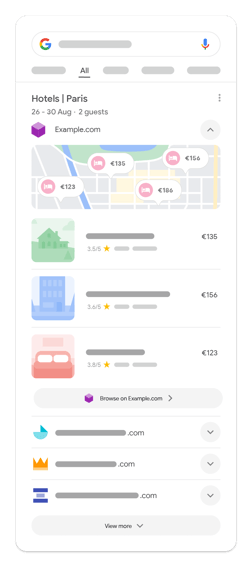
  • An aggregator unit. One vertical search service, such as a hotel or flight comparison site, is expanded by default. Other approved services sit behind a switcher.

    aggregator unit

Image from https://developers.google.com/

A supplier unit. A carousel of direct providers, such as hotels, airlines, rail operators, or retailers.
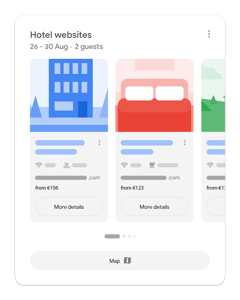
supplier-unitImage from https://developers.google.com/
  • Organic results below, plus other EEA-specific features like job sites and ecosystem carousels.

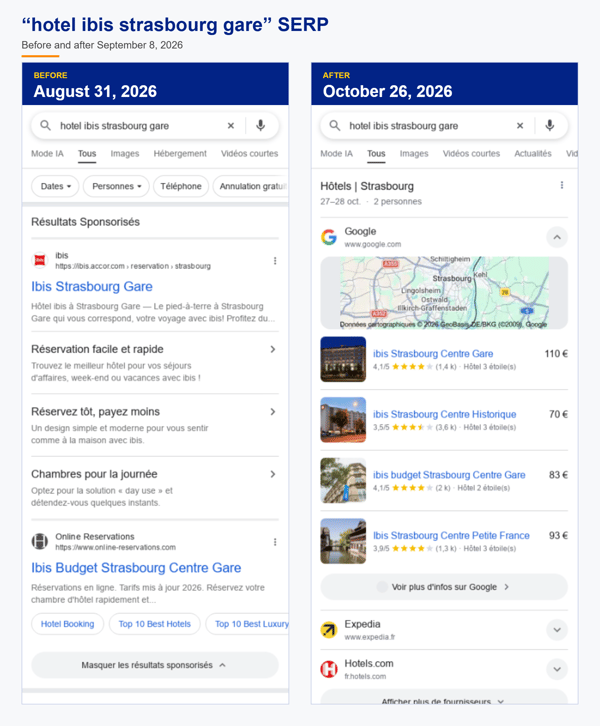
Hotel SERP comparison

The scope keeps growing. The units launched for hotels, flights, long-distance trains and buses, and products. On September 18, Google added local business queries such as dining, services, and things to do.

Google isn’t hiding how it feels about the result. Nick Fox, Google’s SVP of Knowledge and Information, called it the largest reduction in search quality in Google Search’s 29-year history, as reported by Reuters.

Which Markets Get the New Layout?

Global teams often use “Europe,” “the EU,” and “the EEA” interchangeably. For this change, only the EEA counts.

Gets the new layout (EEA)

Keeps the standard layout

All 27 EU member states: Austria, Belgium, Bulgaria, Croatia, Cyprus, Czechia, Denmark, Estonia, Finland, France, Germany, Greece, Hungary, Ireland, Italy, Latvia, Lithuania, Luxembourg, Malta, Netherlands, Poland, Portugal, Romania, Slovakia, Slovenia, Spain, Sweden

United Kingdom & Switzerland (we have not seen the new units there)

Plus Iceland, Liechtenstein, and Norway

All markets outside Europe

There’s an Enforcement Split, Too

The layout isn’t the only difference. Since August 30, site reputation abuse manual actions no longer apply to EEA searches.

Instead, Google says it will separate affected sections from their host domain so they rank independently over time. That means the same URL can be treated differently inside and outside the EEA.

What Is the Difference Between Aggregator and Supplier Units?

This is the most important question for your team: which unit does your business belong in?

The two units have very different entry requirements, and only one of them carries rich data.


Aggregator unit

Supplier unit

Who appears

Approved vertical search services (OTAs, comparison sites, directories)

Direct providers (hotels, airlines, retailers, local businesses)

How you get in

Apply for Vertical Search Service approval; supply a feed or live API

No approval; crawlable content serving EEA users

Data sources

Lodging or POI feeds, Partner Standard Live API, Transport Features API, Comparison Shopping Services

Crawled site content, optionally enhanced by feeds

Display

One service expanded by default, others behind a switcher

Carousel with limited detail

When it shows

Qualifying hotel, flight, ground transport, product, and local queries

Only when an aggregator unit is triggered

Sources: Google’s regional features documentation and Relevant Audience’s breakdown of the eligibility requirements.

A few details are easy to miss:

  • Only one aggregator is expanded per results page. Google hasn’t published how it picks that aggregator. Being approved isn’t the same as being visible.
  • The supplier unit depends on the aggregator unit. If no aggregator unit triggers, the supplier unit doesn’t appear either.
  • Suppliers compete on what Google can crawl. Clean entity data on your own pages (name, address, category, images, ratings) is what feeds your supplier unit presence.

What This Means for Your Business Type

  • OTAs, marketplaces, and comparison sites gain a prominent slot. In return, they now have to manage feed quality and approval across every vertical and market they serve.
  • Hotel groups, airlines, and retailers lose the rich, Google-hosted features they relied on. They now compete in a slimmer supplier carousel or in organic results.
  • Brands that are both (for example, a retailer that also runs a marketplace) should check whether they qualify for aggregator approval in specific verticals.

What Was Stripped From EEA Results?

The supplier-side units are noticeably thinner than the Google features they replaced. In our own checks across EEA markets, we’ve seen these removals:

  • Live prices in the hotel, airline, and restaurant carousels. Supplier listings now show a link, phone number, and address instead.
  • Trip-date entry and date filtering for travel searches.
  • Descriptive tags such as “budget” or “boutique.”
  • The vacation rentals unit in Search. Skift reports it remains on Google Maps and google.com/hotels.
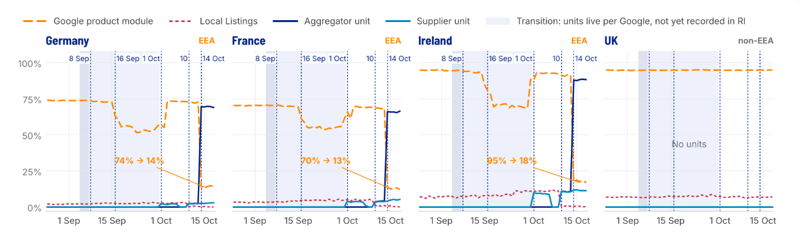
  • Free product listings and product carousels. Google's product module disappeared for the vast majority of our tracked ecommerce queries in mid-October. In seoClarity Rank Intelligence (RI) data, Google's product module appearances dropped from a baseline of 70–95% down to just 13–18% across France, Germany, and Ireland. Over the same period, our control market (the UK) showed no meaningful change, holding steady at about 95%. Google’s Ads Liaison confirmed the removal was due to the DMA ruling. 

That said, prices haven’t vanished from the page entirely. Aggregator units still show photos, prices, and ratings for the expanded provider.

What changed is who owns the price display: the intermediary, not the supplier or Google.

Why Does This Matter for Direct Brands?

A price in a Google-hosted unit often answered the searcher’s first question before the click. Without it, a supplier listing has to earn the click with the brand name and whatever Google can show from your site.

That raises the value of a few things you control:

  • Accurate, crawlable pricing and availability on your own landing pages.
  • Strong organic listings for brand and brand-plus-location queries, where searchers already intend to book direct.
  • Consistent entity data across your site, Business Profiles, and any feeds you still maintain.

There’s precedent for the impact. After its earlier DMA changes, Google reported in November 2024 that free direct booking clicks were down as much as 30%. That figure comes from Google and covers the earlier changes, so treat it as a reason to measure your own baseline, not as a forecast.

Action Tip: Before you change anything, capture a clean baseline of your supplier listings in each EEA market. You’ll need it when leadership asks what changed.

What seoClarity Data Shows by Country: The EEA Is Not One Market

The EEA search landscape hasn't just split in two; it has fractured across markets, verticals, and devices. 

To see how the change played out market by market, we looked at seoClarity's Rank Intelligence data for hotel, flight, and product queries before and after the change.

Methodology:  This study analyzes top-10 search results using seoClarity Rank Intelligence (RI) True Rank data for tracked keyword sets. To isolate the impact of the new SERP features, we compared primary EEA markets (France, Germany, and Ireland) directly against non-EEA controls (the UK and Switzerland). Data was gathered daily on mobile for flights and ecommerce, and weekly on desktop for hotels. Finally, we measured net visibility changes by comparing a clean, pre-launch baseline (August 25–September 4, 2026) against the post-launch landscape (October 1–18, 2026). 

Key Insights:

  • About half or more of tracked travel keywords in FR and DE show at least one aggregator or supplier unit in the top 10. Before launch: none.
  • The units are EEA-only in this data: the UK and Swiss controls show none on any date.
  • Google’s own flight, hotel, and product boxes shrank in the EEA only, by 22 to 77 points net of the controls.
  • Flights lost organic position 1 far more often where a unit appeared. Hotels gained it.

What We Found 

The introduction of the new aggregator and supplier units directly cannibalized Google's legacy modules, but the ripple effects on organic visibility look entirely different depending on your vertical.
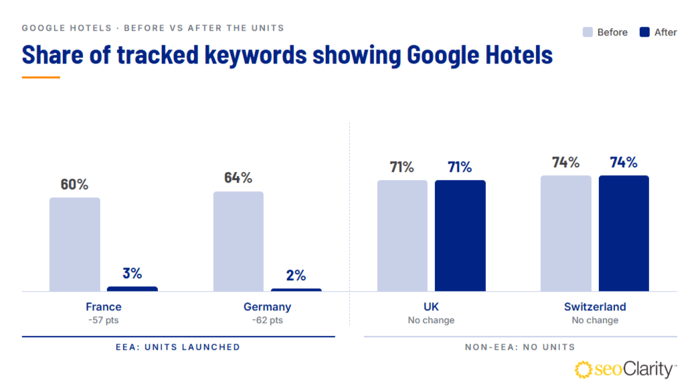
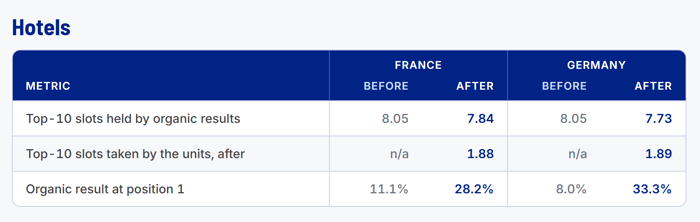
Hotels: Organic visibility at the top actually improved.

  • The Data: Google Hotels held steady through September but collapsed during the first week of October. In France and Germany, Google Hotels fell from a baseline of 61% and 66% down to just 3% and 2%, respectively. 

EEA Hotels before-after

  • Why It Matters: Because the new units replaced the top-heavy Google Hotel Pack, organic results actually moved up. The share of keywords with an organic result at position 1 more than doubled in France (11.1% → 28.2%) and quadrupled in Germany (8.0% → 33.3%). 

Hotels dma comparison chart

Flights: Severe drop in top-of-page organic visibility.

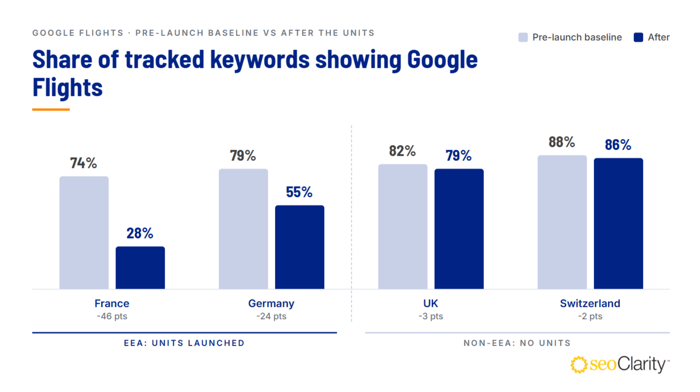
  • The Data: RI recorded the aggregator unit on October 1, reaching 51.8% (FR) and 55.7% (DE) of keywords by October 18. Consequently, Google Flights dropped from a 74% baseline to 28% in France, and from 79% to 55% in Germany. AI Overviews also rose aggressively in October for FR (+18.6 points) and DE (+20.0 points). 

Google flights before and after DMA

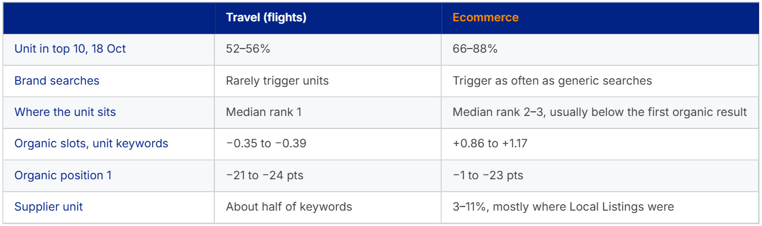
  • Why It Matters: The travel units heavily dominate the top of the SERP (median rank 1). As a result, organic position 1 was decimated, dropping by 21 to 24 points (FR: 53.9% → 30.4%; DE: 40.2% → 19.3%). Where both new units appear, the first organic result is now pushed down to position 3 or lower on 69% (FR) and 79% (DE) of flight keywords. 
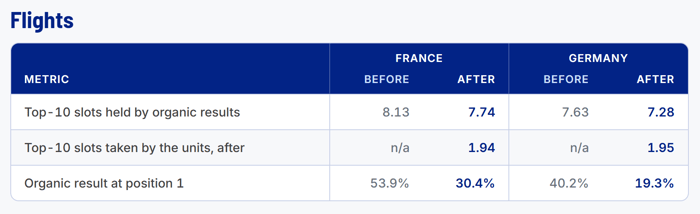
Flights dma comparison chart
 Ecommerce (Products): High disruption, but a net gain in organic slots. 

  • The Data: On October 14, the aggregator unit jumped to 69% in Germany, 66% in France, and 88% in Ireland. Simultaneously, Google's own product module fell from its baseline (74%, 70%, and 95%, respectively) down to just 14%, 13%, and 18%. 

dma ecommerce product module vs the units

  • Why It Matters: The net effect on organic results is mixed. Before the launch, Google’s product module took up about two positions per keyword in the EEA. Because the single aggregator unit replaced it, it freed up space, resulting in an overall organic slot gain of +0.86 to +1.17 for ecommerce keywords. However, the top spot still suffered: organic position 1 dropped by 1 to 23 points across these markets. 

DMA ecommerce vs travel

Switzerland and the UK: The Non-EEA Controls stayed flat.

  • The Data: The UK and Switzerland showed zero new units on any date. Google’s own modules moved by a negligible 2.5 points or less (e.g., UK flights moved 82% → 79%, Switzerland flights 88% → 86%).
  • Why It Matters: This confirms that the massive visibility shifts in France, Germany, and Ireland are strictly isolated to the EEA rollout.

Which Searches Show the Units?

The new travel units are hyper-targeted toward generic discovery rather than brand navigation. In both France and Germany, the units appear almost exclusively on keywords that previously triggered Google’s own comparison boxes (a 91.7% and 92.4% match rate for flights).
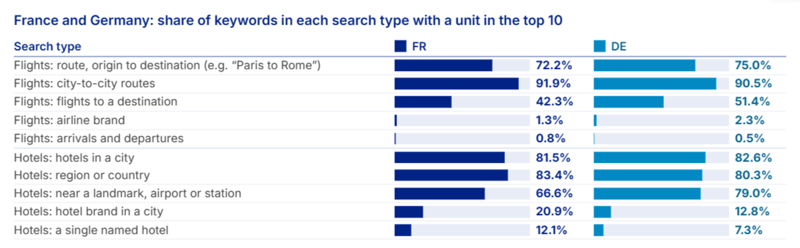
  • Generic Routes & Cities: Generic "city-to-city" flight searches trigger a unit over 90% of the time. "Hotels in a city" searches trigger a unit on 81.5% (FR) and 82.6% (DE) of queries.
  • Brand Searches: The units rarely appear for travel brands (triggering on just 1.3% of FR airline searches and 12.1% of FR single named hotel searches).
  • The Ecommerce Exception: Unlike travel, ecommerce brand searches trigger the new units just as often as generic non-brand searches do.

Searches the show units EEA study

Overall Effect on Organic Results

Google’s own boxes gave up roughly as many slots as the new DMA units took, meaning the net organic slot loss across the top 10 was relatively small in travel (and resulted in a slight gain for ecommerce). 

Why Does Frequency Vary by Country?

  • Aggregator coverage differs by market. A unit can only trigger when approved services have relevant listings for that country and language.
  • Query mix differs. Destination, product, and local demand patterns change what share of your keyword set qualifies at all.
  • Rollout is staggered by vertical. Local business support arrived 10 days after the main launch.

What Should You Measure in Each Market?

Track each market separately, on a fixed keyword set and by device, before blending anything into a European total.

Metric

What it tells you

Aggregator unit frequency (% of tracked queries)

How much of your demand now routes through intermediaries first

Supplier unit frequency, and your presence rate within it

Whether your direct listings appear when the unit triggers

Top-ranked aggregator share

Which intermediaries control the expanded slot in each market

Pixel depth of the first organic result, by device

How far down the page organic visibility now starts

Remaining legacy features (Hotel Pack, product carousels)

Whether rollout is complete in that market

Change vs. a non-EEA control market

Whether movement is DMA-driven or seasonal


With Rank Intelligence from seoClarity, you can track the aggregator and supplier SERP features by country and device on the same keyword set, so the EEA and non-EEA views line up side by side.

What Didn’t Change?

The split is real. However, much of what drives search performance still works the same way in every market.

  • Informational and most non-commercial queries. The units target hotels, flights, ground transport, products, and local businesses. Other query types keep their familiar layout.
  • Organic results. Blue links still appear below the new units, and Google hasn’t announced changes to its core ranking systems for the EEA.
  • Crawling and indexing. Suppliers don’t need a special feed to appear in the supplier unit. Google draws on crawlable site content, so technical health still decides what it can show.
  • Structured data carousels. Google’s regional features guide still lists ItemList carousels for travel, local, and product queries in the EEA, with a minimum of three entities.
  • Search outside the EEA. UK, US, and other results keep the standard layout, including the Hotel Pack and free product listings.

AI search deserves a closer look. Skift reports that the new unit rules also apply to AI Overviews and AI Mode where relevant, but Google’s documentation doesn’t yet describe how. Availability also varies: when AI Mode expanded across Europe in October 2025, France was left out due to regulatory uncertainty.

It’s worth tracking directly. The brands that AI answers cite for EEA travel and shopping prompts may shift alongside the layout.

What Should Enterprise Teams Do Now?

The good news? Most of the work is about measurement and ownership, not brand-new tactics. Here’s a practical sequence.

  1. Split your reporting by SERP regime. Tag every tracked market as EEA or non-EEA. A blended European traffic or visibility number will hide the change.
  2. Segment by device. Report mobile and desktop separately, since the new units may take a different share of the first screen on each.
  3. Reset baselines per country. Compare the weeks before and after September 8 for each EEA market, using a non-EEA market as a control.
  4. Decide which unit you compete in, vertical by vertical. Suppliers focus on supplier unit presence and organic results. Intermediaries evaluate Vertical Search Service approval and feed quality.
  5. Audit what Google can crawl from your pages. Entity details, images, ratings, pricing, and availability should be accurate and consistent in each language version.
  6. Keep structured data in place. ItemList carousels still apply, and product, local, and lodging markup continues to help Google understand your pages.
  7. Protect brand demand. With less rich data in supplier listings, branded and brand-plus-location queries carry more weight for direct booking and direct purchase.
  8. Revisit spam and reputation assumptions. If you share an EEA market with sites that were demoted for site reputation abuse, check whether those sections now rank there.
  9. Brief stakeholders early. Finance, revenue management, and regional teams should know why EEA and non-EEA numbers are diverging before they spot it in a dashboard.

Which Reporting Segments Should You Set Up?

Segment

Split

Why it matters

Market

EEA vs. non-EEA, then by country

Isolates the markets with the new layout

Device

Mobile vs. desktop

Shows where the units take the most space

Query type

Brand vs. non-brand

Separates layout effects from brand demand

Vertical

Hotels, flights, products, local

Units and rollout timing differ by vertical

How Do You Explain CTR Volatility to Leadership?

When prices, dates, and images disappear from your listings, click-through rate can move even if rankings hold steady. Leadership will want to know: is it the layout, the season, or our performance?

Here’s how to frame it:

  • Compare August 2026 with October 2026 for the cleanest before-and-after view of the layout change.
  • Control for seasonality. Travel and retail demand shifts between those months, so pair the comparison with October 2025 or a non-EEA market over the same weeks.
  • Split brand from non-brand. Brand queries show how your direct demand holds up. Non-brand queries show where the new units take the click.
  • Lead with visibility, then clicks. Show where you appear on the page (unit presence, organic position, pixel depth) before showing CTR, so the movement has context.
  • Stick to what you’ve observed. Present the changes you’ve measured and the next review date rather than a projected traffic loss.

Action Tip: Bring these questions to your next planning meeting:

  • Which of our top 20 revenue markets are inside the EEA, and what share of their keywords now trigger an aggregator unit?
  • Which intermediaries hold the expanded aggregator slot for our most valuable queries?
  • How often do we appear in the supplier unit when it triggers, on mobile and on desktop?
  • Are AI Overviews and AI Mode citing us, or the aggregators, for the same queries?

How Do You Set This Up in Rank Intelligence?

You know which markets and verticals matter most to your business. Here’s how to set up Rank Intelligence so both SERPs are visible side by side.

  1. Tag keywords by market regime. Create EEA and non-EEA tags on top of your country tags, so every report can split by regime first and country second.
  2. Track the same keyword set in a control market. Pair each priority EEA market with a non-EEA market (for example, Germany with the UK or Switzerland) for the same queries.
  3. Track mobile and desktop separately. Keep device as its own segment in every view.
  4. Filter by SERP feature. Monitor how often the new aggregator and supplier units appear alongside legacy features like the Hotel Pack and product carousels. 
  5. Tag brand and non-brand queries. This makes the CTR conversation with leadership much easier.
  6. Set a review cadence. Compare weekly while the rollout settles, then move to monthly once feature frequency stabilizes.

The data shows you where the SERPs diverge. Your team decides which markets and units are worth competing for.

Recap: Managing One Google, Two SERPs

  • The Page Has Split: Since September 8, EEA searchers see aggregator and supplier units in place of Google’s own travel, shopping, and local features.
  • Know Your Unit: Approved aggregators get the rich, expanded slot. Direct suppliers compete in a thinner carousel and in organic results.
  • Rich Data Is Thinner: Live prices, trip dates, descriptive tags, and free product listings are gone from supplier-side results in the EEA.
  • Measure Market by Market: The EEA covers 30 countries; the UK and Switzerland keep the standard layout. Track each market and device separately.
  • Frame CTR With Context: Use control markets, prior-year data, and brand vs. non-brand splits to show leadership what the layout changed.

Ready to see how the new EEA layout affects your visibility? Schedule a demo of Rank Intelligence today.

FAQs

Does the new layout apply in the UK or Switzerland?

No. Google documents the aggregator and supplier units for the EEA only. The UK is outside the EEA, and seoClarity data shows no product carousel change there. Switzerland is also outside the EEA, and our tracking hasn’t shown the new units there.

Do suppliers need to submit a feed to appear?

No. Supplier units draw on crawlable site content. Feeds can enhance listings, but they’re optional.

Can a direct brand appear in the aggregator unit?

Only if it’s approved as a Vertical Search Service and supplies the required feed or API. Google hasn’t published its acceptance criteria.

Are live prices gone completely?

Not from the page. They were removed from supplier-side carousels, but the expanded aggregator still shows prices.

Will this change again?

Likely. Local business support arrived 10 days after launch. PPC Land also reports that DMA-required data sharing with rival search engines is scheduled to begin in January 2027.